Discover / Subjects & Meaning
How to Read a Thangka: Iconography, Buddhist Mudras and Symbols
Explore thangka iconography through real artworks: Buddhist mudras, held objects, body colour, lotus seats and surrounding figures. Learn how their relationships make an image readable.
In this story
Thangka iconography is the visual language of figures, gestures, attributes and symbols. A hand can express meditation or giving; a sword, book or flower can help us recognise a particular form. These details become more intelligible in company. The figure’s posture, the object it holds and the scene around it explain relationships that a list of isolated symbols misses. Buddhist mudras—the meaningful arrangements of hands and fingers—are a useful place to begin.
Begin with the figure and its surroundings
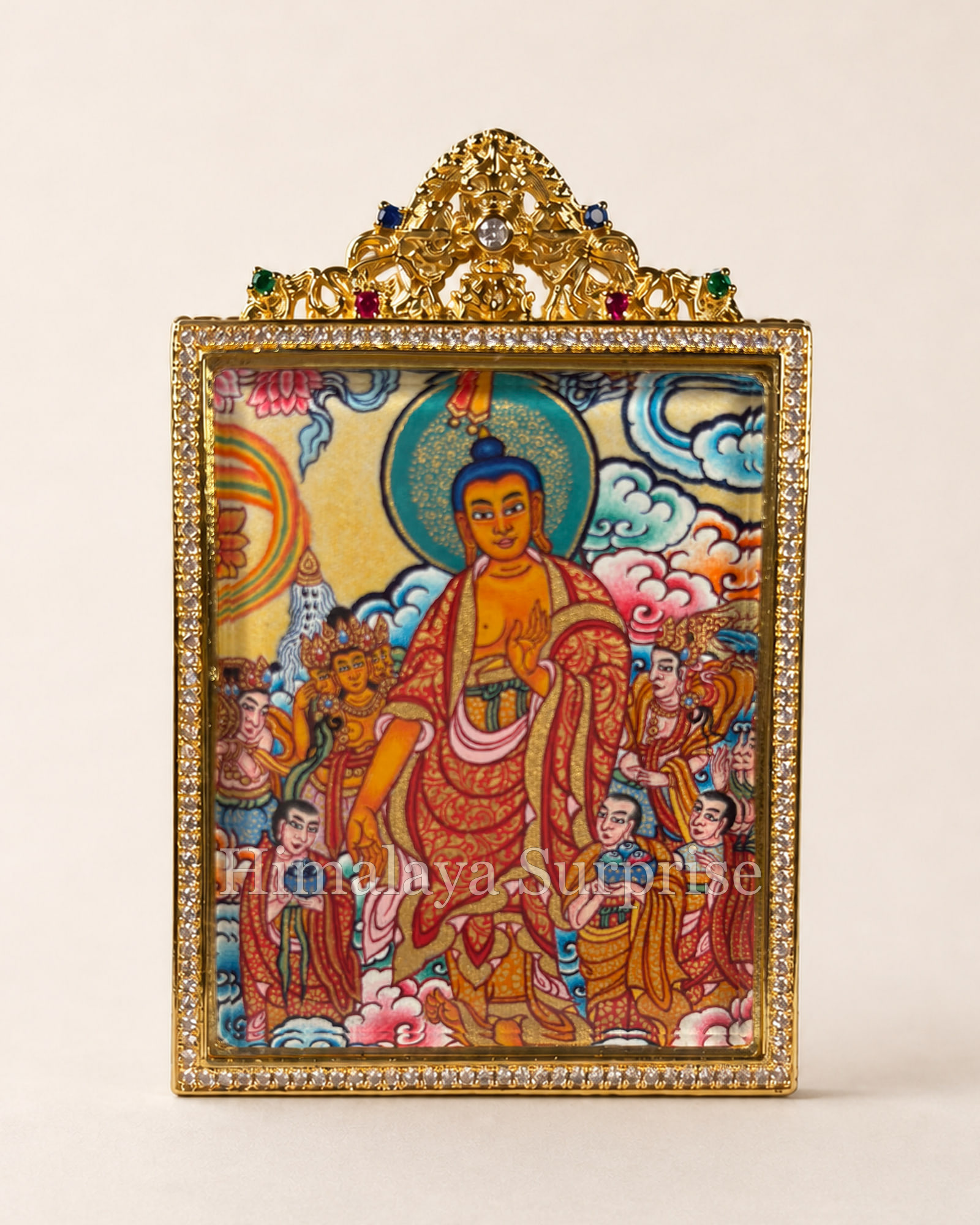
In the painting above, a large seated Buddha draws the eye before the small scenes around him. His robe, halo and lotus seat establish the central presence; two monks stand beside him, while buildings, people and landscape fill the remaining space. Cleveland Museum of Art identifies the subject as Shakyamuni Buddha with scenes from his life story. Scale and placement give a first route through a densely populated image.
Now look at the hands. One extends over the knee, while the other supports a bowl in the lap. Those details connect the central image with the story of awakening. Starting with the whole composition gives the gesture a setting, instead of treating a small hand as a separate symbol.
Other thangkas arrange teachers in a lineage, surround a principal figure with related deities, or organise a sacred palace as a mandala. A row of smaller figures is therefore not automatically a sequence of events. The subject determines how the surrounding figures belong together. What is a thangka? introduces the painting and its mounting; here the focus is the visual language inside it.
Bhumisparsha: the hand reaching toward the earth
Bhumisparsha, the earth-touching or earth-witness mudra, usually shows the figure’s right hand reaching over the right knee, with the fingers pointing down and the palm turned inward. The left hand rests in the lap. In the Buddhist story, Shakyamuni calls the earth to witness his awakening as Mara challenges him beneath the Bodhi tree. The gesture makes that episode recognisable within a seated image.
The fingers may reach toward a lotus seat rather than a separately painted patch of ground. What matters visually is their downward, inward-facing relationship to the knee. This helps distinguish earth-touching from an open palm extended outward in generosity. Akshobhya also commonly makes an earth-touching gesture; the hand alone does not settle which Buddha is present.
Dhyana: two hands resting in the lap
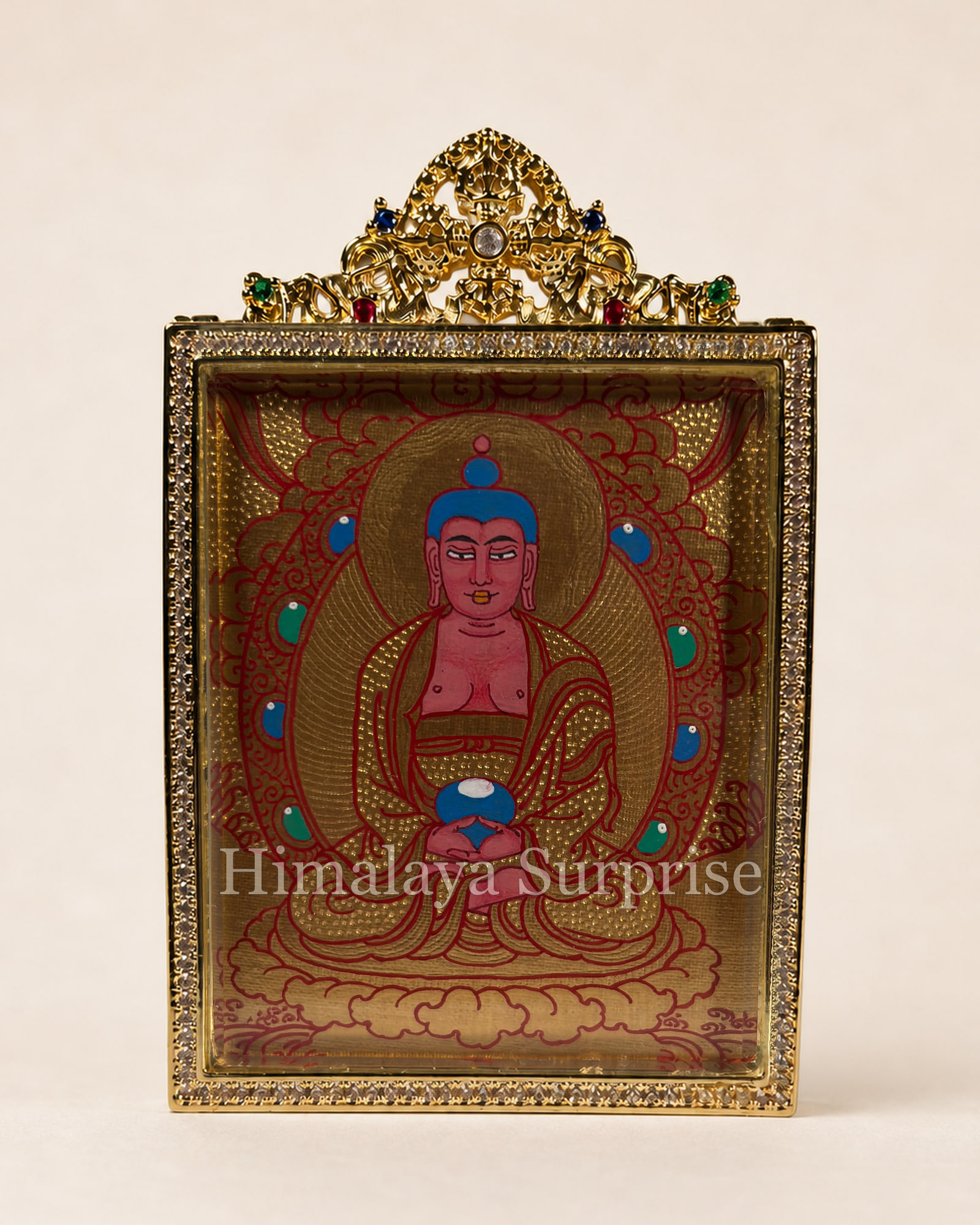
In the familiar dhyana mudra, both palms turn upward in the lap, with the right hand resting on the left. The thumbs may meet lightly; their exact arrangement varies. The gesture expresses meditation or meditative stability. It appears with Shakyamuni and Amitabha, among other representations. A bowl can rest on the hands, adding another visible element without replacing their meditative arrangement.
The Met’s Tibetan painting of Amitabha in Sukhavati shows the red Buddha seated beneath a flowering tree, his hands gathered in the lap around a bowl. The surrounding bodhisattvas, pools and crowded paradise make the identity more intelligible than the gesture by itself. Read the hands first, then let the larger setting complete the interpretation.
Abhaya and varada: reassurance and giving
Abhaya means fearlessness. Its familiar form raises an open palm toward the viewer, usually near shoulder height, with the fingers pointing upward. It conveys reassurance or protection. In this early sandstone Shakyamuni from Mathura, the raised palm is immediately visible, while the tree and lions on the base supply further context. The sculpture shows that an identifiable Buddha need not always use the same gesture.
Varada, the gesture of giving or granting, extends an open palm downward and outward. In Tibetan Tara images it is often the figure’s right hand, while other traditions may place it on the left or pair it with abhaya. Follow the palm’s direction and the other hand rather than memorising “downward hand equals one particular deity.”
Vitarka and dharmachakra: two teaching gestures
Vitarka is often translated as discussion, explanation or teaching. The thumb and index finger meet to make a small circle, commonly with the hand raised and the palm facing outward. The other hand may rest in the lap or take part in the gesture. A circular opening can also accommodate a flower stem or accompany another attribute, so its surroundings matter.
Dharmachakra means the wheel of the teaching. Both hands are usually raised near the chest, with thumb and finger circles brought into relation; the right palm commonly faces outward and the left inward. It recalls the Buddha setting the Dharma in motion through teaching, especially the first sermon at Sarnath. Actual images vary in how the fingers touch or how far the hands stand apart.
“Teaching mudra” is an English umbrella label, not a guarantee that every source means the same finger arrangement. Compare whether one or both hands are involved, where they are held, and what accompanies them. That small distinction is often lost in a simplified hand-symbol chart.
Follow the flower stem in a Tara painting
In this painting from Guge, White Tara sits on the viewer’s left and Green Tara on the right. Both extend the figure’s right hand in giving and hold a flower stem with the left. The stem leads the eye from the fingers toward a blossom near the shoulder. It joins the hand to a larger structure, rather than adding an unrelated decorative flower.
Their different seated postures and body colours help distinguish the two figures, even though their hand arrangements resemble one another. White Tara is commonly shown with seven eyes, including eyes on the palms and soles; small reproductions may make these details difficult to see. Green Tara’s extended leg supplies another useful clue. The Green Tara guide follows these relationships more closely.
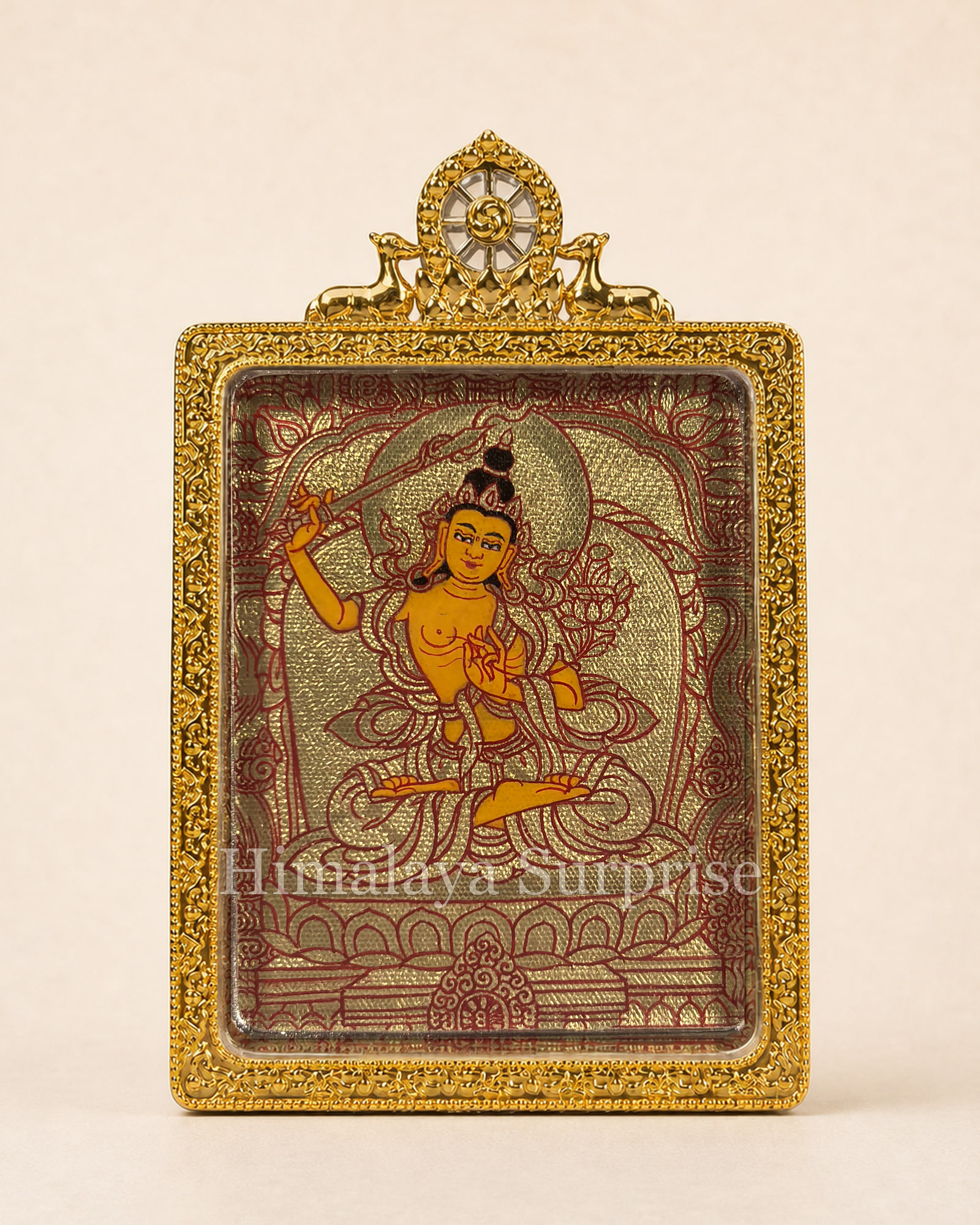
A lotus can hold an object as well as a flower. In many Manjushri images, a book appears on a lotus near the shoulder while a sword supplies another wisdom attribute. A hand that grasps the stem belongs to that whole arrangement. Colour, posture, flower, book and sword become more informative when read together.
Joined hands, crossed wrists and held objects
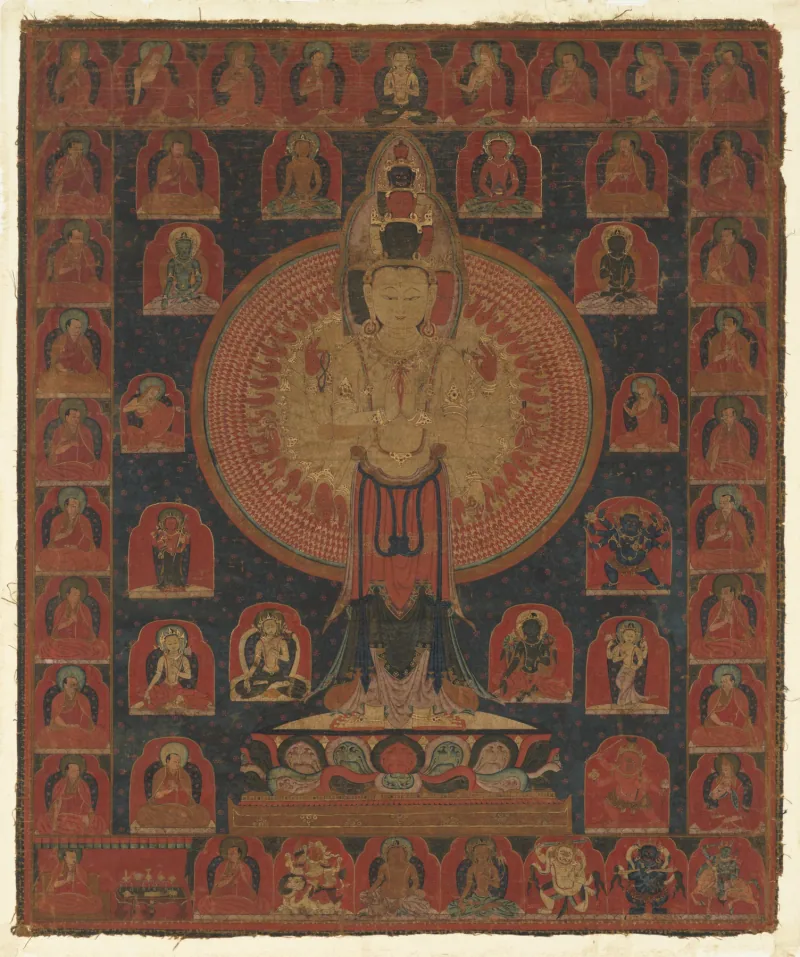
Anjali brings the palms together in greeting or reverence. A similar-looking arrangement can occur with four-armed Avalokiteshvara, whose front hands hold a jewel at the heart; this is part of the figure’s iconographic form. The remaining arms, rosary and lotus help explain the difference. Not every pair of joined hands is simply a greeting.
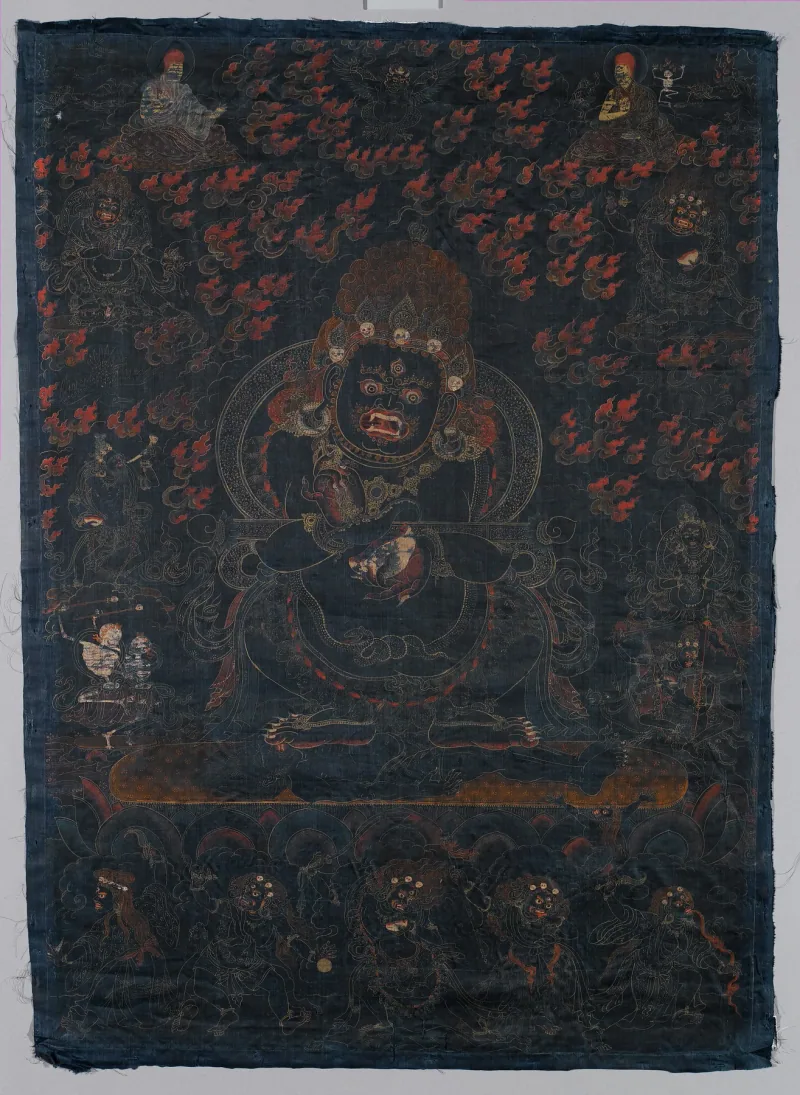
Crossed wrists holding a vajra and bell, often called vajrahumkara, make another recognisable group. In many Tibetan images the vajra is in the figure’s right hand and the bell in the left; the pair expresses the union of method and wisdom. A pointing forefinger or a hornlike arrangement of raised fingers can instead belong to a warning or obstacle-subduing gesture. These details are especially varied in wrathful imagery.
These are useful names for looking at art. Ritual performance gives gestures a further setting through teachings, recitation and sequences of movement. A still painting and a practice demonstration answer different questions; there is no single short list that covers every Buddhist mudra.
A held object belongs to a particular figure
A vase, vajra or lotus is more informative when we can see where it belongs. A vase balanced in a teacher’s hand, a vessel among offerings and a vase within a group of auspicious emblems occupy different roles in a painting. Begin with the connection: which hand carries it, what stands beside it, and whether it is part of a larger group.
An eighteenth-century Bhutanese portrait of the teacher Jigme Sengge offers a specific example. The Asia Society exhibition caption describes a vajra in his right hand and a vase on his left palm. The teacher, his hat, the paired attributes and the surrounding landscape make a coherent portrait. Seeing the vajra alone would lose much of what this image tells us.
The same attention to placement helps with familiar auspicious motifs. A parasol, conch, wheel or victory banner can appear together as emblems, but they may also form part of an offering, an architectural detail or a figure’s attributes. Our guide to the eight auspicious symbols follows the emblem group; here, the surrounding image tells us how a motif is being used.
Read the figure’s colour separately from the ground
The red Amitabha in the Pure Land painting above and the White and Green Tara figures show colour working within a particular iconographic form. In the paired Tara painting, colour joins posture and the flower stem; it does not replace them. The surrounding water, rocks and vegetation belong to the setting and follow a different set of pictorial choices.
A gold, red or black ground describes how the broader surface is treated. It is not the same thing as the colour of the central figure, and it does not provide a single meaning for everything painted on it. Fine gold lines may become prominent against a dark ground; a landscape can instead create depth through several colours. The thangka painting styles guide looks at these ground and palette choices in more detail.
Whose right hand are you looking at?
Descriptions normally use the figure’s own left and right. When you face the Buddha in the first painting, his right hand appears on your left. The White Tara in the paired painting likewise extends her own right hand toward the viewer’s left. Keeping that relationship in mind resolves many apparent disagreements between text and image.
A cropped photograph may hide the second hand, a flower stem or another arm. A mirrored reproduction reverses the direction altogether. When the image is small, it can be more accurate to notice “a raised open palm” than to decide which two fingertips meet. Returning to a wider view often supplies the missing relationship.
Let the details lead you back through the painting
Once the main figure and hands are clearer, look outward again. Teachers may connect an image with a lineage; attendants and offerings establish relationships; small narrative scenes unfold a life story. A lotus seat, halo or flame has a role in that setting, but none by itself names every figure who uses it. A mandala’s gates and enclosures call for a different reading, explored in our Buddhist mandala guide.
Museum titles and readable inscriptions can support an identification when they are available. They can also preserve uncertainty. The pleasure of looking does not depend on naming every small figure: follow a hand toward its bowl, a flower toward its book, or a gesture toward the scene that gives it meaning. The painting gradually reveals how its parts belong together.
Questions and answers
How many Buddhist mudras are there?
There is no universal fixed total. A beginner’s art guide may select five or eight familiar gestures, while ritual traditions and historical catalogues contain many more. The number depends on what is being counted and within which tradition.
How do earth-touching and giving differ?
In a familiar earth-touching pose, the right hand reaches over the knee, with the palm inward and fingers downward. Giving usually presents the palm outward. Look at the palm, the second hand and the figure together; a downward hand alone is not enough.
Can a mudra identify the Buddha by itself?
Usually it provides a clue rather than a complete identification. Shakyamuni and Akshobhya can share earth-touching; Shakyamuni and Amitabha can share meditation. Posture, colour, held objects, surrounding scenes and a reliable title help distinguish the image.
Does one colour always identify one deity?
No. Colour becomes a useful identifying clue alongside posture, hands and held objects; several figures can share the same colour.