Discover / Subjects & Meaning
Manjushri Meaning: The Sword, Book and Lion
Discover Manjushri, the bodhisattva of wisdom. Read his sword, lotus-supported book and lion through historical artworks, different forms, stories and prayers.
In this story
Manjushri is the bodhisattva of wisdom in Mahayana Buddhism. A youthful figure, a sword and a book carried on a lotus make him familiar in thangkas, but his images are far more varied than one pose. Looking at a painting beside a standing bronze and a lion-riding figure reveals how artists give wisdom a visible form.
Who is Manjushri?
Manjushri embodies prajna: wisdom that understands the nature of experience, especially the emptiness taught in the Perfection of Wisdom scriptures. Here emptiness does not mean that nothing exists or that life is pointless. It challenges the assumption that things possess a separate, unchanging essence. The familiar image connects this profound teaching with something a viewer can see: a cutting blade and a treasured text.
Mañjuśrī is commonly translated as Gentle Glory or Gentle Splendour. Prajna means wisdom; it is not another translation of his name. In Tibet, Jampalyang and Jamyang refer to the gentle-voiced figure; in China he is Wenshu, and in Japan, Monju Bosatsu. These names help connect works that may otherwise look quite different.
He often appears as a richly adorned youth, sometimes described as sixteen years old. The youthful form expresses the freshness of awakened wisdom. In Buddhist texts he can appear as the Buddha’s questioning disciple, a teacher of other bodhisattvas, or an already awakened Buddha. Those perspectives are part of religious interpretation, rather than a biography with a single historical birth date.
What does Manjushri’s sword mean?
The sword cuts through ignorance: the confusion that prevents clear understanding. Flames around the blade intensify this association with wisdom. Its presence in a peaceful figure’s hand makes the relationship particularly striking. He is not pictured attacking an opponent; the force of the image is directed towards delusion.
In many familiar forms the sword is in his own right hand, on the viewer’s left. Follow the fingers towards the handle before looking at the blade. In the opening Japanese painting, a weapon is held upright beside the figure; other paintings raise it above the head. The direction of an arm shapes the composition as well as carrying religious meaning.
A photograph should show the whole relationship between hand and attribute. A bright streak beside a head is not enough to identify a sword, and some Manjushri forms place attributes on flowers or use a different gesture. For a wider introduction to hands and surrounding figures, see how to read a thangka.
The book on the lotus—and a missing blade
The book represents the Prajnaparamita, or Perfection of Wisdom, scriptures. It may resemble a small rectangular stack of manuscript leaves rather than a modern bound book. In the twelfth-century Tibetan bronze shown here, a text sits on the lotus blossom near the shoulder. Look down from the blossom to the stem and hand to understand how the artist joins these elements.
The Met identifies the projecting hand as holding a sword hilt; the blade is missing. The statue remains identifiable as Manjushri because the surviving attributes and the object record can be read together. A missing piece is a condition of this particular sculpture, not a new symbolic meaning for all Manjushri images.
Nor has the book always occupied the same position. Some forms hold it directly near the heart, alongside the now-familiar lotus-supported arrangement. A book in the hand and a book on a flower can belong to different forms of the same wider subject. The lotus in Buddhist art explains why a held flower and a lotus seat also deserve separate attention.
Why does Manjushri ride a lion?
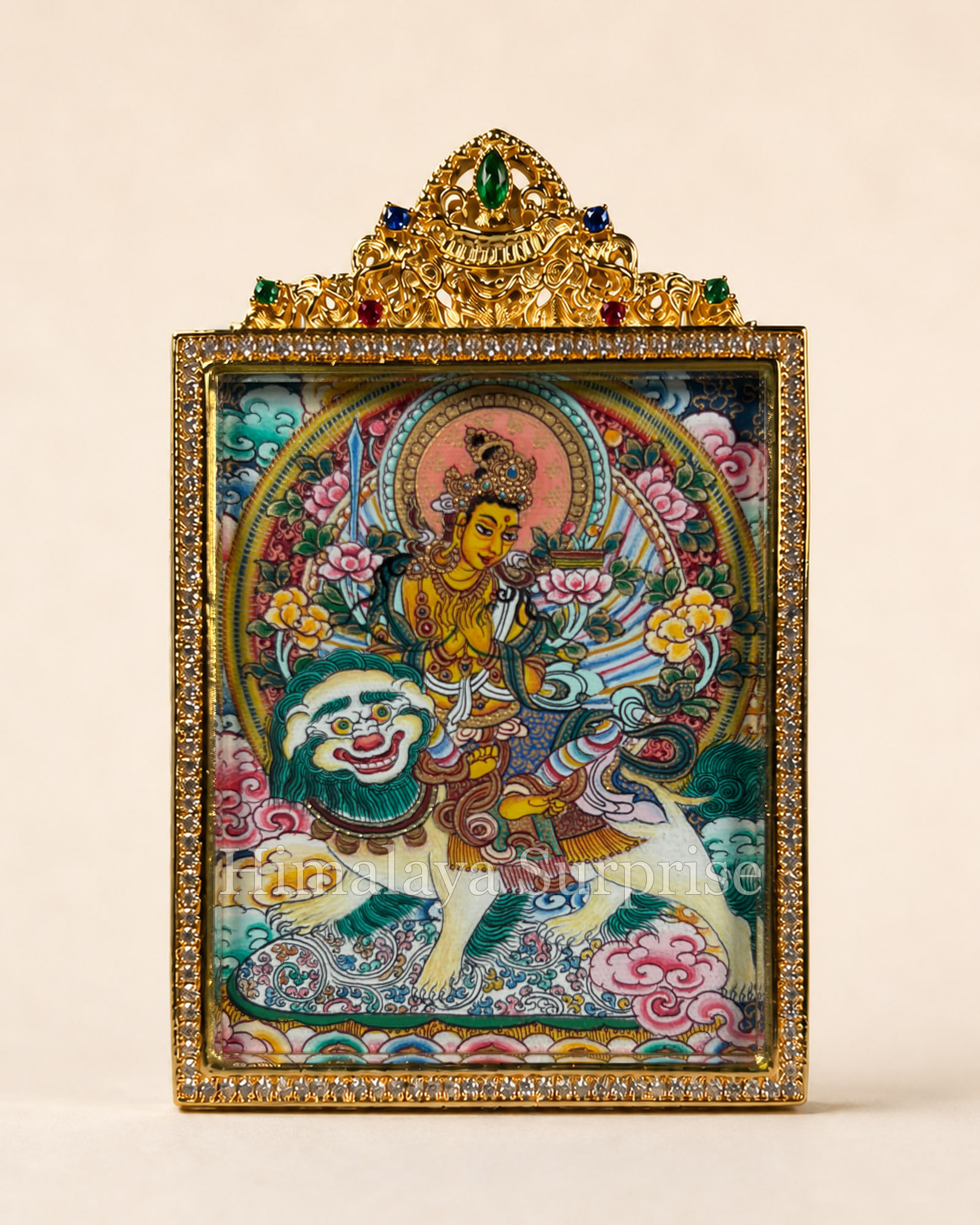
The lion expresses the authority and fearlessness of wisdom and Buddhist teaching. It also gives a seated figure a powerful pictorial foundation. In the opening painting, Monju sits on a lotus above a richly adorned lion, with attendants below. The animal and the surrounding figures are part of the image’s meaning, rather than decoration that can be cropped away without a loss.
This smaller bronze at the Cleveland Museum of Art was made in China in the 900s. A lotus pedestal rests above the lion, and a bearded attendant stands beside it. Something once passed through the lion’s harness and the attendant’s hands. That missing connection invites a closer look at how this miniature group originally worked.
A lion is not exclusive to Manjushri, and not every image of him includes one. In East Asian compositions, Manjushri on a lion can attend Shakyamuni alongside Samantabhadra on an elephant. Tibetan groupings may instead place him with Avalokiteshvara and Vajrapani, associated with compassion and power. These are different arrangements; the three bodhisattvas comparison explores the latter in more detail.
Orange, white and other forms
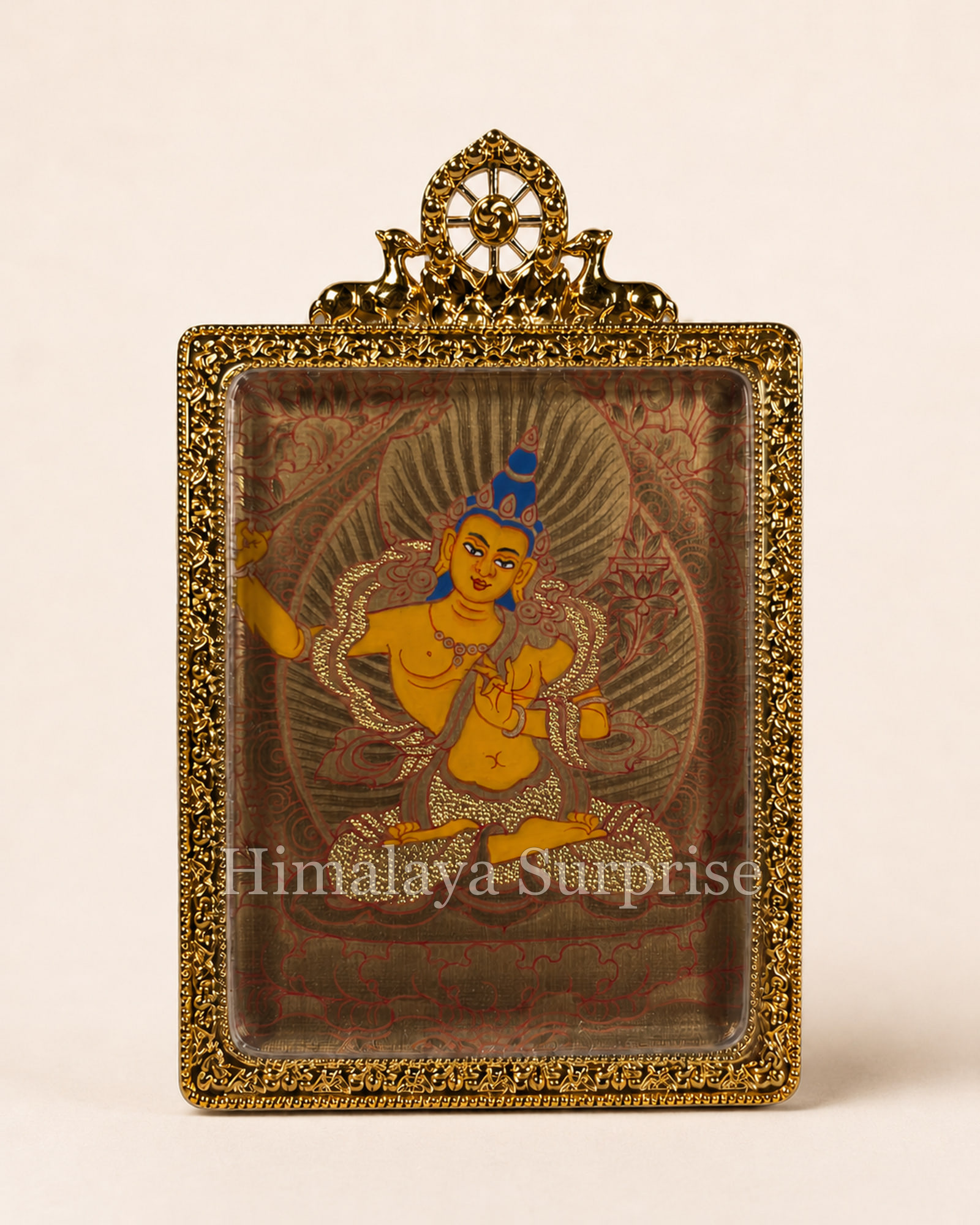
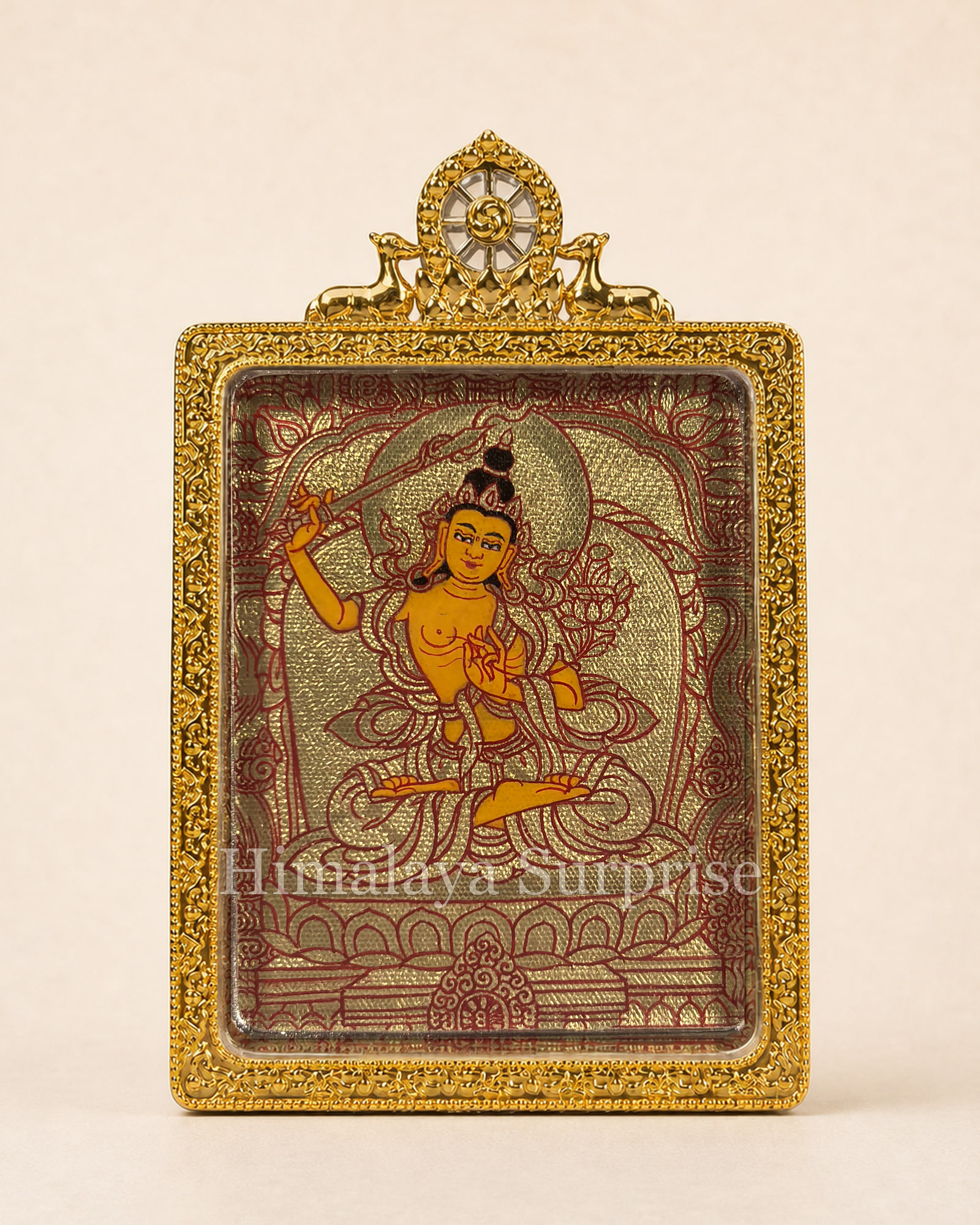
Orange Manjushri with one face and two arms is familiar in Tibetan painting. White forms, multiple arms and other arrangements are also documented. Names such as Arapachana and Siddhaikavira refer to particular forms and practices. A gold background describes a painter’s treatment of the surface; it does not by itself make the figure a separate deity.
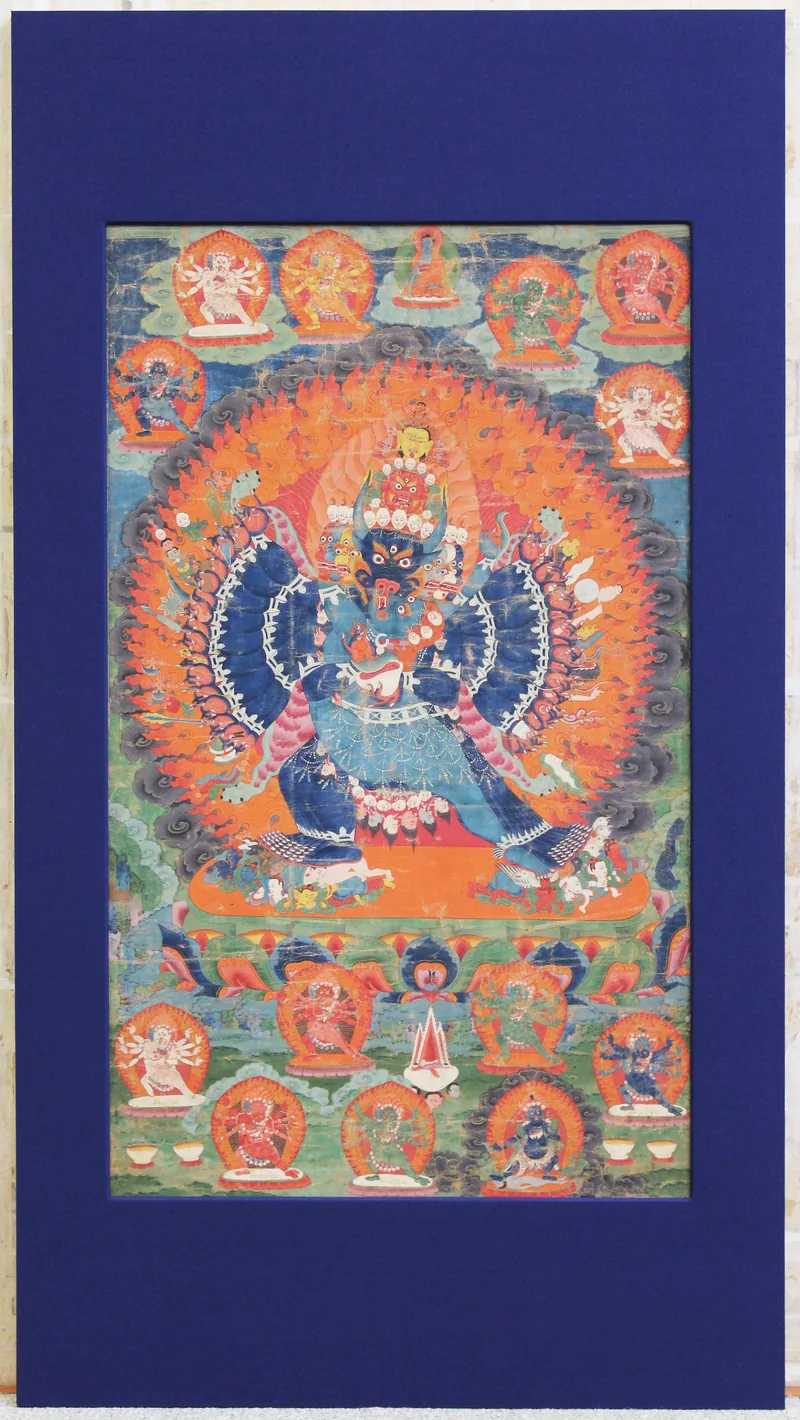
Some devotional depictions allow considerable artistic variation, while particular tantric forms follow prescribed descriptions. Vajrayana belongs within the broader Mahayana Buddhist setting; it is useful here to distinguish ways an image is specified and used. Colour, faces, arms and gestures need to be read together with a work’s named form. Yamantaka is associated with Manjushri’s wrathful manifestation, but its different iconography and practice merit a separate treatment.
Manjushri in scriptures and sacred places
In the Vimalakirti Sutra, Manjushri visits the lay practitioner Vimalakirti and joins a demanding exchange about Buddhist understanding. The sutra presents him as the bodhisattva willing to enter that conversation. This is another way of meeting the wisdom figure: through inquiry and teaching, beyond the symbols of a sword and book.
Mount Wutai in China is closely associated with devotion to Manjushri. In Nepal, the Swayambhu Purana tells of his journey to the Kathmandu Valley and a sword stroke that opened a gorge, draining a lake so devotees could reach Swayambhu. These are sacred associations and narratives. They do not establish an ordinary birthplace for the bodhisattva, nor does the story of a sword stroke supply geological evidence for how the valley formed.
Manjushri’s mantra and prayers for wisdom
A familiar mantra is Om A Ra Pa Ca Na Dhih; Tibetan-style transcriptions often write Tsa in place of Ca. The sequence A Ra Pa Ca Na is associated with teachings on the Perfection of Wisdom. It should not be turned into an ordinary sentence translated word by word, or a promise that recitation will guarantee exam results.
Prayers to Manjushri also belong to the daily life of study. Samye notes the praise recited in Tibetan monastic colleges, while a prayer by Khenchen Ngawang Palzang records its composition during his study and teaching of Dharmakirti’s work on valid cognition. Those examples connect devotion with sustained learning. Detailed meditation and self-visualisation follow a teacher’s instructions for the relevant practice.
Choosing a Manjushri thangka
Begin with the whole painting: the figure, seat, mount and any teachers or attendants. Then examine the connections between fingers, sword, flower stem and book. Clear details matter especially in a miniature, where a face or attribute may occupy only a few millimetres. Ask for the painted dimensions, artist and materials, rather than judging craftsmanship from a symbolic label alone.
A gold-ground work concentrates attention on fine line; a polychrome work may draw the eye through clothing, landscape and the lion’s body. Compare two paintings of the same subject to find the expression that holds your attention. Our guide to buying a thangka online develops the questions of scale, photographs and artist information. The selection below provides a route from reading to actual works, with individual photographs and dimensions on each product page.
Questions and answers
Is Manjushri a god?
He is usually introduced as the bodhisattva of wisdom, and some Buddhist traditions describe him as an already awakened Buddha. He is not a creator god. The term deity in art catalogues may describe a sacred figure without implying a creator.
Is Manjushri male or female?
His familiar peaceful images present a youthful male bodhisattva. This describes the form represented, rather than limiting awakened wisdom to one gender.
Must a Manjushri image have a sword and lion?
No. Forms and compositions vary, and a historical object may also have lost an attribute. Compare the whole figure and the work’s recorded identification; neither a sword nor a lion alone establishes the subject.