Discover / Subjects & Meaning
Yamantaka Meaning: Vajrabhairava, the Buffalo Head and Fierce Wisdom
Explore Yamantaka and Vajrabhairava through three museum works: a Tibetan thangka, a small stone relief and a Mongolian figure made to resemble gilded bronze.
In this story
Yamantaka means the one who puts an end to Yama, the Lord of Death. In Tibetan Buddhist art the name often refers to Vajrabhairava, a powerful buffalo-headed manifestation of Manjushri’s wisdom. The two names are closely connected, but Yamantaka also has a broader use that includes other forms. A fierce face is the first impression; the work of the artist becomes clearer in the arrangement of heads, hands and figures around it.
Yamantaka, Vajrabhairava and Yama
The Sanskrit name brings together Yama and antaka, “one who brings to an end”. Yama is the Lord of Death; Yamantaka is the figure who overcomes him. Similar names and shared buffalo imagery can make the subjects easy to confuse. Their relationship is a confrontation within Buddhist imagery, rather than two interchangeable names.
Vajrabhairava is often translated as “adamantine terrifier”. Its Tibetan name, Dorje Jigje, expresses the same forceful character. Yamantaka.Org, a specialist community resource, distinguishes this buffalo-headed form from the wider Yamantaka or Yamari terminology. This is a useful starting point for reading an artwork’s title.
Why fierce wisdom belongs to Manjushri
Manjushri is familiar as the bodhisattva with a sword and scripture. In Gelug and Sakya traditions, Vajrabhairava expresses that wisdom in a wrathful form. The energy is directed toward ignorance and the forces that bind beings to suffering; it gives the quiet idea of insight an emphatic visual presence.
In his introduction to the subject, Alexander Berzin connects the forceful form with understanding reality and overcoming the ordinary cycle of death and rebirth. “Destroyer of death” belongs to that religious meaning. The horns, exposed teeth and fire give the teaching intensity, while its connection to wisdom explains the direction of that intensity.
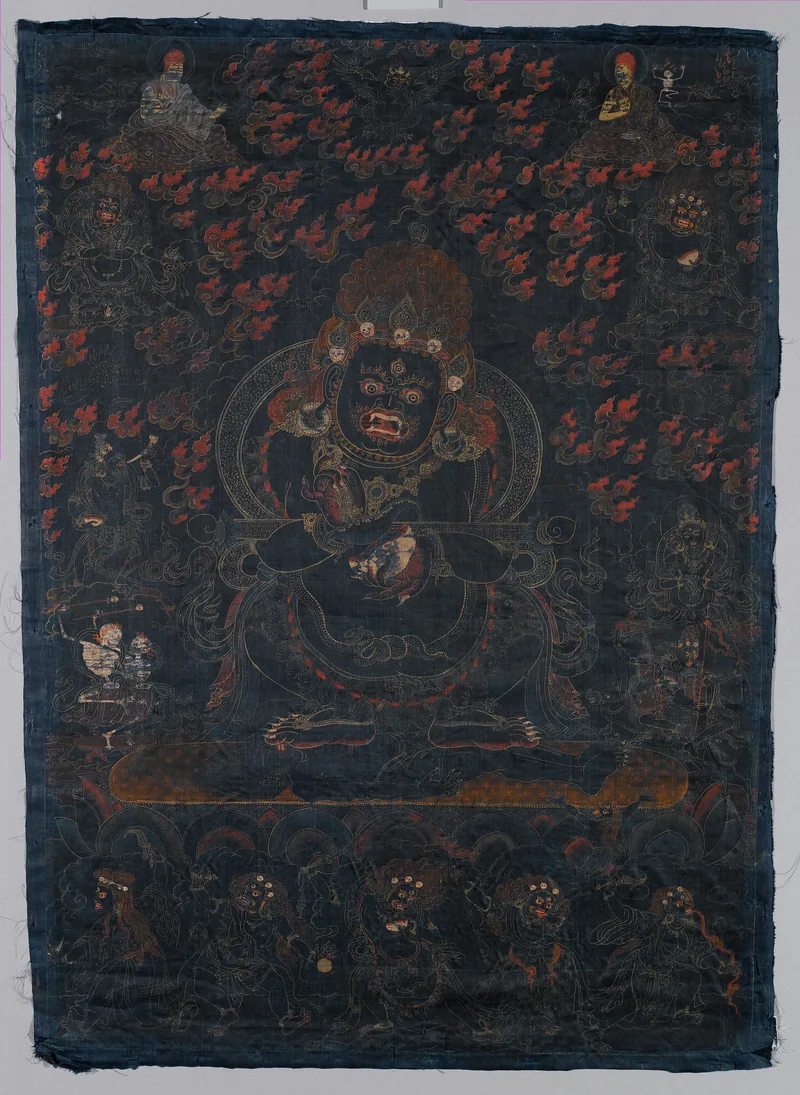
A buffalo head at the centre of a Tibetan thangka
The eighteenth-century Tibetan thangka shown above is catalogued as Vajrabhairava with his consort Vajravetali. The dark central body opens into a fan of arms inside an orange-red flaming aureole. Gold-edged clouds separate this intense centre from the smaller figures around it. The painting gives both movement and a strong sense of order.
The horned buffalo face anchors the image. Above and beside it, other faces rise in carefully arranged layers; below, numerous feet spread across the pedestal. This work has thirty-four arms and sixteen legs. Those counts describe the selected form, rather than every work that bears the name Yamantaka.
How many arms become a readable image
At first the arms can seem like a dense border. Following their direction reveals an underlying rhythm: hands and implements radiate out from the chest, leaving the central face visible. Repeated curves carry the eye around the body before it returns to the face. The effect depends on placement as much as on the number of limbs.
Berzin explains the familiar nine-headed, thirty-four-armed, sixteen-legged form as a way of holding many aspects of the path together. He also describes other Vajrabhairava configurations. The visual abundance has a precise religious purpose, and its organisation gives a painter or sculptor an unusually demanding design problem.
Vajravetali and the surrounding sacred figures
Vajravetali appears close to the main figure in the thangka. Their intertwined bodies form an intimate centre inside the expanded limbs. In tantric imagery, such union expresses the inseparability of method and wisdom. The compact pairing and the wide circle of arms create two contrasting scales within one body group.
Akshobhya appears at the top, with Hayagriva manifestations among the surrounding deities. These smaller figures make the painting more than an isolated portrait. Their placement situates Vajrabhairava within a particular sacred assembly, giving the central image a setting that a close crop would leave out.
A fifteenth-century relief only eighteen centimetres high
A Tibetan black-stone relief in the Metropolitan Museum condenses the subject into a work about 17.8 centimetres tall. Traces of polychromy remain across the dark surface. Horns and a broad central face project forward; smaller heads and many hands crowd into the arched outline. The carving makes a complex subject legible at a remarkably small scale.
The thangka uses blue, red and orange to distinguish parts of the image. Here, raised edges, shadows and the remaining colour carry that work. Comparing the two shows how a familiar iconographic subject changes when it moves from a painted cloth into stone.
A gilded figure with a surprising structure
A Mongolian Vajrabhairava and Vajravetali, dated to the eighteenth or nineteenth century, looks like a gilded metal sculpture. A technical study instead found a clay-based compound bound with tung oil over a wire framework. Different wire thicknesses support the body, arms and small hand-held attributes. Gold leaf laid over a red cinnabar foundation gives the surface its warmth.
The tiny sculpture repeats the spreading limbs seen in the thangka, but now the hands reach into open space. Its construction shows the practical ingenuity behind a demanding form: each small extension needs support, and the many parts still have to read as one coherent figure.
Why different Yamantaka images do not look alike
The wider terminology includes Vajrabhairava, Black Yamari and Red Yamari. The latter two lack the buffalo head in the systems discussed by Berzin. Even within Vajrabhairava, the arrangement of heads and the surrounding mandala can vary by transmission. Ra Lotsawa and Mal Lotsawa are important names in the histories of those transmissions into Tibet.
Yamantaka has a place in both Gelug and Sakya traditions, with additional forms in other Tibetan contexts. Those histories explain why one name can lead to different compositions. The thangka, stone relief and Mongolian figure offer three distinct ways of giving fierce wisdom a visible form.
Questions and answers
What does Yamantaka mean?
The name means one who brings an end to Yama, the Lord of Death. In Buddhist tradition it concerns wisdom overcoming death and the cycle of suffering.
Are Yamantaka and Vajrabhairava the same?
The names often refer to the same buffalo-headed figure, especially in Gelug usage. Yamantaka also has a wider meaning that includes related Yamari forms, so the context of the name matters.
Is Yamantaka a form of Manjushri?
Vajrabhairava is understood as a wrathful manifestation of Manjushri in Gelug and Sakya traditions. The fierce appearance expresses the force of wisdom directed against ignorance.
Does every Yamantaka have nine heads and thirty-four arms?
No. This is a familiar Vajrabhairava configuration, but other forms exist. The specific object, tradition and title help explain which configuration is being shown.