Discover / Subjects & Meaning
Mahakala Meaning: The Protector and His Forms in Buddhist Art
What does Mahakala mean? Explore the Great Black One, the Shiva distinction, two- and six-armed forms and White Mahakala through real Buddhist artworks.
In this story
Mahakala is widely known in Tibetan Buddhist art as a protector of the Dharma. His name is often translated as the Great Black One, and many images show a dark, fierce figure among red flames. Yet Mahakala appears in several forms: two arms, four arms or six; dark bodies or white; different implements and surrounding figures. Those changes tell us something about the tradition and the role of the image.
Who is Mahakala in Tibetan Buddhism?
In Himalayan Buddhist art, Mahakala names a category of male tantric deities, most often serving as protectors. Particular forms are associated with particular teachings and meditational deities. The name is therefore a starting point for a family of images, with many variations in appearance.
Their wrathful appearance has a religious setting. Wide eyes, fangs, flames and forceful movement express a protector’s activity within Buddhist teaching. A fierce face can be understood in that setting without being treated as an everyday portrait of anger.
The name Mahakala, and its connection with Shiva
The Sanskrit name is commonly explained through maha, great, and kala, which can carry the senses of black or time. Great Black One is the familiar gloss in Himalayan Buddhist art. In Hindu Shaiva contexts, Mahakala is also a name of Shiva, often understood in relation to Great Time. The same word leads a search toward more than one religious tradition.
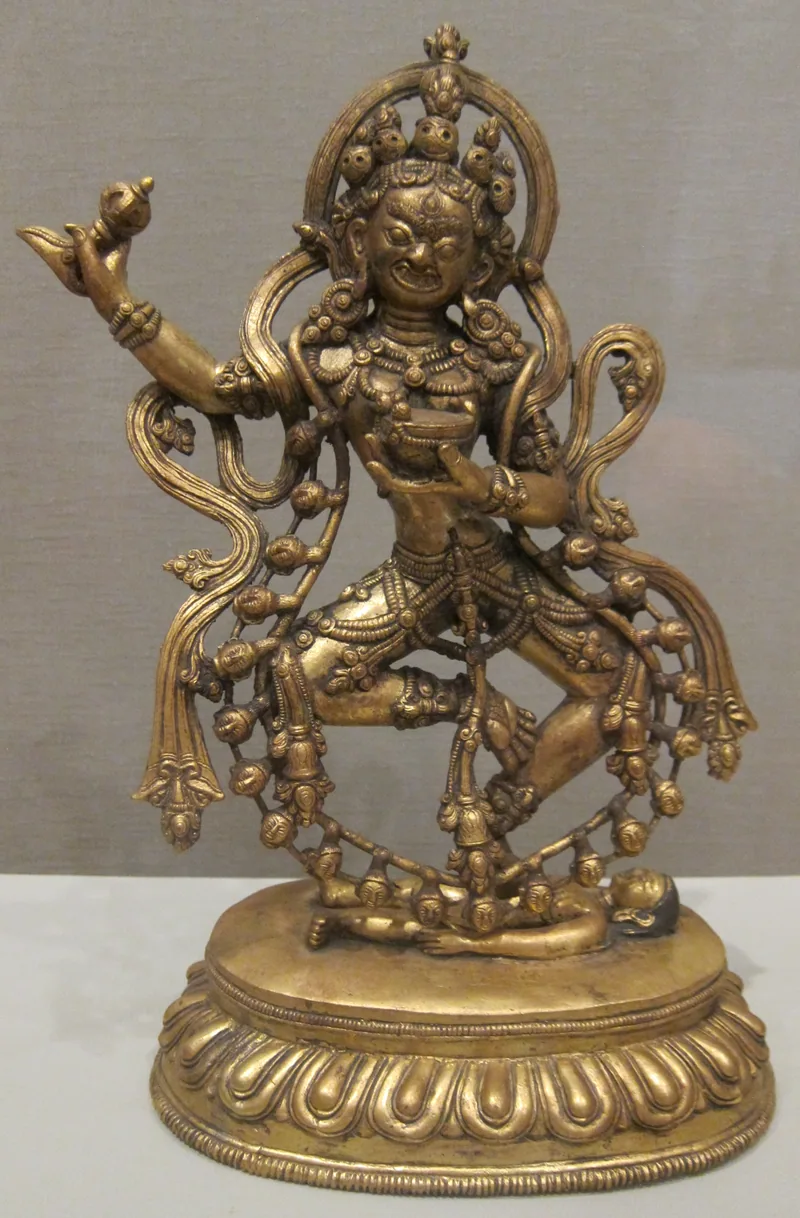
A Rajasthan painting of about 1700–1710 in the Cleveland Museum of Art, for example, is explicitly titled Shiva in his ferocious aspect as Mahakala dancing. The Tibetan objects on this page belong to Buddhist contexts. These are distinct uses of the name, each with its own imagery and history.
Two, four and six arms
A dark figure surrounded by flame can overwhelm the eye. Begin with the head: is there one face, three, four or more? Then count the arms, checking for hands hidden behind the torso or crossing over an implement. One-face two-arm, one-face four-arm and one-face six-arm forms all occur, alongside multiple-face configurations.
The number makes a useful first comparison. It does not identify the lineage by itself: at least six traditions of six-armed Mahakala include one-faced and three-faced forms. Implements and the figures around the protector help distinguish these images from one another.
The fierce face and the field of flames
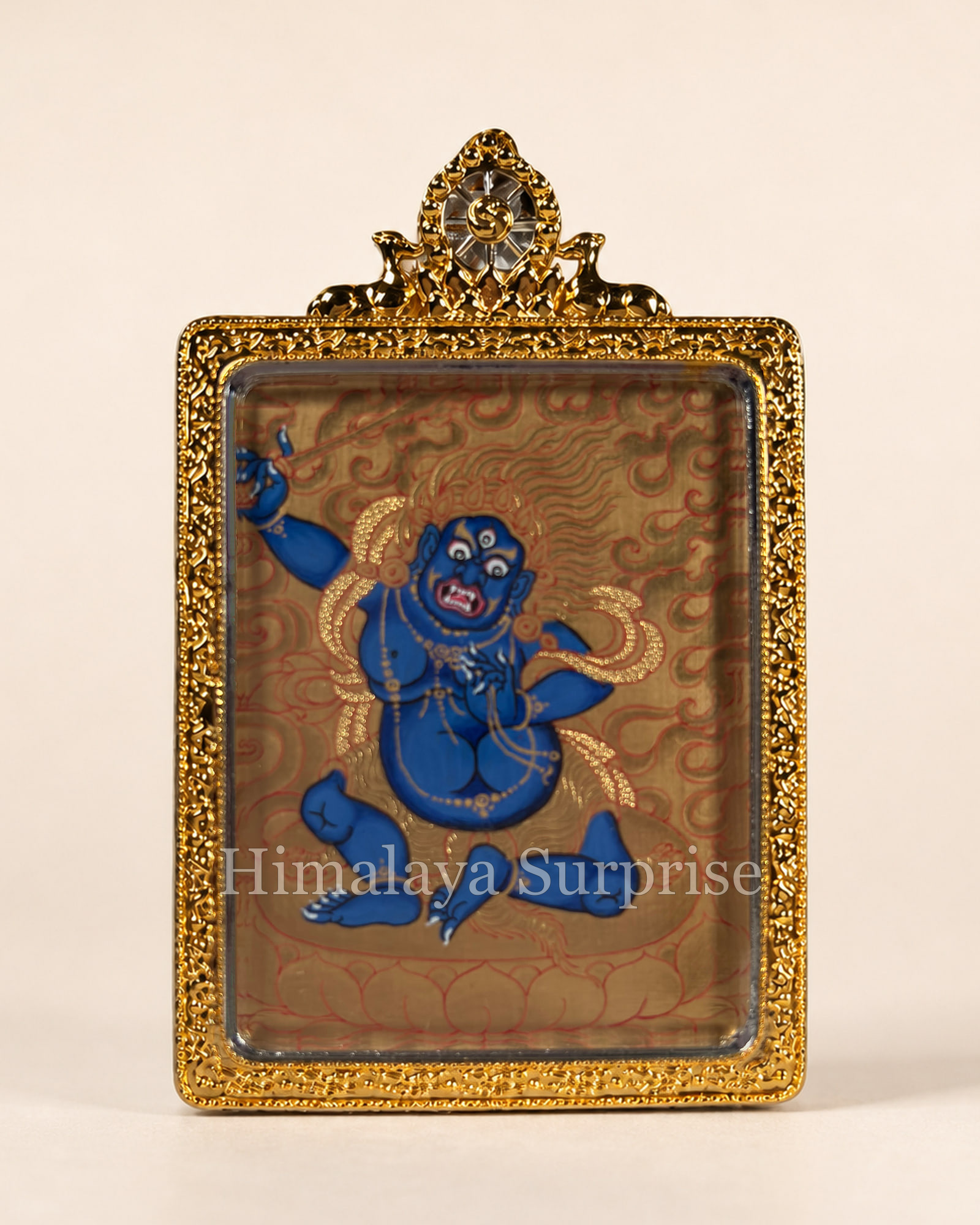
The dark-ground painting at the beginning of this article uses colour sparingly. Gold contours, pale ornaments and red flames emerge from the blue silk, concentrating attention on the central protector. The fierce face belongs to the same composition as the smaller teachers and attendants; it is one part of a larger sacred arrangement.
This is why a fixed dictionary of symbols can miss something important. A flame or skull-shaped ornament may recur across several wrathful figures. The particular combination of body, hands, implements and companions gives a painting its identity.
Panjaranatha: the Protector of the Tent
The late-fourteenth- to early-fifteenth-century steatite sculpture titled Mahakala Panjaranatha (Protector of the Tent) is a useful reminder that Mahakala does not mean “six arms.” The compact Tibetan figure is shown with two arms. Its colour and gilding, carved attributes and surrounding details belong to this particular Panjaranatha image rather than to every two-armed protector.
The two hands bring a curved knife toward a skull cup, or kapala. A horizontal baton rests in the crooks of the arms. The baton is a staff used to call monks to assembly. That small horizontal feature is particularly helpful when comparing the sculpture with a painted Panjaranatha.
A six-armed figure in clay
A black-painted clay figure in The Metropolitan Museum’s collection is titled Six-Armed Mahakala and dates to about the fifteenth century in Tibet. Its compact sculptural body makes the repeated rhythm of the arms especially easy to notice. It is a clear example of a six-armed form, while still being one object within a much larger family.
The black surface and overlapping limbs make the sculpture feel compact, while the arms extend activity beyond the central torso. Its title establishes a six-armed Mahakala; no narrower lineage is assigned. A comparison with other six-armed images can proceed from what the object actually shows, without supplying an unconfirmed tradition.
White Mahakala and wealth imagery
In this eighteenth-century Tibetan thangka, White Mahakala appears with six arms and three wide eyes, encircled by red flames. Five Transcendent Buddhas preside above. The subject is Shadbuja Sita Mahakala, a wealth deity, and many smaller auspicious and protective figures fill the painting.
Here wealth-related meaning comes from the identified form and the painting’s religious context. The white body is one feature of that form. The richness of the surrounding scene makes this example especially different from the dark, two-armed protector at the beginning of the article.
Teachers and companions in a dark-ground thangka
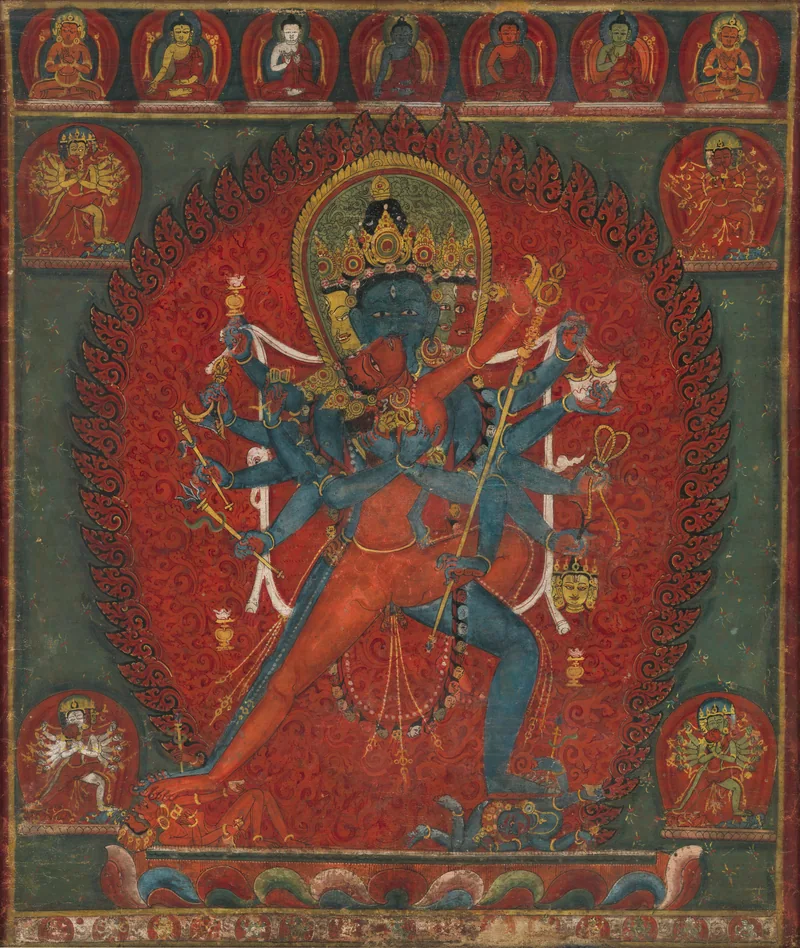
The opening painting, made around 1650, also depicts the Protector of the Tent. The curved knife, skull cup and horizontal gandi staff reappear in paint. Gold lines make the arms and implements legible against the dark body; the red flames widen the central silhouette. The sculpture and painting share this identifiable group of attributes across different materials.
Sakya hierarchs occupy the upper corners. Brahmarupa appears at the left with a thighbone trumpet, and Palden Lhamo rides a mule among the companions. These named figures provide a much more specific reading of the painting than a general statement about a fierce black deity. Our guide to reading a thangka follows similar relationships between the central figure and its surroundings.
Mahakala and Yamantaka are not interchangeable
Mahakala and Yamantaka can both appear with flames, skulls, multiple arms and a forceful stance, but they are different named figures and iconographic systems. A buffalo head can be an important clue toward a Yamantaka form, yet even that clue belongs with the title and complete composition. Similar visual intensity does not make two deities the same.
The distinction is especially useful when browsing unfamiliar thangkas: Mahakala is a protector category with many forms, while Yamantaka belongs to a different named subject. Our Yamantaka guide looks more closely at the buffalo face and its connection with Manjushri.
Returning to the details
A horizontal staff, a pair of hands or a small figure in a corner can make a familiar subject newly interesting. In Mahakala images, those details reveal how varied the art of a protector can be.
Questions and answers
What does Mahakala mean in Buddhist art?
In Himalayan Buddhist art, Mahakala usually names a family of male tantric Buddhist protector forms. The exact meaning depends on the particular form, associated deity, implements and tradition shown in the work.
Is Mahakala always black and six-armed?
No. Black or blue-black and six arms are common clues, but two-arm, four-arm, multi-face, white and other forms are documented. Colour and arm count should be read with the complete image.
Is Mahakala the same as Shiva?
Mahakala is a name used for Shiva in Hindu traditions and for several protector forms in Tibetan Buddhism. The shared name connects different religious contexts; a Buddhist Mahakala image needs to be understood through its own form and tradition.