Discover / Subjects & Meaning
Vajrayogini Meaning: Forms, Symbols and Thangka Art
Explore Vajrayogini in Buddhist art: red and dancing forms, the curved knife and skull cup, and how Vajravarahi and Naropa’s form belong to a wider visual tradition.
In this story
Vajrayogini is a female tantric Buddhist deity who embodies enlightened wisdom. Her best-known images are vivid and active: a red body, a curved knife, a skull cup and ornaments that move with the figure. Yet Vajrayogini is not one fixed portrait. The Naropa form, Vajravarahi and other manifestations give this name a rich visual range, in paintings, sculpture and mandalas.
Vajrayogini and the world of dakinis
The Sanskrit name Vajrayogini is known in Tibetan as Dorje Naljorma. In the Chakrasamvara cycle of Buddhist tantras, she is a principal female deity and a representation of buddhahood in female form. Her imagery brings wisdom into an energetic, sometimes semi-wrathful presence. A fierce expression, exposed body or crown of skulls belongs to that religious visual language; it is not simply a portrait of anger.
Vajrayogini is frequently described as a dakini, but the wider word has many uses. It can refer to wisdom figures, classes of beings and titles in different traditions. Vajrayogini names a particular deity with a family of forms. The guide to dakinis explores that broader vocabulary; here the focus is on the figures associated with this name.
Red, movement and a vivid presence
Many familiar Vajrayogini paintings set a red body against flames, sky or an aureole. One leg bends, the other extends or supports the figure, and the arms carry the movement through the composition. Curving ornaments and ribbons continue those lines. Red contributes to this charged presence and sits within a traditional imagery of desire, bliss and transformation. It is one part of the meaning, alongside the posture and implements.
The visual family is wider than this familiar red figure. It includes red, black, white and yellow manifestations. Some are dancing; others take a lunging stance. The gilded Nepalese sculpture shown above gives movement through bent limbs and open spaces around the body. Its metal surface offers a different experience from the saturated colour of a painted thangka.
The curved knife, skull cup and tantric staff
A curved knife, called kartika or drigug, and a skull cup, or kapala, are recurring attributes. For female tantric deities, the knife can express wisdom overcoming obstacles to enlightenment. The cup can express the bliss of realizing the nature of reality. Some images show it raised to the lips; others keep it near the chest. The vessel is recognizable even when its contents are too small to distinguish.
The tall khatvanga may rest in the crook of an arm, with heads, a trident-like finial and ribbons above the shaft. For a female deity, it can represent the male consort and the union of wisdom with method. Together, knife, cup and staff make a meaningful ensemble: their religious associations are connected, while their shapes give the image its distinctive rhythm.
Where Vajravarahi fits
Vajravarahi is an important form within the wider Vajrayogini family. Her name is often translated as “Vajra Sow,” and a small sow’s head beside the human head or at its crown is a characteristic feature in many representations. She shares the curved knife, skull cup and energetic posture found elsewhere in the family. This relationship explains why the two names occur together, while a particular artwork can still be titled more precisely as Vajravarahi.
The small twelfth-century sculpture beside this section is catalogued by the Met as Vajravarahi Dancing on a Corpse. The lifted leg leaves an open space below the body, while the long staff runs diagonally past the torso. At only 10.5 centimetres high, it concentrates a complex arrangement into a compact object. It is a useful comparison with the larger gilded sculpture above, rather than a substitute title for it.
Naropa’s form and the painting around it
The Naropa form, also called Naro Khacho, is a prominent manifestation in Tibetan art. A familiar version is red, with a lunging stance, a knife directed outward and a cup raised towards an upturned face. The Rubin Museum’s late nineteenth-century Khechari Vajrayogini painting provides a specific example. Above the central figure are Vajradharma and Sakya teachers, so the composition communicates a teaching lineage as well as the presence of the deity.
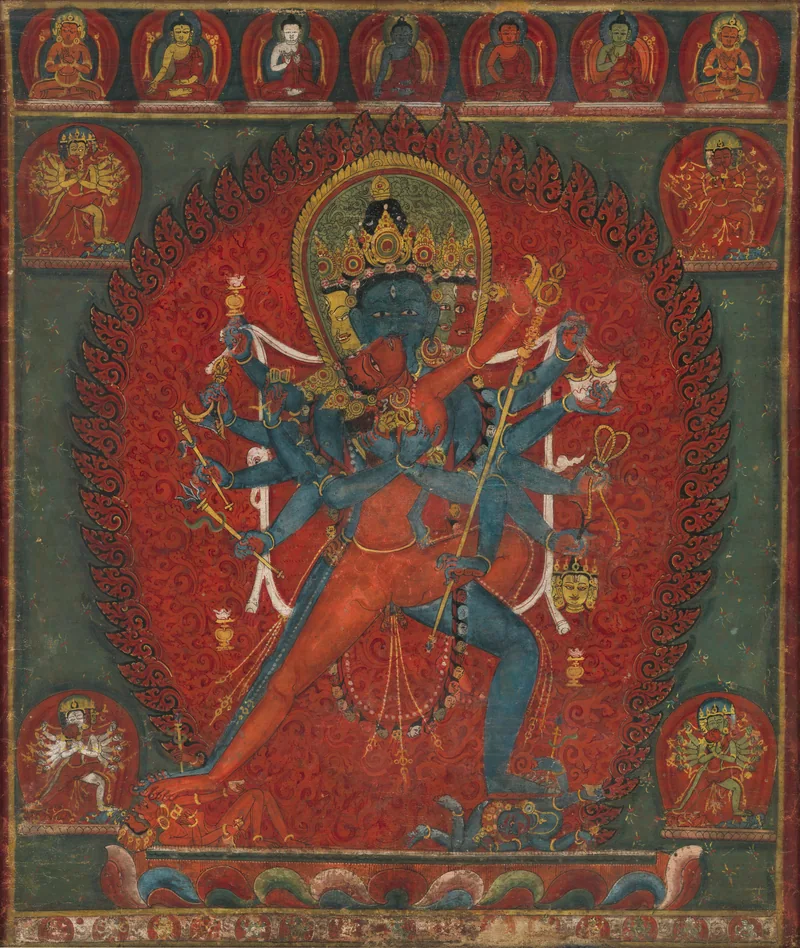
Other compositions place the related Vajravarahi in union with Chakrasamvara. The Nepalese painting shown here, dated 1575–1600, centres their blue and red bodies inside a flame arch; smaller figures occupy the upper register and surrounding spaces. It is titled Chakrasamvara and Vajravarahi. Reading this paired composition alongside a solitary figure reveals how much the surrounding arrangement contributes to an image’s identity.
Looking beyond the first impression
A face or a red silhouette gives only the beginning of a reading. Follow each arm to its implement, then look at the crown, stance, staff and figures below the feet. In a thangka, continue into the upper teachers and smaller surrounding figures. In sculpture, the spaces between limbs and the projection of the implements can reveal details that a frontal outline misses.
These are works made to carry a living religious tradition, and their individual arrangements reward patient attention. A single name opens onto many forms; a closer look makes their differences more interesting. For a broader introduction to figures and composition, continue with how to read a thangka.
Questions and answers
What does Vajrayogini mean in Buddhist art?
Vajrayogini represents buddhahood in female form and enlightened wisdom. She is a named tantric deity with many manifestations, rather than a general label for every dakini.
Is Vajrayogini a dakini?
She is frequently described as a dakini or vajra dakini. Dakini is the wider term; Vajrayogini identifies a particular deity and her forms.
What is Vajrayogini drinking?
Many representations raise a skull cup to the mouth. In tantric descriptions it may hold blood or nectar, while the cup’s symbolism concerns bliss and realization. The visual motif belongs to that symbolic religious language.
Why is Vajrayogini red?
Red is prominent in familiar forms and contributes to their imagery of desire, bliss and transformation. It is not universal: the wider family includes other colours and appearances.
Are Vajrayogini and Vajravarahi the same?
Vajravarahi is a form within the broader Vajrayogini family, often distinguished by a sow’s head. They are connected names, but an individual artwork may specify Vajravarahi, Naropa’s form or another manifestation.