Materials & technique
Colour, gold, red and black: four ways of seeing a thangka
The same figure can take on a different presence against a different ground. Colour does more than fill a contour: it shapes the way we enter the image.
Some thangkas first announce themselves through vivid colour. Others seem to unfold from a golden field, or reveal fine lines against deep black. Such differences depend not only on the figure depicted, but on the ground and the way colour is applied.
Polychrome, gold-ground, red-ground and black-ground painting offer useful entry points. They describe visual treatments rather than a hierarchy of quality or a complete classification of every thangka style.
Polychrome: building through colour
Polychrome painting organises figures and surroundings through several colours. Body, clothing, lotus seat, sky and foliage can be distinguished as coloured passages, then refined with shading and outline.
Read the larger relationships first: where the strongest colour sits, how quieter areas support it, and how warm and cool passages are distributed. Rich colour does not require every area to speak equally loudly. Emphasis often comes from choosing where to concentrate it.
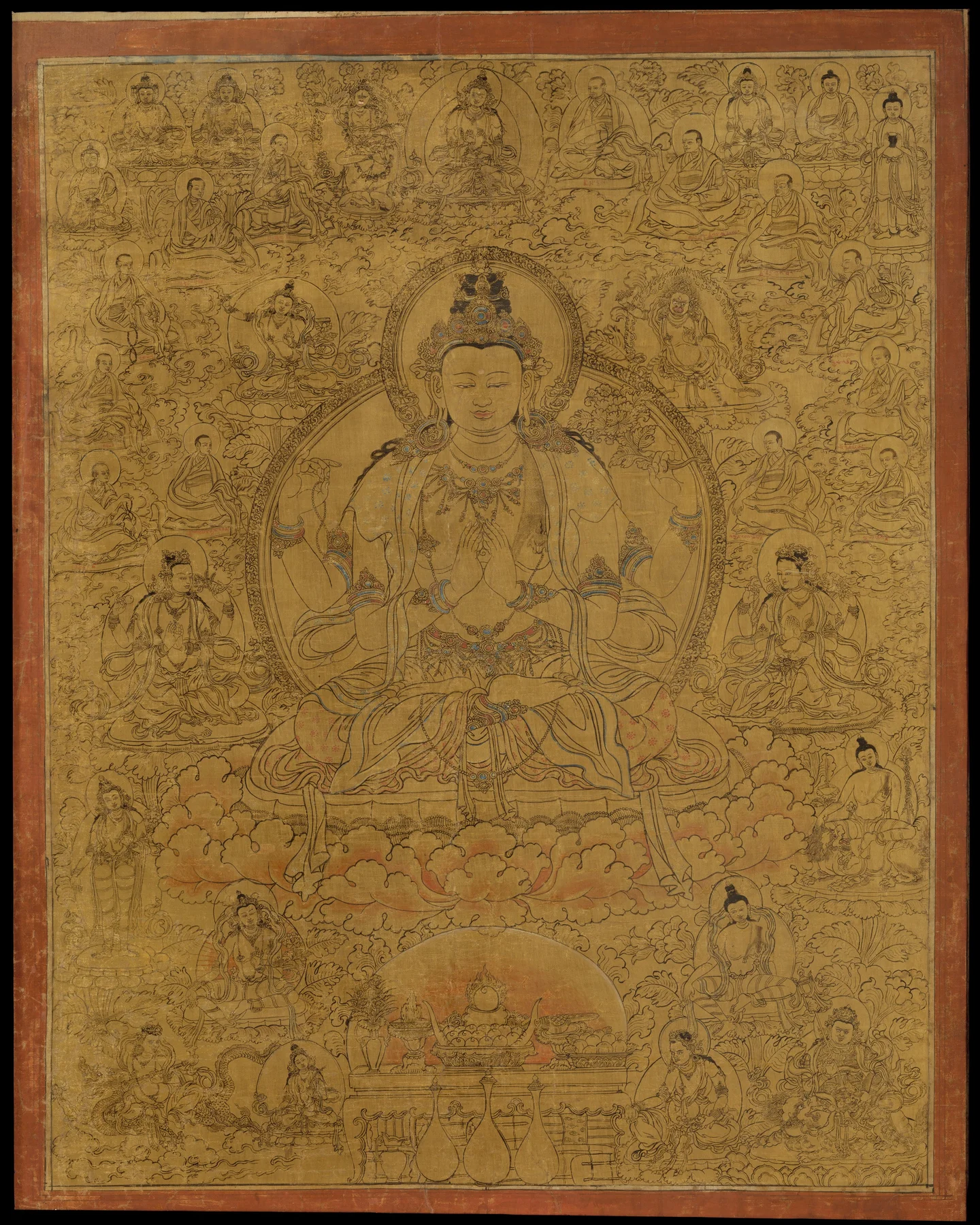
Gold ground: detail within a luminous field
A gold ground gives figures and surrounding ornament a shared luminous field. Fine lines, selective colour and differences in sheen make forms distinct within closely related tones.
From a distance, the gold can feel continuous and unified. Up close, folds, petals and patterns inside halos become legible. The pleasure lies in moving from that overall brilliance into the drawing, rather than simply looking for a larger area of gold.
Red and black grounds: giving line the leading role
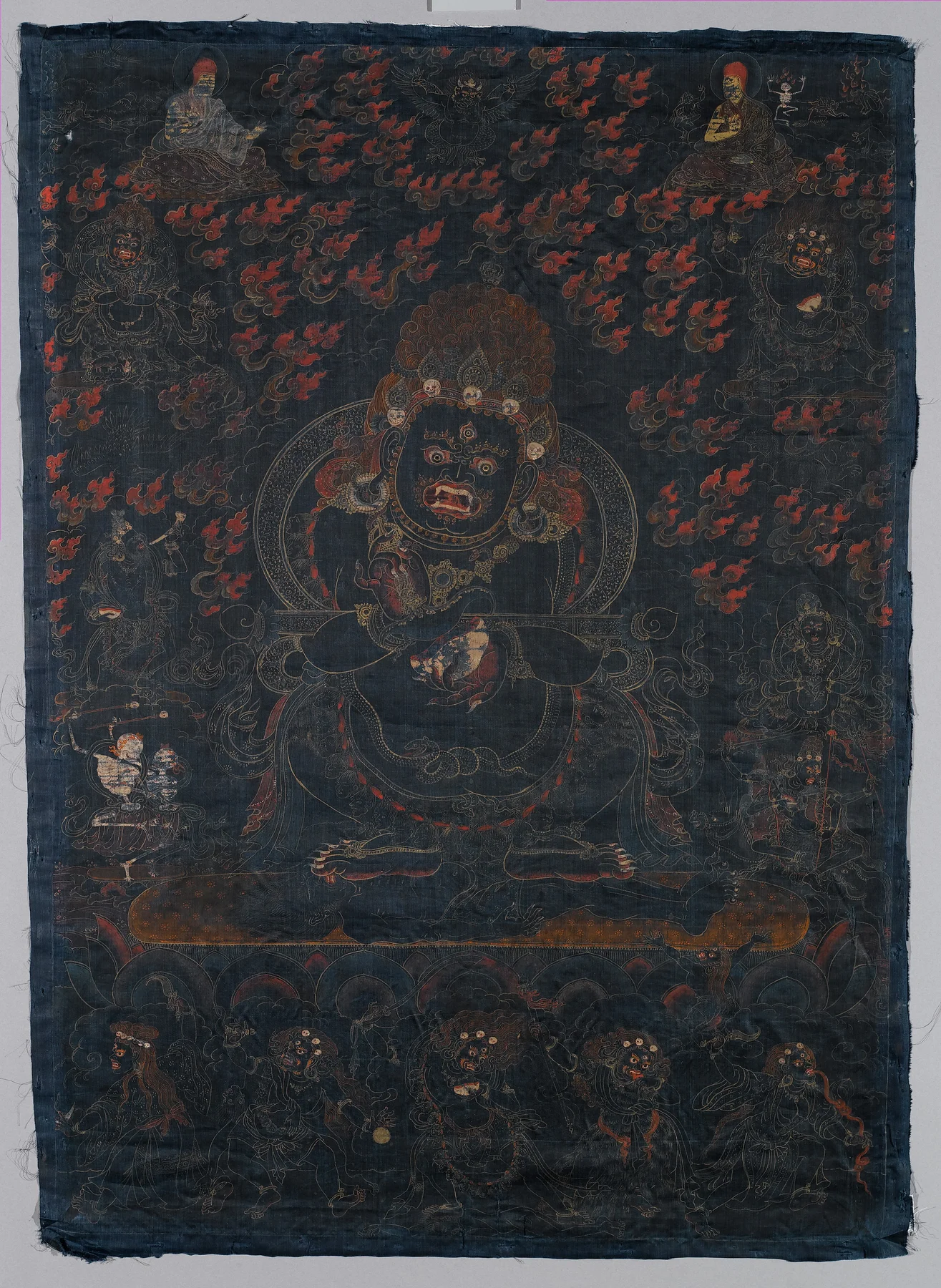
Red- and black-ground paintings often describe forms in gold or other bright lines against a strong base colour. Continuous contours, turning garments and flowing flames gain particular prominence. The contrast can give the image considerable visual tension.
A black ground is not simply an ordinary background painted dark. Space and contour have to be considered together: what remains in outline, what receives colour and where the ground stays visible all affect the figure’s force.
A red ground places the image within a different visual temperature. An artist may retain broad areas of the base or introduce selective colour and shading. Actual treatments vary; the revealing relationship is between the ground and the subject it carries.
Compare one detail at a time
Choose a hand, a lotus or a fold and notice how different grounds make it visible. Polychrome painting may separate forms through adjacent colours, gold-ground work through delicate drawing, and red or black grounds through luminous contours.
A technique then becomes more than a name. You can begin to recognise whether you are drawn to distinct colour relationships, subtle changes within gold, or flowing lines across a dark field. Comparison makes enjoyment more precise without turning taste into a ranking.