Discover / Materials & Craft
How a Thangka Is Painted: Techniques from Cloth to Finished Image
Follow the main stages and documented techniques of thangka painting: preparing the ground, measuring proportions, building colour, modelling transitions, reinforcing lines, adding gold, and mounting the finished work.
In this story
A painted thangka takes shape through connected stages: preparing the cloth, arranging proportions, building colour, shading and refining the final lines. Each stage affects the next. Following the work from its support to the finished image reveals how a steady surface, measured drawing and fine brushwork make such dense detail possible.
The process starts with the ground
Before a figure appears, the cloth must become a stable surface. In one traditional preparation method, fabric is stretched, sized and covered with a ground before it is polished smooth. The ground controls how a brush moves and how later colour sits on the surface. The exact recipe is not universal: support, binder and finishing can differ with a tradition, a workshop and the work being commissioned.
Preparing this surface is already part of the drawing. When the weave is less prominent, a brush can travel across it more steadily; when the ground is even, later colour has a more consistent foundation. A tiny eyelid or garment border depends on that earlier work. This account concerns a painted cloth support: embroidered and appliqué thangkas are constructed differently.
A steady support is part of this working condition. One documented account stretches canvas from a bamboo frame onto wood to maintain even tension; another uses wooden rods and a larger frame before polishing the prepared surface. These are different setups, not one mandatory construction, but both place support and surface preparation before controlled line and colour.
Proportion turns a subject into a drawing
With the surface ready, the painter establishes the image through measured lines. A central figure, seat, hands, attributes and surrounding forms are placed within a proportional system rather than guessed from the edge inward. Guides may be built with a grid, reference units or lightly drawn axes; they are working lines, not the finished appearance. The method protects relationships between parts when the subject is small or densely composed.
The proportions depend on the figure. A seated image and a standing image need different arrangements; a raised arm also needs space for its attribute. Guiding lines help coordinate those relationships, and experienced painters may rely less on a visibly drawn grid. Once the arrangement is clear, ornament can enrich it without crowding the subject.
A measured sketch becomes a painted line
A measured drawing does not have to use fixed centimetres. In one Avalokiteshvara drawing example, twelve small units make one larger unit, with a central perpendicular and two diagonal guides helping retain relationships. The units are relative to the chosen figure and composition; they describe a working system, not a universal ratio or a template that every finished thangka must show.
The first marks and the later painted line also do different jobs. A documented Sikkim process begins with pencil or charcoal on the prepared canvas and follows with a fine-brush outline; another recorded sequence passes over the sketch with a brush dipped in black ink. The media can vary, but the movement from measured placement to reinforced line gives the painter a clearer structure for later colour.
This early construction line should not be confused with the contour that returns after colour has been modelled. The first organizes the figure, space and attributes; the later line clarifies edges, overlaps and emphasis in the finished image. To see how those decisions meet in an individual painting, continue to original thangka paintings.
Broad colour gives the image its first rhythm
After the drawing is settled, colour is built in broad areas: background, figures, garments, landscape and other major forms. A painter is not simply filling empty spaces. Each field has to leave room for later modelling and keep the hierarchy of the composition readable. Some traditions move from the background toward the central figure; others adjust the order to suit the subject, palette and workshop practice.
Opacity and dilution affect how a colour covers the prepared ground. Neighbouring fields also change how it appears: a pale face against dark blue cloth reads differently from the same face beside a gold field. Mineral, organic and modern manufactured colours belong to the broader history of thangka painting, with choices varying by period and workshop.
Shading gives flat colour volume
The next work is often quieter to the eye: thin layers and controlled transitions model faces, limbs, fabric and clouds. A painter may deepen a form from an edge, soften a passage or repeat a transparent layer until the surface has enough depth. This is why a finished face can look calm and dimensional even though it was built from small, separate decisions.
Shading should not be reduced to a single signature look. The amount of modelling depends on the school, the subject and the intended visual language. A useful comparison asks whether the transitions support the form and whether the layers remain clean, rather than assuming that more contrast automatically means better painting.
One Sikkim method blends different shades with several brushes while the paint is still wet on the canvas. Another method places shading and gradual tonal transitions after the initial coats. Together, these examples show how colour can be handled in relation to stage and surface; they do not define one wet-or-dry recipe for every thangka.
Outlines and details make the image readable
Fine contour lines return definition to forms that have been softened by colour. They separate a sleeve from a body, clarify a hand and attribute, and make small architectural or botanical motifs hold together. The line is not merely an outline around a coloured shape; its weight and direction can describe distance, material and emphasis.
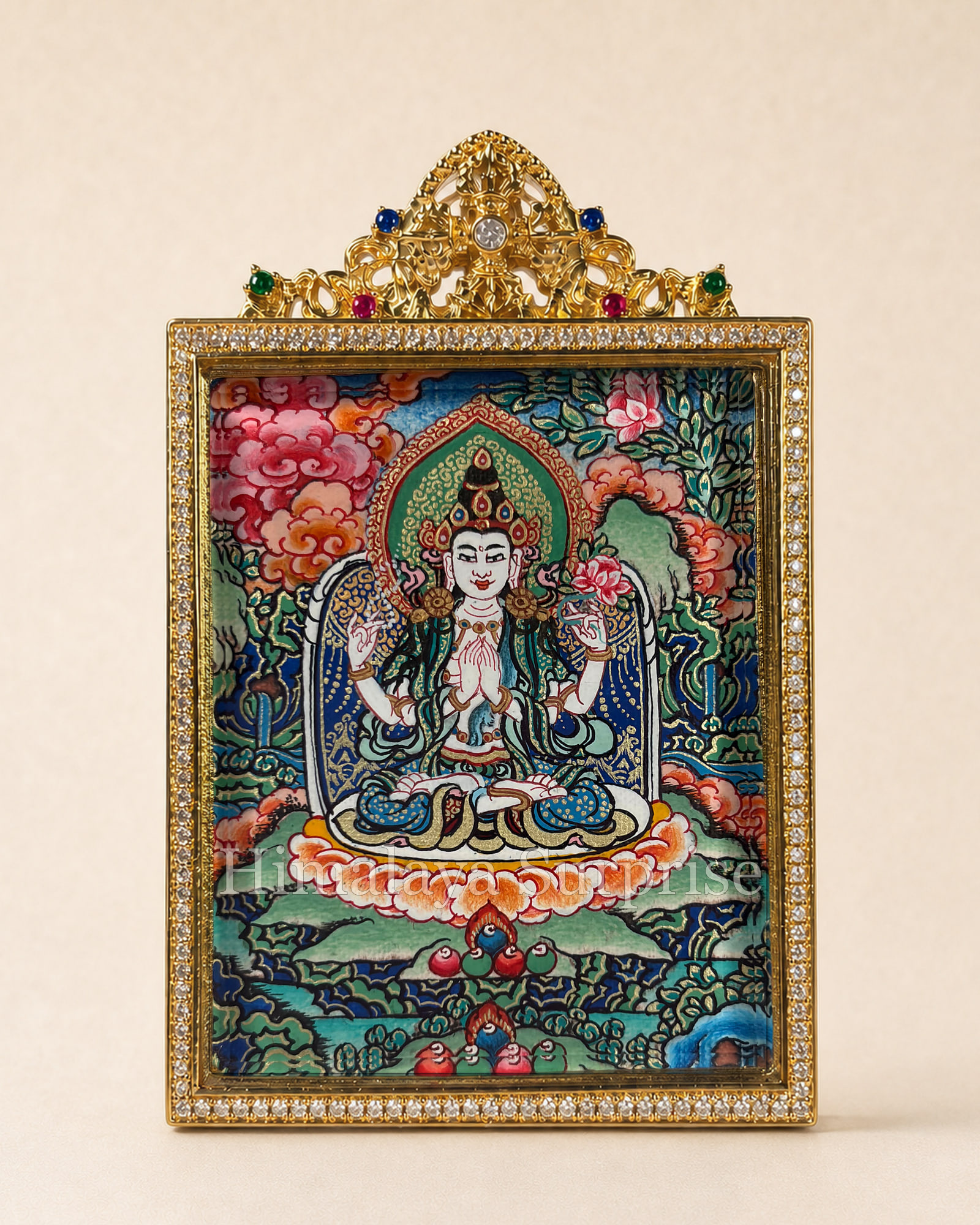
A finished detail of Four-Armed Avalokiteshvara shows these relationships at a painted scale of 4 × 5 cm. The joined hands remain distinct from the patterned drapery, and coloured petals have fine boundaries. This is a view of the finished image, rather than a photograph of its making. It helps show why line and colour have different jobs within the same small space.
Gold, eyes and final corrections set the emphasis
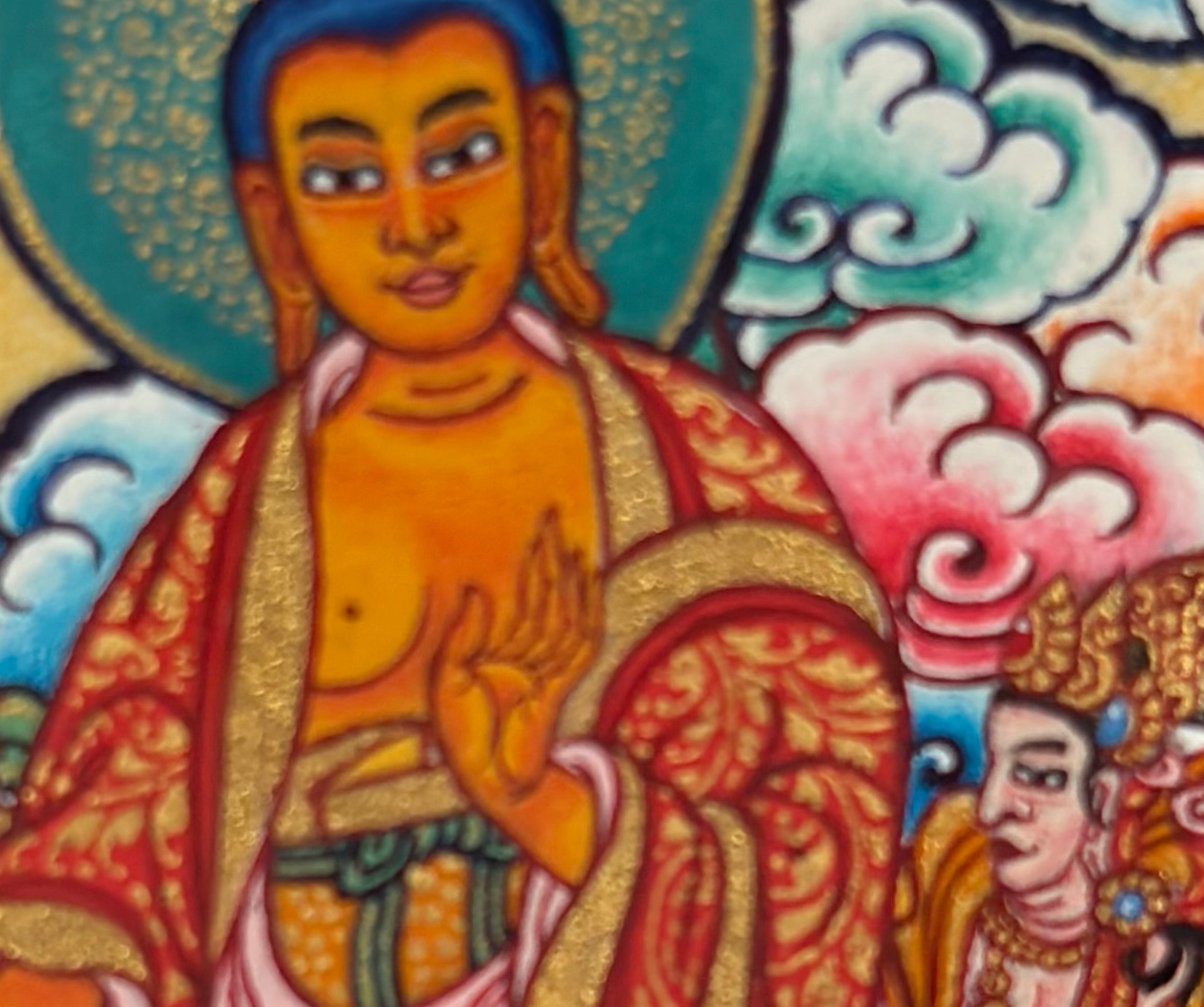
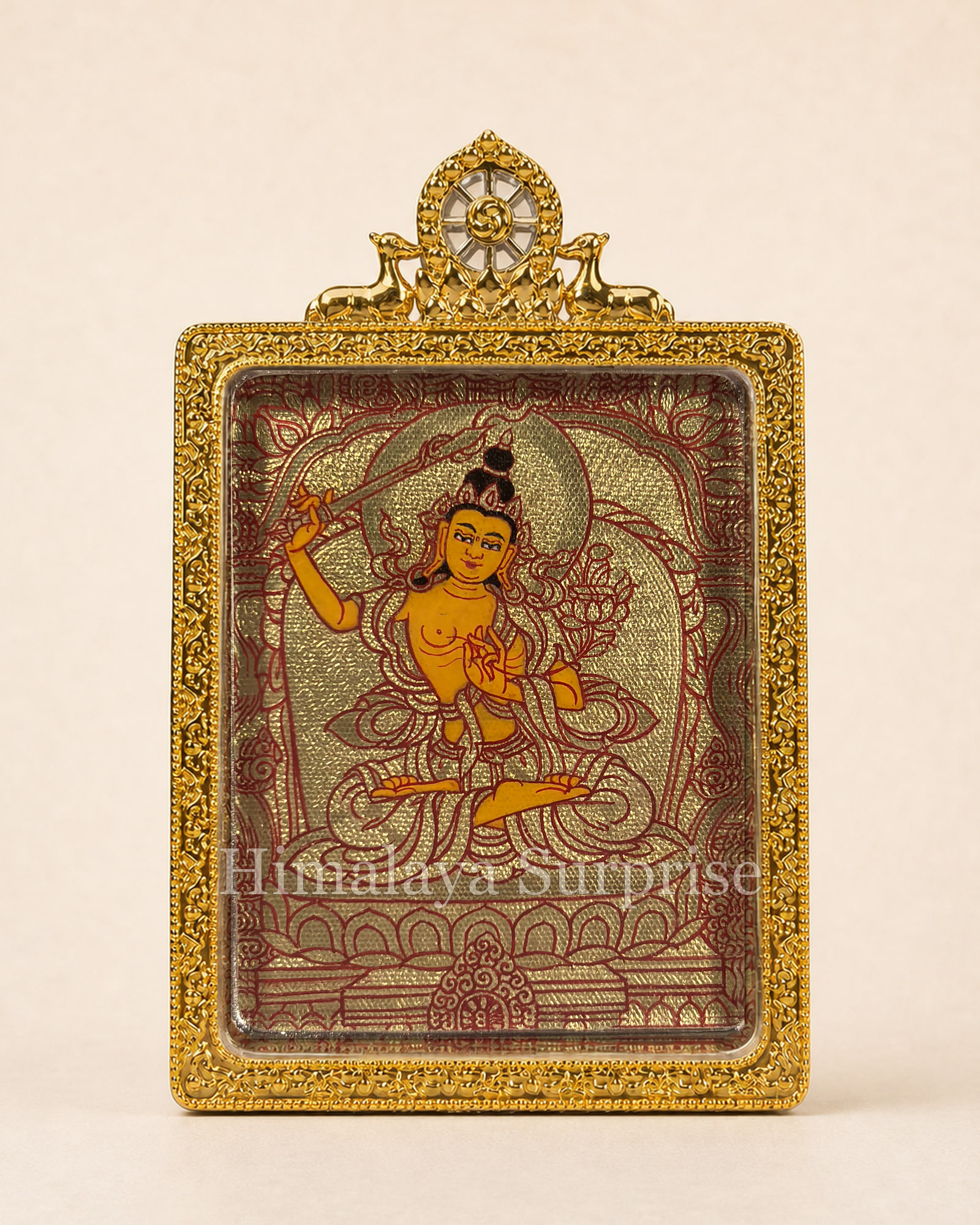
In the Rubin Museum’s documented example, outlines in gold, red and black follow the shading, and selected gold areas are polished to catch the light. This gives particular ornaments an emphasis that differs from the surrounding colour. A gold-ground painting uses a broader gold field, as in this Manjushri detail, where red contours carry much of the image.
The face is resolved through very small relationships between eyelids, brows, lips and outline. Painting the eyes can be a meaningful late stage in a particular Buddhist painting practice. Consecration is a related religious practice with its own context; it is different from completing the painted surface. Neither needs to become a universal statement about every finished work.
Mounting turns a painting into a finished object
Painting is not the only work that determines how a thangka is experienced. After the surface is dry and checked, the painted textile may be mounted with a textile surround, backing, rods or other display elements. Museum process descriptions treat mounting as part of the object's construction because it protects the painting, gives it a way to hang and changes the boundary a viewer sees.
A textile mount and a rigid frame offer different ways of presenting the painting. Brocade, rods and a veil can extend beyond a hanging’s painted panel; a framed miniature brings its own surround. The painted image and the complete object therefore have different dimensions. The size and display guide follows that distinction into choosing a place to hang or display a work.
Knowledge passed from hand to hand
Thangka skills pass through families and master-apprentice relationships, among both monastic and lay artists. Buddhist painting manuals guide figures, colours and patterns, while working beside an experienced painter brings those instructions into practice. The making method lives within a community that keeps teaching it: preparation, drawing and colour are learned through sustained work, not simply copied from a finished image.
Return to the finished image
When you next look at a thangka, move from the composition to a hand, an eyelid or a petal. Their clarity began before the final contour was drawn: the ground supported it, the proportions made room for it and the colours gave it a setting. These stages become most interesting when you can see how they meet in one image.
Questions and answers
How long does it take to paint a thangka?
There is no reliable universal number. Size, composition, detail, medium, workshop practice and the painter's working rhythm all change the schedule. A seller's estimate should be treated as a statement about that commission, not a rule for every thangka.
Are all thangkas made with natural pigments?
No. Natural mineral and organic colours appear in historical painting traditions, while modern workshops may also use manufactured or mixed colours. The palette varies by period and workshop; appearance alone cannot identify a pigment’s source.
What is iconometry in thangka painting?
Iconometry is the measured relationship between parts of an image: the central figure, face, hands, attributes, seat and surrounding forms. It gives a composition a stable structure before colour and detail are added; the exact system can vary with the subject and tradition.
Is gold always used in a thangka?
Gold is used in some works, including particular ornaments and gold-ground paintings. Other works use different palettes. Gold can be applied and finished in different ways, so its role in an image matters more than assuming every thangka must contain it.
Does the painting process include consecration?
A painting may be consecrated within a particular religious practice, but this is separate from its physical making. It should not be assumed for every painting.