Discover / Thangka Essentials
What Is a Thangka Painting? Image, Mounting and Use
Explore a thangka’s Buddhist setting, painted or textile image, brocade mounting and making process, with historical works and a miniature you can examine closely.
In this story
A thangka is a Buddhist image associated with Tibetan and Himalayan traditions, commonly presented as a portable scroll. Many are painted on cloth; others are made with textile techniques such as embroidery or appliqué. They can show a Buddha, bodhisattva, teacher, protector, mandala or story. The picture, its surrounding mount and the way people use it together explain the object.
A picture within a living Buddhist tradition
Thangkas appear in monasteries and household shrines, where they may support devotion, instruction, visualisation and ritual. A painted teacher can preserve a lineage; episodes from the Buddha’s life can help tell a story. A commissioned image may accompany a prayer or an act of thanksgiving. Its purpose depends on the subject and the community using it.
This religious setting informs the drawing. A figure’s posture, hands and attributes often follow a documented form rather than the painter’s passing preference. Backgrounds and decorative details still give artists room to work. Learning to look means recognising both the inherited image and the choices visible in an individual painting.
Some works undergo consecration for religious use. A photograph or a familiar sacred subject does not establish that a particular work has been consecrated. A work can also be studied as art: respectful attention to its subject, making and history is a useful starting point.
Begin with one painting: Thousand-Armed Avalokiteshvara
The painting above is a fourteenth-century Tibetan image of Thousand-Armed Avalokiteshvara, also called Chenresi or Chenrezig. Arms spread around the standing figure to form a golden field. Smaller figures occupy the surrounding niches, and an offering table with monks appears at the lower left. The centre is prominent, but the edges remain part of the picture’s meaning.
The work is recorded as distemper and gold on cloth, with an image measuring 73 × 61 cm. Its modern framed measurements are larger. This illustrates a useful distinction: the size of the painted image is not the size of its present frame, and neither measurement describes an original brocade scroll unless that mounting is documented.
A dated surviving object gives us firmer ground than a single sweeping origin story. Religious accounts about the first image of the Buddha have their own significance, but they are a different kind of evidence from an identified historical painting. For the longer development of the tradition, continue to our history of thangka painting.
The painting and the textile mounting
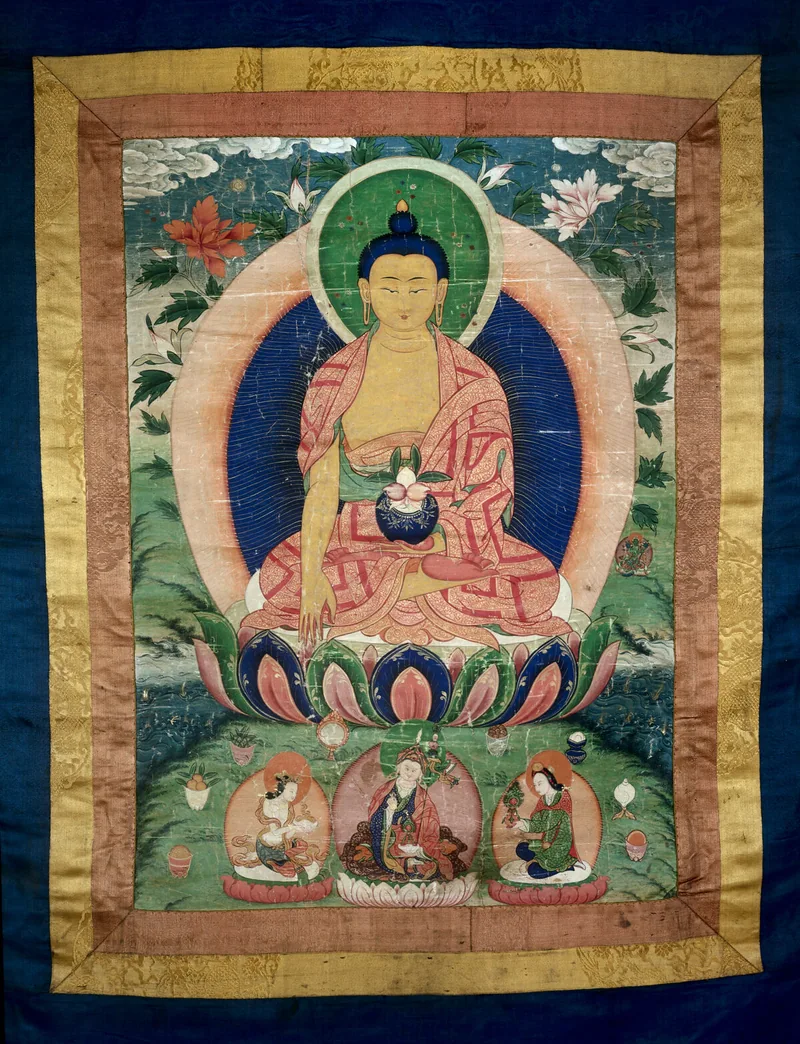
A traditional scroll may combine a painted panel, textile borders, upper and lower rods, a covering veil and ties. The rods help suspend and roll the work; the textile surrounds the painting and contributes to its presentation. A photograph showing only the painted rectangle leaves much of that construction outside the frame.
This Wellcome Collection example shows the difference clearly. Medicine Buddha occupies the central painted field, with Padmasambhava below, while broad patterned textiles extend around it. The painting is on prepared linen mounted on brocade, and the painted area measures 60 × 44 cm. That figure should not be read as the total hanging size.
Mounts can be replaced, repaired or adapted over time. When comparing objects, ask whether the photograph includes the complete mounting and whether dimensions refer to the image, mount or frame. Our brocade and mounting guide looks more closely at those parts.
How a painted thangka takes shape
The process begins before colour reaches the surface. Cloth is stretched, prepared with a ground and smoothed so that fine drawing is possible. The painter plans the composition and establishes the proportions of the figures. This preparation helps a small hand, eye or attribute retain its place within a much larger arrangement.
Colour, shading, outlines and gold details are developed through successive stages. A field report from Rebgong published by Smithsonian Folklife describes artists learning prescribed proportions while working together in studios. Dastkari Haat Samiti’s documented workshop in Gangtok shows another setting, including surface preparation, drawing, colouring and textile mounting. These are particular working practices, not one recipe shared by every artist.
Materials and working time vary. Examples include natural pigments, modern paints and different binders. For one standard 18 × 12 inch painted thangka, the work took roughly six weeks; that is a specific example, not a universal production time. Size, detail, technique and the division of work all matter. Read the painting process guide for a fuller account.
Painting, embroidery, appliqué and reproduction
A painted thangka forms its image with colour and drawing on a support. An embroidered work develops the image through stitches. Appliqué assembles shaped pieces of cloth; at Norbulingka, patterned silk pieces are outlined, cut and sewn into the composition. A silk border around a painting does not make the central image an embroidered or appliqué work.
Gold, red and black grounds describe another aspect of the work: the treatment of the painted field. They do not name the same distinction as painting versus textile construction. Likewise, a mandala names an organised sacred diagram that can be represented in different media. Technique, background and subject help describe a thangka together.
A printed image may reproduce a painting, or printing may be combined with later hand work. “Hand-finished” is therefore not necessarily equivalent to a fully hand-painted image. Ask what was printed, what was painted and how that description is supported. Close photographs and a clear maker’s record are more helpful than treating a sacred inscription as proof of the production method.
Recognising the subject without flattening the picture
Start with the principal figure or the compositional centre. A Buddha, a teacher’s portrait, a protector, a mandala and a narrative painting ask for different kinds of looking. In a mandala, the ordered structure is central. In a life story, the relationship between episodes may matter more than one isolated figure.
For a figure, compare posture, hands, held objects and the surrounding company. Four-Armed Avalokiteshvara commonly brings joined hands, prayer beads and a lotus together. Medicine Buddha commonly has a blue body and medicine-related attributes. Those combinations are more useful than identifying a painting from a colour alone. A fierce face does not by itself identify an evil being: many wrathful figures belong to protective or meditational traditions.
Then return to the edges. Teachers, attendants, patrons and inscriptions can change the reading of the whole. Our guide to reading a thangka follows that movement from the centre to the surrounding image.
What changes when the painting is a miniature?
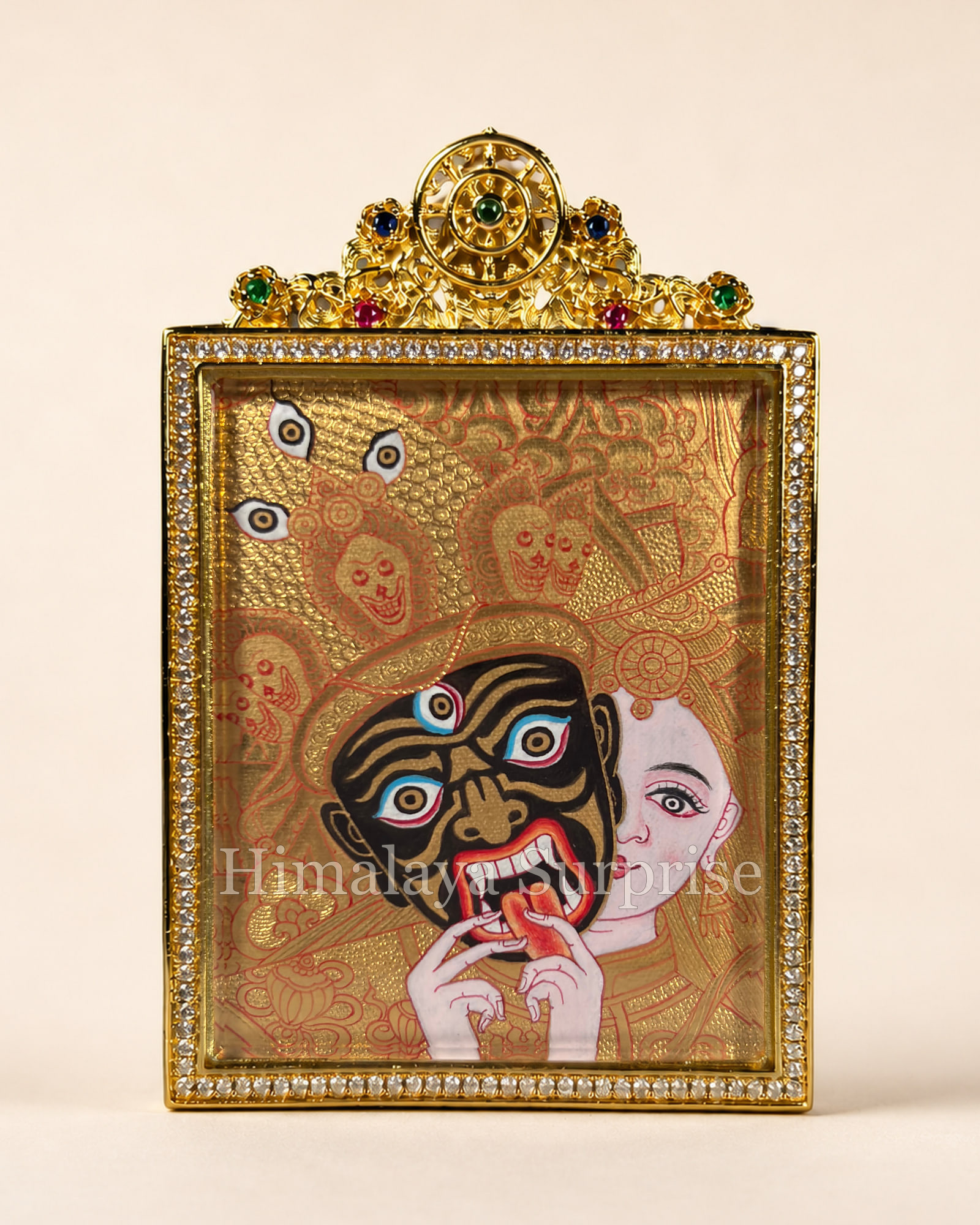
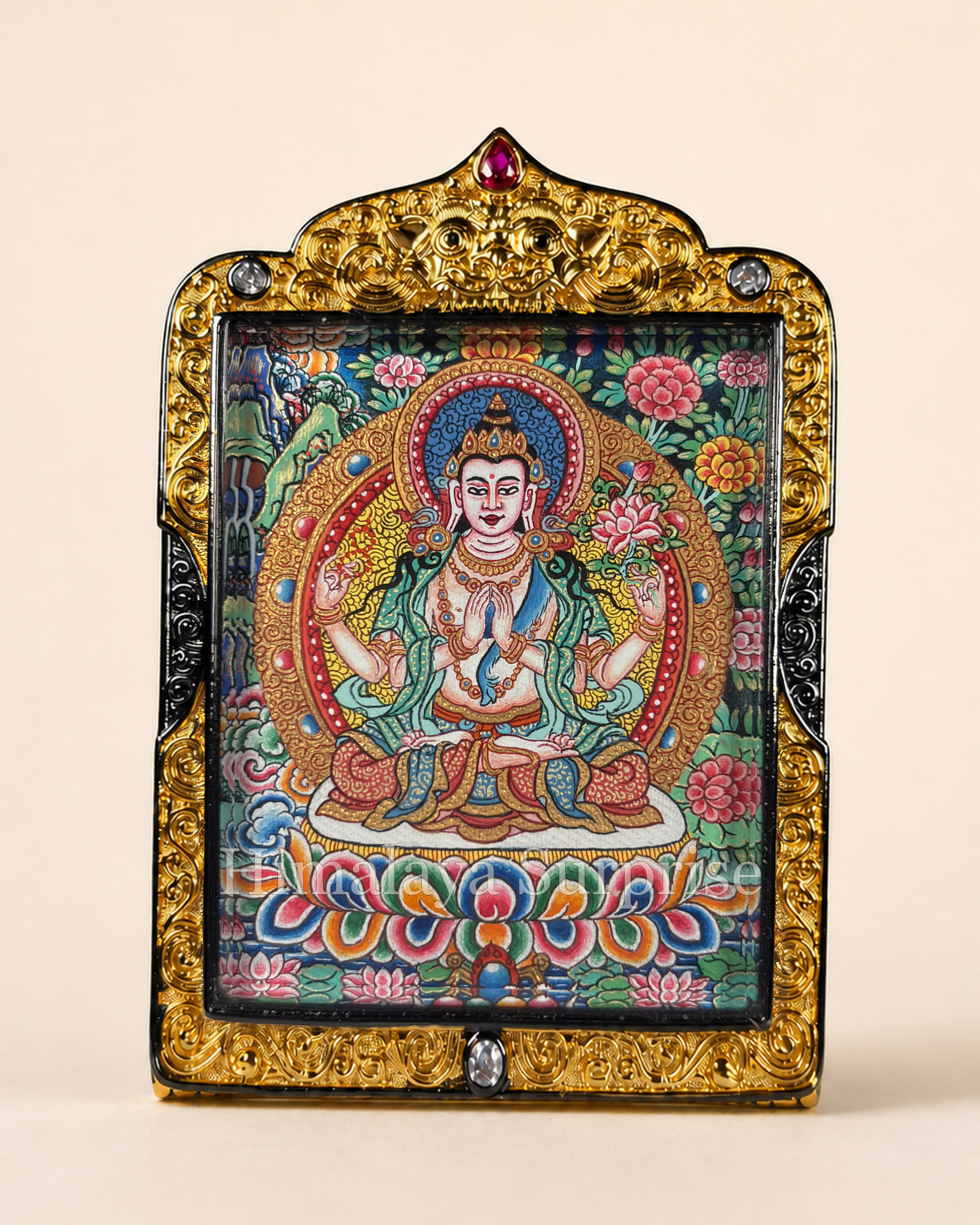
At Himalaya Surprise, our collection includes framed, hand-painted miniatures. In this Four-Armed Avalokiteshvara, TG-010, the listed 4 × 5 cm refers to the painted image. The gau housing and cord are separate parts of the complete object. It is designed for close viewing, wearing or collecting, rather than being a large rollable brocade scroll.
Look at the face, the joined hands, the outer arms and the lotus seat. They form a complete composition within the small painted field. A miniature asks for a different viewing distance; it does not necessarily mean that a larger painting has simply been cropped. Its outer dimensions and housing should still be checked separately.
The individual listing identifies Dan Jiao Xian as the maker and records cotton preparation, pigments and gold details. Those descriptions belong to this work’s record. They should not be extended into a claim about the materials or authorship of every miniature.
From understanding the object to choosing a work
Begin with the subject and the scale at which you want to enjoy it. A wall scroll, a framed painting and a small pendant have different physical demands. Compare photographs of the whole object with close details, then read the painted dimensions, outer dimensions, material description and artist or workshop information together.
There is no single price for a thangka. Scale, workmanship, materials, mounting, condition and a work’s documented history can all affect a listing; an auction estimate and a new retail price also represent different markets. A large size or a gold-coloured surface alone is an incomplete comparison. If you want to weigh actual listings, use our guide to thangka prices.
You do not need to know every deity before looking closely. Choose a picture that interests you, learn what it represents and ask for details that the photographs leave unclear. A clear record helps turn an initial attraction into an informed choice.
Display begins with the object’s construction
Light, handling and the condition of the support matter. Low-light display and periodic rotation can limit exposure. At home, avoid sustained direct sunlight and place a work where it can be appreciated without touching the painted surface. A scroll and a rigidly housed miniature require different handling.
Rollability describes a traditional format, not an instruction to roll every old painting. Fragile pigments, repairs or a changed mount can make handling unsafe. For a framed miniature, hold its support or housing. If paint lifts or powders, stop handling it and seek qualified conservation advice. The care guide covers these differences in more detail.
Questions and answers
Is every thangka a mandala?
No. A mandala is an ordered sacred diagram; a thangka may depict one, but it can also show a figure, teacher, lineage or narrative.
Is a thangka always painted on cotton?
Many painted examples use cotton, but other supports and textile techniques occur. The mounted Wellcome work shown here is recorded as a painting on prepared linen. Read the individual object’s record.
Does buying a thangka mean it has been consecrated?
No. Consecration is a religious practice and requires separate confirmation for the individual work. Subject, price and appearance alone do not establish it.