Discover / Materials & Craft
Thangka Brocade Meaning: The Painting and Its Textile Mount
Explore the brocade borders, silk veil and rods of a thangka, with real museum objects and a clear example of image size versus mounted size.
In this story
In a thangka description, brocade usually means the patterned woven fabric around the image, or more loosely the textile mount as a whole. It gives the painted cloth a setting and helps form a hanging scroll. The painting and its surround can be enjoyed together: the narrow border beside a lotus, the shimmer of a wider fabric panel and the fall of a curtain all change the encounter with the image.
Brocade around a painted image
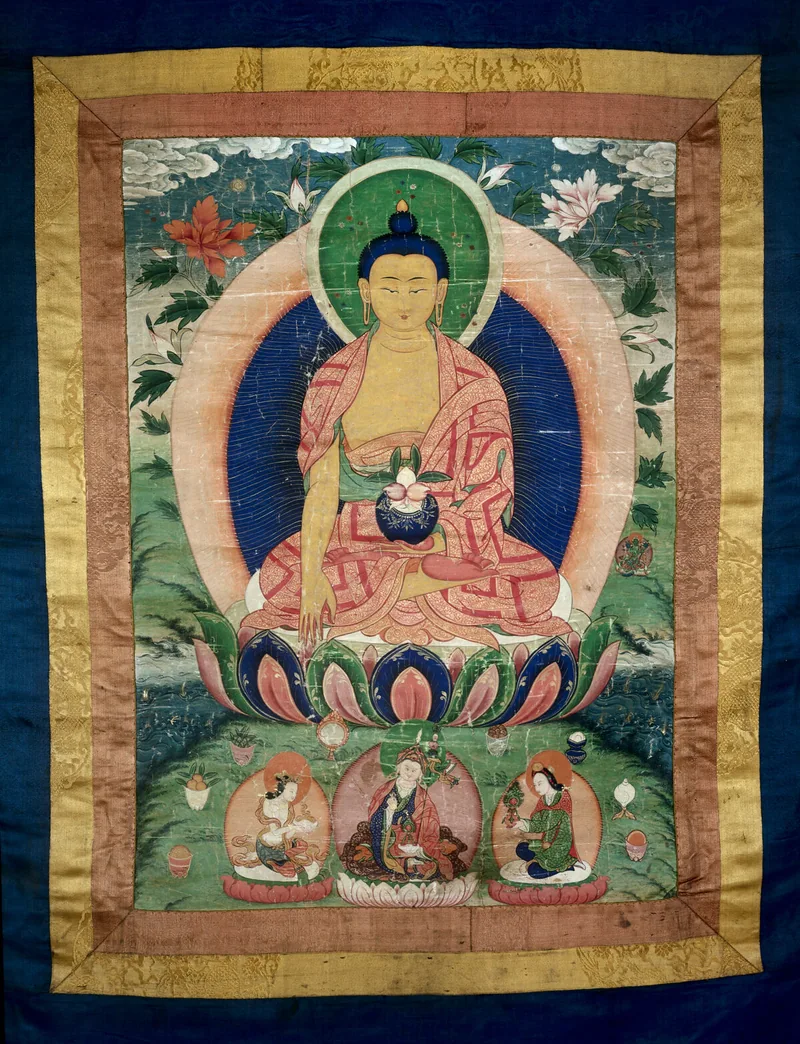
A brocade pattern is woven into the fabric. Floral scrolls, clouds or repeating motifs can enrich the surround of a thangka without becoming part of its painted scene. In the Wellcome Collection hanging shown above, a reddish inner band separates the painting from a broad yellow patterned border. The cloth presents the image as one complete object, while its seams keep the two kinds of workmanship legible.
This work uses distemper on sized linen, mounted on brocade. Linen names the prepared painting support; brocade names the surrounding textile. In embroidered and appliqué thangkas, thread or cut cloth can instead build the figures themselves. The same material family therefore plays different roles in different works.
From the painted edge to the hanging scroll
Follow a textile-mounted thangka outward from the painted field. A narrow border may sit next to the image, with wider fabric at the sides and across the top and bottom. A hanging cord and a lower wooden rod can complete the scroll. Some works also carry a veil, backing and rod caps. These elements give the flexible image a larger structure, with the joins doing as much practical work as the patterned cloth.
The lower rod supplies weight and a support around which a suitable scroll can roll. The cord provides a hanging point. The surround also finishes the cloth edges and separates them from much of the ordinary handling. A mount is still fabric, however: it does not make the paint waterproof or remove the need for a considerate display setting. Not every thangka has all these parts, and textile mounting is one form of presentation among several.
How a finished painting becomes a scroll
A 2022 example shows the making of an Avalokiteshvara thangka. After colour, shading, ornament and the eyes were finished, the artist trimmed the painting with white cord and stitched it to its brocade surround. The sides were hemmed with red cord; a wooden rod and caps finished the bottom, and a hanging cord completed the assembly. Painting and textile work meet at this final stage.
That example uses carefully planned proportions between the painted area and the upper, lower and side panels. The generous lower section and smaller upper section give the hanging its characteristic silhouette. Other works can vary in their proportions, fabrics and construction. Brocade is therefore easiest to understand by looking at a whole scroll, where the width of a band and the position of a seam become visible.
A curtain in front of the image
A veil or cover cloth can be gathered above the painting when it is viewed and lowered across the front when it is covered. It belongs to the presentation of the scroll, with a different task from the patterned border. The border remains around the image; the curtain changes the view of its surface.
The separate silk curtain illustrated here is catalogued by the Met as Tibet or Nepal, seventeenth century. Its dimensions are 154.94 × 91.44 centimetres. Shown on its own, it makes the distinction especially clear: this is a textile associated with a thangka, rather than a painted image or a complete brocade mount.
Image size and mounted size
The Met’s seventeenth- to eighteenth-century Manjushri thangka offers a useful measurement example. Its record gives height × width: the image is 42.5 cm high and 27.9 cm wide; the overall mounted object is 65.1 cm high and 47 cm wide. The first pair describes the painted field. The second describes a larger object, including its surround. These are two measurements of one work, not two alternative ways to write the same size.
The mount adds 19.1 centimetres to the width and 22.6 centimetres to the height in that particular example. Those additions should not become a standard ratio: a wider border, projecting rod or longer lower panel changes the footprint. For wall planning, image size explains the scale of the composition, while overall mounted size explains the space it occupies. The thangka size and display guide develops that room-scale question.
Colour, pattern and the life of a mount
A red inner band can pick up a colour from a robe; a gold-toned textile can echo the ornaments in the painting; a darker surround can let a bright figure stand forward. A woven lotus or auspicious motif can also carry an association of its own. These relationships reward looking at the actual combination, rather than assigning every border colour one meaning. The colour of the mount and the ground of the painted image are separate choices.
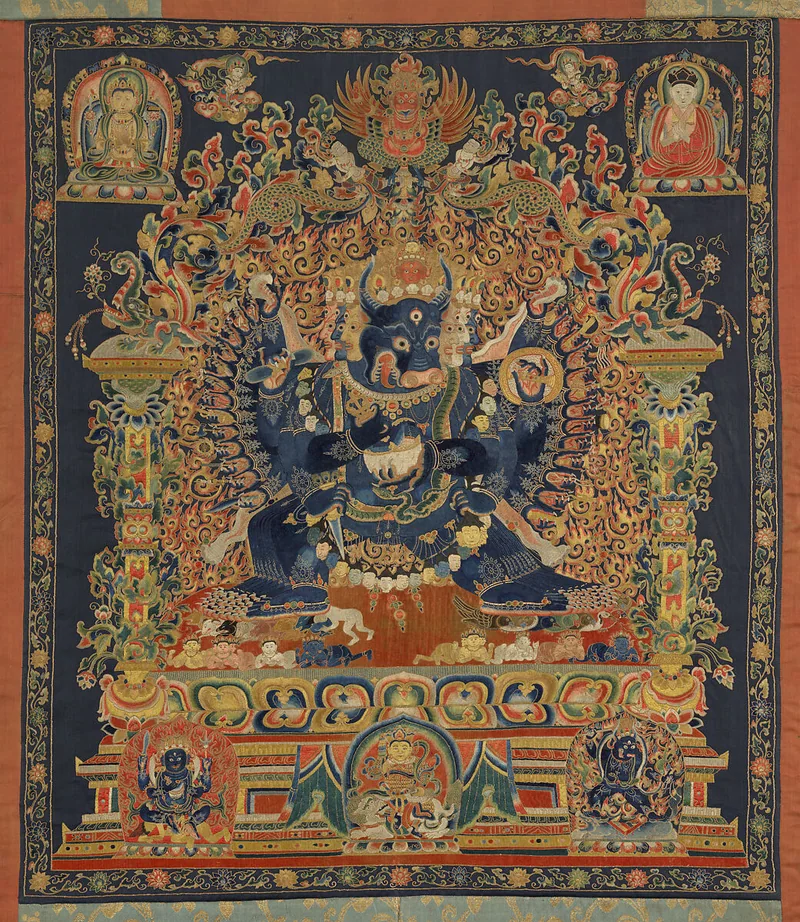
A mount can also preserve another part of an object’s history. In the Cleveland Museum of Art’s Vajrapani and Garuda hanging, the central painting dates to about 1650, while the embroidered top and bottom panels date to about 1350. Different periods and techniques have been brought together. The surround can deserve attention in its own right, with a history that is not simply the date of the central picture.
Seeing the complete work
Textile mounting and a rigid picture frame solve different presentation questions. The former keeps the form of a flexible scroll; the latter encloses or supports a work in a more fixed arrangement. Some displays bring both together. The separate framing guide explores those options, while thangka care considers the conditions in which paint and textile can be enjoyed.
Seen as a whole, a thangka has a rhythm that extends beyond its painted edge. The figure occupies one field; the textile gives it another. Moving between them reveals the work of painting, weaving and assembly, and the way each contributes to the presence of the hanging.
Questions and answers
What does thangka brocade mean?
Usually the patterned woven fabric surrounding the image, or more loosely the entire textile mount. It is distinct from the cloth on which the central picture is painted.
Is brocade the same as an embroidered thangka?
No. A brocade mount surrounds an image. Embroidery builds an image with stitched thread, while appliqué builds it from attached pieces of cloth. A work can combine these techniques.
What is a thangka veil for?
A cover cloth can lie in front of the painting when it is covered and be gathered above it for viewing. It is a separate component from the patterned border; not every work has one.
Why is mounted size larger than image size?
The surrounding textile adds width and height, and rods or caps may extend beyond it. Image dimensions describe the composition; overall mounted dimensions describe the whole object’s footprint. In the Met example above, both measurements are given as height × width.
Does every thangka need brocade?
No. Thangkas can be unmounted, textile-mounted or presented in other forms. Brocade is an established way to finish a scroll, with materials and arrangements varying between works.