Discover / Materials & Craft
Embroidered Thangka: Silk, Stitches and Appliqué
Explore embroidered and appliqué thangkas through real textile works: how stitches and cut silk build an image, why brocade is different, and what changes at festival scale.
In this story
An embroidered thangka builds its image with thread. An appliqué thangka uses cut pieces of fabric attached to a ground. Both can bring Buddhist figures to life in silk, and a single work may combine them with painted details. Their surfaces reward a closer look: the direction of a stitch, the edge of a fabric piece and the light on a raised contour all contribute to the image.
Embroidery and appliqué: two ways to make an image
Embroidery builds a line, field or texture with thread worked through or fixed onto a textile. Appliqué builds the image from separate pieces cut from fabric and attached to a base. Woven or kesi image-making lets the structure of the weave carry the pattern as the textile is formed, while printed textile begins with a design transferred through ink, dye or another printing process. A work can combine methods, but the terms describe different actions.
The terms overlap in everyday descriptions, but they name different parts of the work. “Silk thangka” may refer to silk cloth, embroidery thread, attached fabric or a brocade mount. Woven images, including kesi, form their pattern during weaving; embroidery adds thread to a textile that has already been made. A print transfers a design onto its surface. These are useful distinctions even when the subject and colours look similar.
The image and its brocade surround
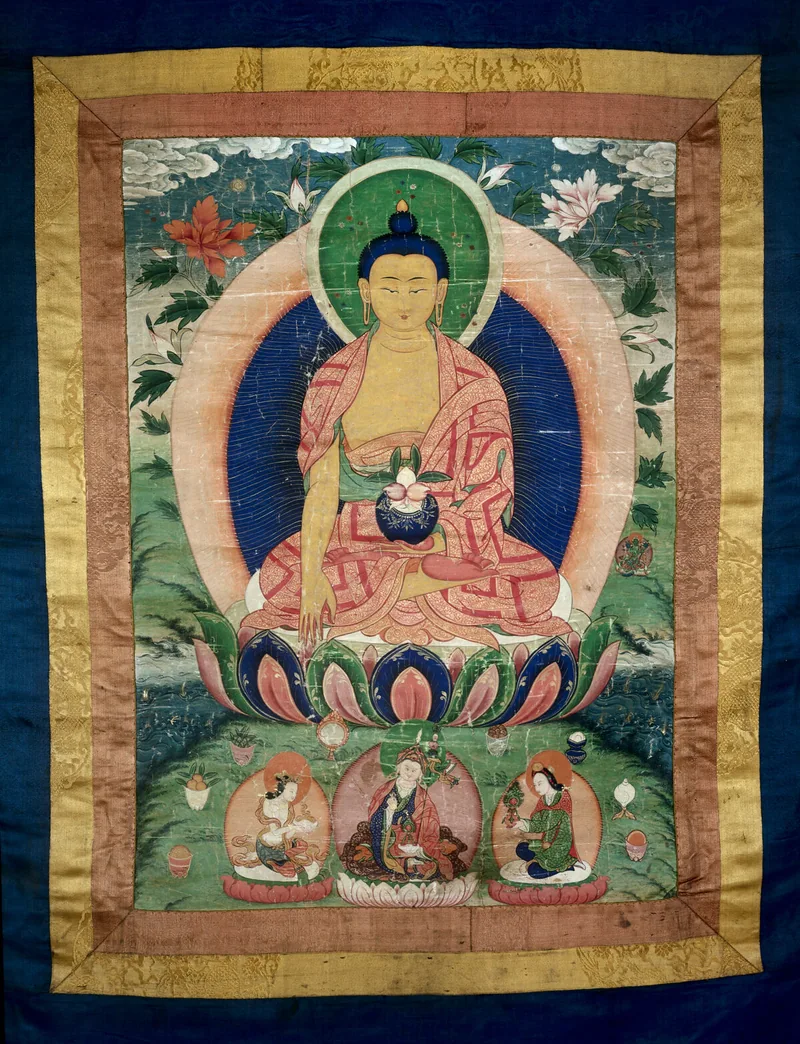
A textile may carry the sacred image, surround it, or do both. In a painted thangka, silk can be the painting support while the brocade around it belongs to the mount. In an appliquéd work, cut cloth may create the body, robe, cloud or lotus inside the image. The surrounding brocade, rods, cords and cover cloth describe how the complete object is presented, not necessarily how the central forms were made.
The Cleveland Museum of Art’s Vajrapani and Garuda offers a striking example. Its central painting dates to about 1650, while its embroidered top and bottom panels are about three centuries earlier. The central figure and the textile panels belong to different techniques and histories, brought together in one hanging. A richly worked surround therefore does not make the central picture embroidered.
How fabric pieces become figures
An appliqué image grows through selection, cutting, placement and attachment. A fabric may be chosen for its colour, sheen, weave or pattern, then cut to fit a body, robe, cloud, lotus or landscape passage. Edges can be turned, overlapped, covered by a line of stitches or left legible as a seam. The large silhouette has to read from a distance, while the small join determines how the image feels close up.
In the nineteenth-century Kurukulla textile shown here, red cloth shapes the moving body while patterned fabrics build the surrounding forms. The Met’s examination found satin, damask and brocade, together with embroidered silk and painted accents. Textile patterns become part of a robe or halo instead of remaining a background decoration. The blue surround also shows how a broad field can give a complex figure room to be seen.
What thread can do that paint cannot
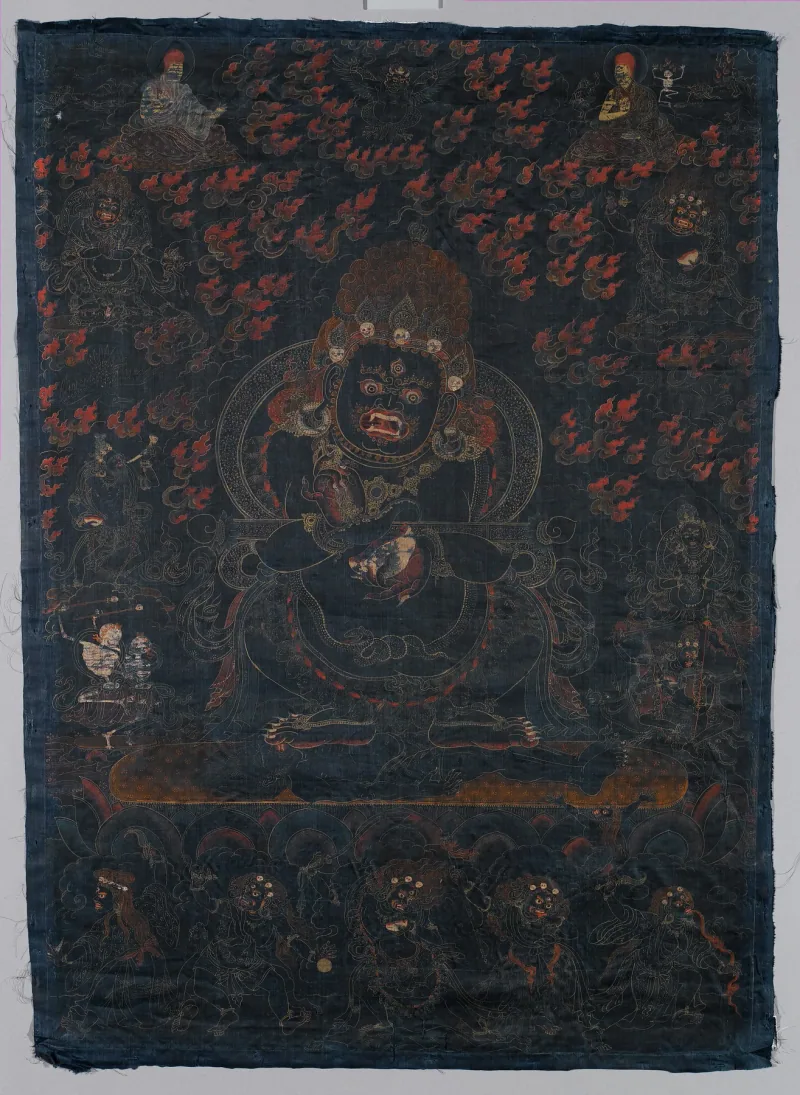
A stitch can draw a contour, fill a colour field or gradually model a face. Changing its direction changes how silk catches the light. In the early fifteenth-century Vajrabhairava embroidery shown above and in this detail, fine silk floss creates colour gradations, while horsehair beneath some areas gives relief. The crowded arms, ornaments and flame scrolls are built as a textile surface rather than brushwork.
Couching gives an outline another kind of presence: a cord or thread is laid across the surface and held down with small stitches. In the Met’s Kurukulla case, silk wrapped around a horsehair core creates raised contours. Different methods can work together—the cloth supplies a broad shape, the stitched line defines an edge, and embroidery develops a smaller feature.
When painting and textile work meet
A textile image can include painted features. The Kurukulla work combines applied fabrics, embroidery and hand-painted accents; the Cleveland hanging brings an entire painted image together with older embroidered panels. Neither example needs to be forced into a single technique. The interest lies in how the parts work together.
The wider Regong arts tradition includes painting, sculpture and silk patchwork known as barbola. UNESCO describes cut silk shapes assembled as soft relief. This places textile construction within the same artistic world as painted Rebgong thangkas, while keeping their ways of making an image distinct.
A different encounter at festival scale
Appliqué can expand far beyond the scale of a room. Monumental festival textiles are unfurled for public viewing, sometimes across a building or hillside. At that distance, the broad silhouette and large colour areas do much of the visual work. Seams, backing and the coordinated labour of moving the textile become essential to its making and display.
Small and monumental works can share a subject without sharing every construction detail. The Christie’s catalogue of the Yongle Raktayamari thangka discusses a different large-scale achievement: an embroidered image measuring 336 × 214 cm, with graded silk colours and couched gold-thread contours. Size alone does not tell us whether an image is sewn from pieces or embroidered with thread.
Looking closely at a textile thangka
Begin at the edge of a robe, halo or cloud. A change of weave may follow the shape of a cut fabric piece; tiny stitches may hold down a contour cord; parallel threads may turn to model the body. Move back from the surface and those small decisions become a figure, a flame or a landscape.
An overall view gives the composition; a close view reveals the rhythm of its making. It is this movement between the two that makes a textile thangka rewarding to explore. The guide to thangka size and display continues with how scale changes the way an image is encountered.
Questions and answers
What is an embroidered thangka?
It is a thangka whose image or important image areas are built with thread worked through or fixed onto textile. It may also include appliqué pieces, couched cords, painted details or a separate brocade mount, so the exact construction belongs to the individual work.
Is an appliqué thangka the same as an embroidered thangka?
No. Appliqué attaches cut fabric pieces to a base, while embroidery uses thread to build lines, fields or texture. One work can combine both, but the terms should stay distinct.
Does silk thangka mean the image is embroidered?
Not necessarily. Silk may be the support, an appliqué piece, an embroidery thread or the brocade mount. The description should say which part uses silk and what actually makes the image.
How is woven or kesi imagery different from embroidery?
Woven or kesi imagery lets the structure of the weave carry the pattern as the textile is made. Embroidery adds or fixes thread through or on an already formed textile.
Are giant festival thangkas always embroidered?
No. Giant describes scale and display, while embroidered describes one construction method. Large festival images may use appliqué or related textile techniques, and the exact method should be named from the object evidence.