Discover / Materials & Craft
Thangka Canvas: From Cloth and Ground to a Painted Surface
What is thangka canvas made of? Explore cloth, sizing, ground and polishing, the difference between painting and brocade, and hand-painted thangkas versus canvas prints.
In this story
A painted thangka begins well before its first figure appears. Cloth must become a surface on which a fine line can stay clear and colour can settle evenly. Stretching, preparation and polishing help make that possible. The word “canvas” often covers this whole prepared surface, yet the cloth, the ground above it and the brocade around the finished picture each have a different job.
What “canvas” means in a thangka
Canvas is a convenient English name for a cloth surface used in painting. In a traditional painted thangka, that surface is prepared rather than simply cut from a roll of fabric. The textile carries the ground and colour above it. Cotton is common in many painting processes, but painted thangkas also have other supports, including linen and silk. The word canvas does not identify the fibre by itself.
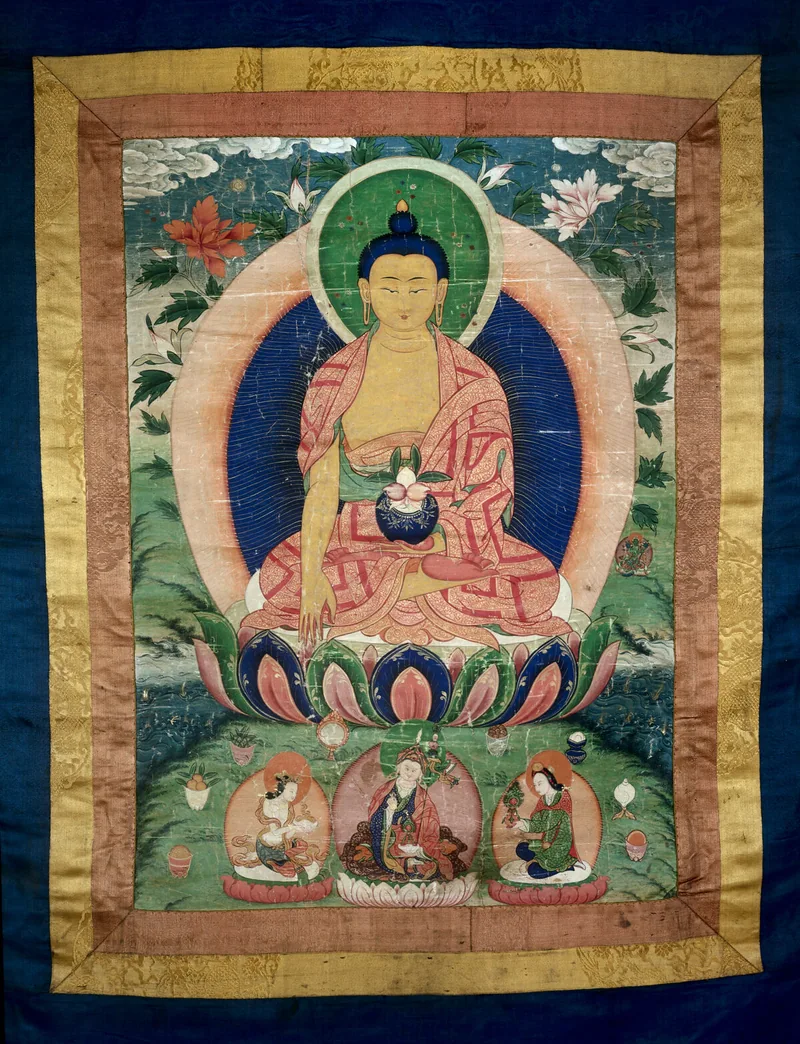
The Medicine Buddha scroll in the opening image makes the distinction tangible. Its painted area is distemper on sized linen, measuring 60 × 44 centimetres, with brocade around it. Linen belongs to the painting support; brocade belongs to the mount. They appear together in a photograph, but they are not interchangeable descriptions of the same cloth.
Stretching gives the cloth a working plane
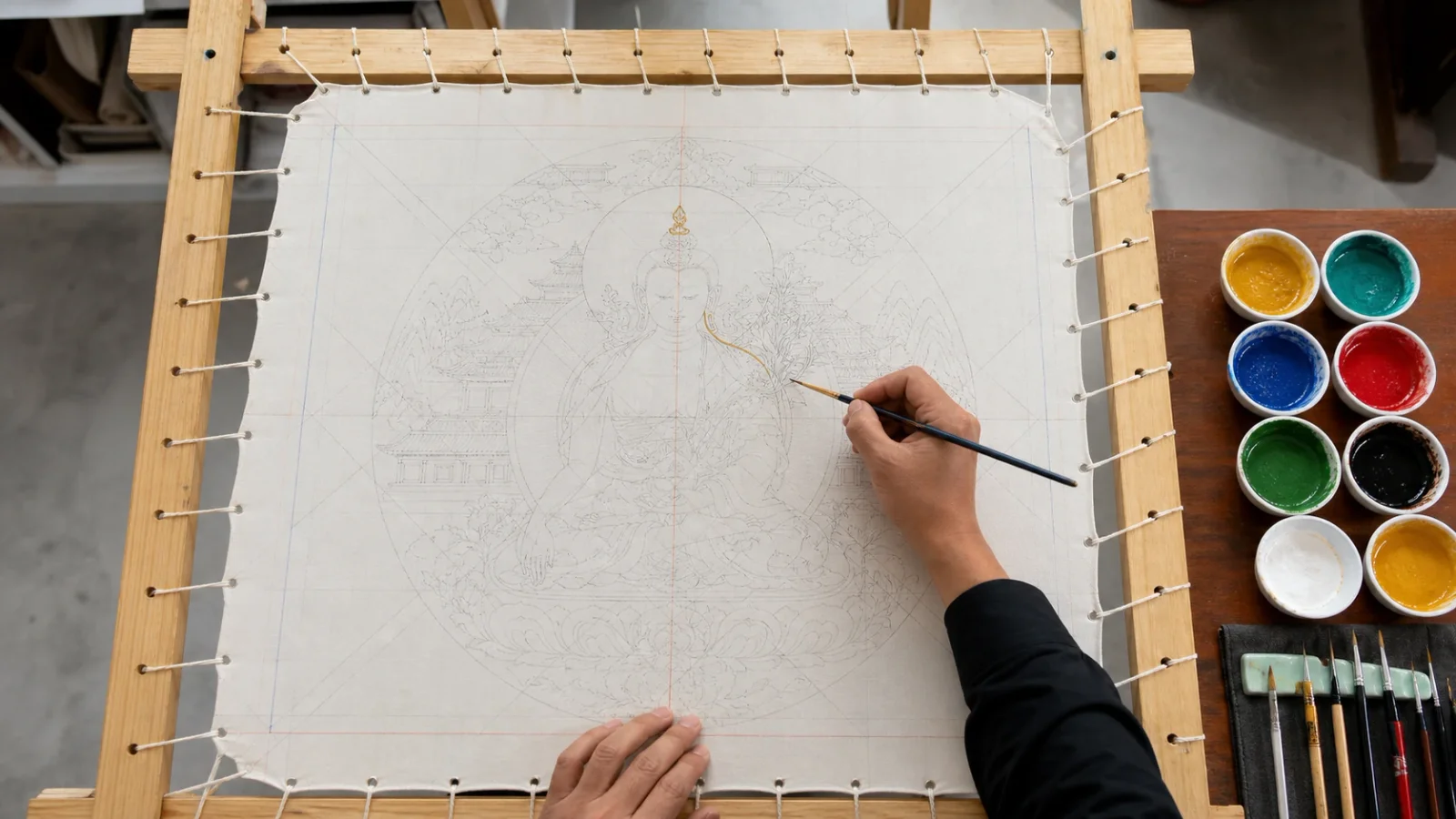
Loose fabric moves under a drawing tool or brush. A working frame holds it under tension so the artist can establish proportions and work across the composition. One traditional arrangement stitches the cloth to narrow rods along its edges and laces these into a larger wooden frame. The gap and adjustable cords allow the surface to be tightened as preparation proceeds.
This is a tool for making the painting, not necessarily its final display frame. Once the work is complete, its support may be removed from the working frame and incorporated into a textile mount. A modern canvas print stretched over wooden bars is a different construction. The similar rectangular outline can conceal a very different relationship between image, cloth and frame.
Sizing and ground prepare the surface
Sizing is an adhesive treatment of the cloth. In one documented painting process, a dilute glue layer is applied before a smooth base made with size and lime. The preparation moderates how the fabric receives the next layers. The ground is that prepared layer over the textile: it helps reduce the prominence of the weave and creates a more even surface for drawing and paint.
Traditional accounts also describe chalk or white earth mixed with a binder. These are ways of preparing a painting ground, not one formula shared by every artist. Materials and the sequence of application vary. The useful distinction is the role of each part: the cloth provides a flexible support, while preparation changes the surface on which the image is made.
Why the ground is polished
After the prepared surface has dried, polishing with a smooth stone can make it more even. A small irregularity in raw cloth can interrupt a narrow line; a prepared and smoothed ground offers the drawing tool a steadier path. Faces, fingers, petals and ornaments benefit from this control, especially when several details meet in a small area.
Smooth does not mean that the surface must resemble glossy paper. It still has to receive colour and hold the painting layers. The artist is balancing evenness with the response of the ground to brush, binder and pigment. The painting process continues from this preparation into proportion, colour, contour and the face.
Preparation becomes visible through the drawing
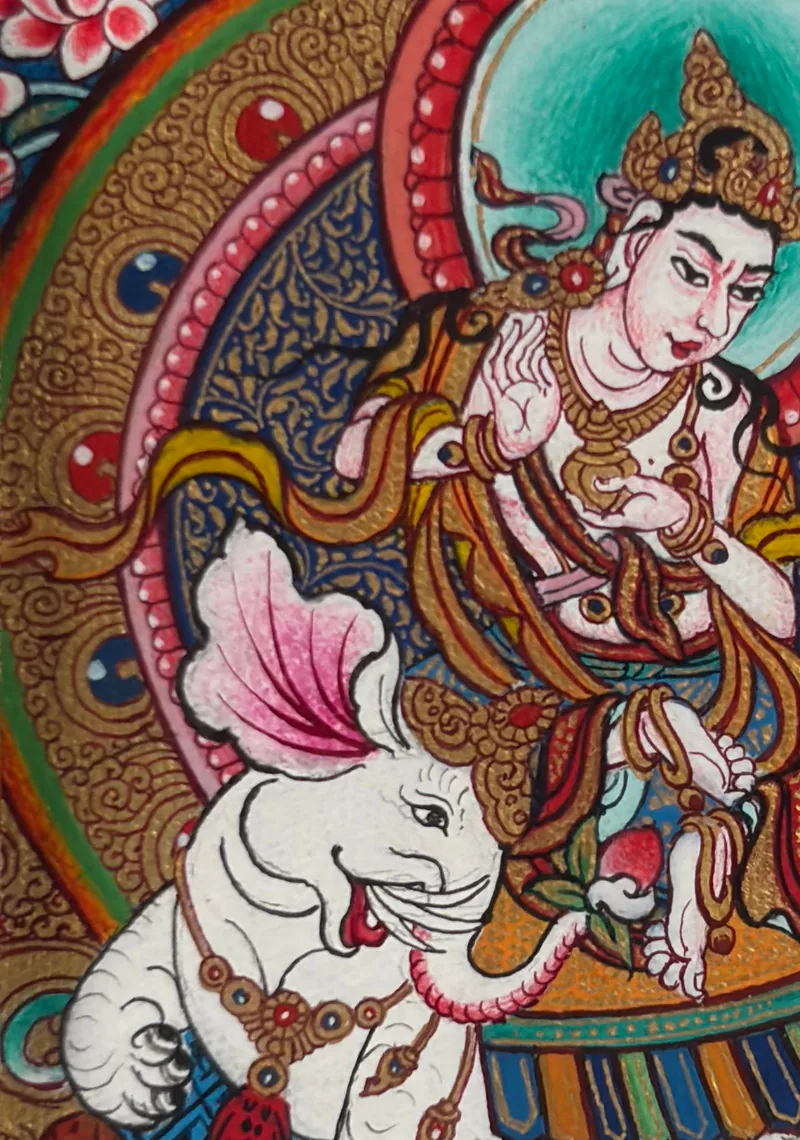
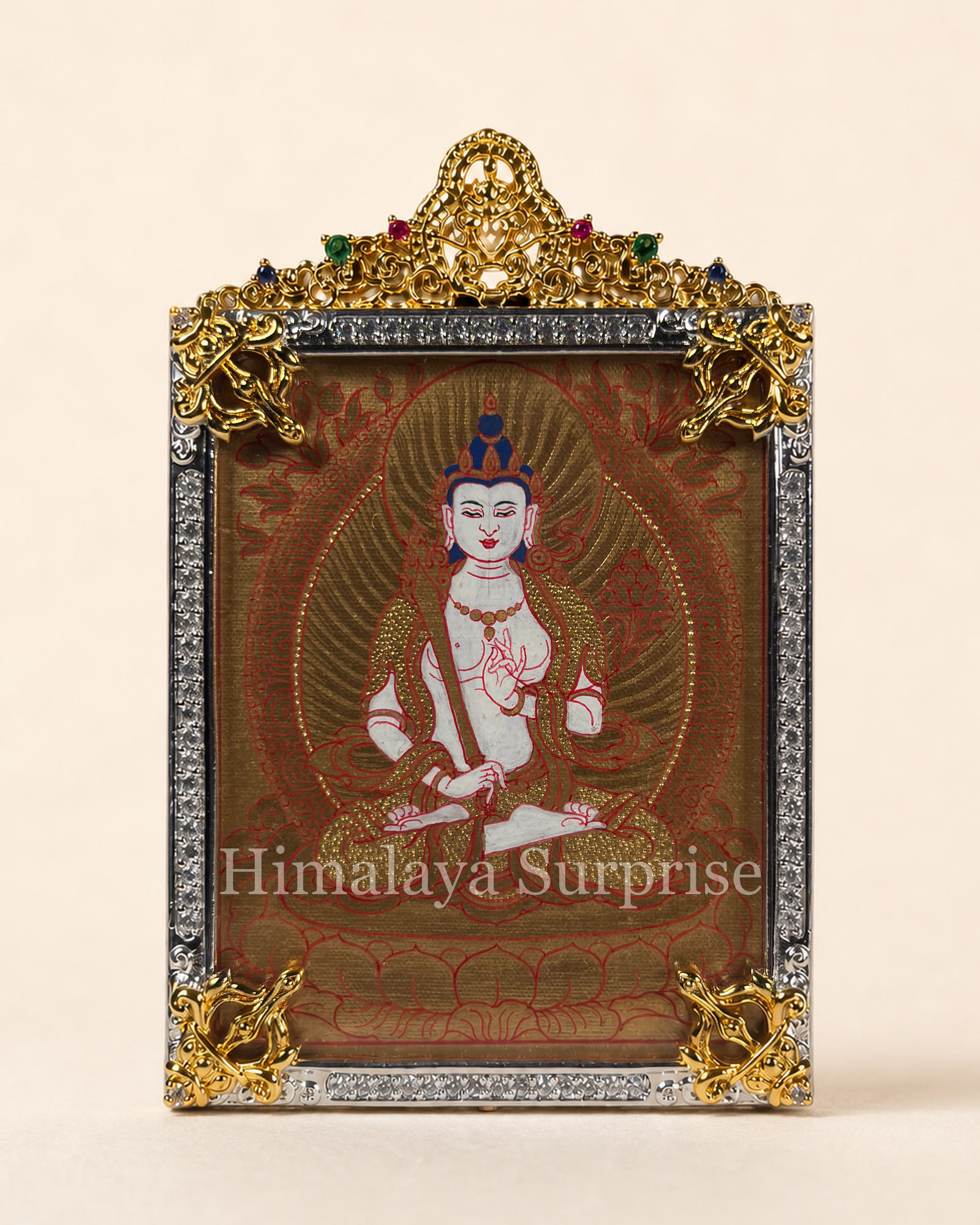
In this Four-Armed Avalokiteshvara miniature, follow the narrow lines through the garments and the layered lotus petals. Colour establishes the larger areas; finer marks keep adjacent folds, fingers and ornament distinct. The painted area is only 4 × 5 centimetres, excluding its frame. Such close relationships show why a manageable drawing surface matters.
The photograph shows the finished drawing and colour, rather than the cloth preparation underneath. Its value here is visual: look at how a line turns around a petal or leaves a small interval beside a hand. The work gives us an example of precision at a small scale without revealing every material or step hidden below the image.
The brocade is a separate part of the object
A completed painted panel can be stitched into a textile surround. Backing, a cover cloth, rods and cords may form part of the hanging arrangement. These elements frame the image and help organise its display. The outer fabric can be silk even when the painted support is a different textile, as in the linen painting and brocade combination shown at the beginning.
The painted area and the size of the whole mounted scroll are therefore different measurements. Embroidered and appliqué thangkas add another distinction: thread or shaped fabric helps build the image itself, rather than merely surrounding a painted panel. The brocade and mounting guide follows the textile structure around a finished work.
Hand-painted thangkas and canvas prints
A canvas print reproduces an image onto a textile surface. It can be sold rolled, stretched over bars or already framed. A hand-painted thangka builds its image through drawing and applications of colour on a prepared support. Both can use cloth and depict the same figure, while the way the image comes into being is different.
That difference matters when words such as canvas, print and painting appear together. Brocade around a reproduced image remains a textile mount; it does not change printing into brush painting. An image drawn in a traditional style may also be reproduced by modern methods. The subject, the way it is made and the way it is mounted are three separate aspects of the finished piece.
From the surface to the picture
The preparation beneath a thangka is easy to overlook because the finished image takes our attention. Yet the textile, ground and paint work together. A broad colour field can sit beside a delicate outline because the artist has a surface suited to both. The support is the beginning of the picture, even when little of its weave remains visible.
Return to the Medicine Buddha scroll and notice where the image ends and the border begins. Then look within the painting, at the clear outlines of hands, robes and lotus petals. The surrounding textile and the painted surface contribute different kinds of structure. Seeing both makes the whole object easier to understand.
Questions and answers
What is thangka canvas made of?
Cotton is common in many painting processes, but painted thangkas can also use linen, silk and other supports. Canvas is a broad name for the painting surface, not a guarantee of one fibre. The Medicine Buddha pictured here is on sized linen.
What is sizing in thangka painting?
Sizing is an adhesive treatment of the cloth, used to prepare how it receives subsequent layers. A documented process uses a dilute glue foundation before the ground. Materials and sequence vary between practices.
Is the ground the same as the canvas?
The cloth is the support; the ground is a prepared layer over it. Together they provide the surface on which the artist draws and paints. The brocade surrounding the finished image belongs to its mount.
Why is thangka canvas polished?
Polishing evens the prepared ground so fine drawing and colour can be controlled more readily. The aim is a usable painting surface, with an appropriate response to the brush and paint, rather than a uniformly glossy finish.
Is a canvas print a hand-painted thangka?
A print reproduces an image on a surface; a hand-painted work creates the image through drawing and colour applied by the painter. Cloth, brocade or a frame can appear in either format, so those features alone do not describe how the image was made.