Discover / Subjects & Meaning
Kapala Meaning: The Skull Cup in Tibetan Buddhist Art
What is a kapala? Explore the skull cup, its lid and stand, and its meanings in images of Vajrayogini, Mahakala and Padmasambhava.
In this story
A small bowl can change the way we read a Buddhist image. Raised toward a yogini’s mouth, held beside a curved knife, or resting in the hands of a seated master, the kapala belongs to several different visual settings. Its skull form is striking, but the gesture and the figure holding it explain far more than the shape alone.
What is a kapala?
A kapala is a skull cup used in tantric religious contexts, including Tibetan Buddhist traditions. The Sanskrit word kapāla means skull; in discussions of ritual objects it refers to a cup fashioned from the upper part of a cranium, or a vessel representing that form. Tibetan thöpa is another name readers may encounter. In Chinese, 嘎巴拉 and 颅器 are used for the object.
The name does not identify a single material. Historical examples can combine a bone bowl with metal fittings, while contemporary vessels may be made in metal or resin. The skull form also occurs in Hindu tantric traditions, so kapala is broader than a label for one Tibetan deity. Here, the focus is the object and its place in Tibetan Buddhist art.
Cup, lid and stand: reading a kapala set
The ensemble in the opening photograph makes the parts easy to distinguish. The pale, rounded bowl sits between a metal rim and a separate support. Above it is a domed cover with openwork ornament and a vajra-shaped finial. Below, a three-sided stand raises the cup above the surface. The object is a nineteenth-century Tibetan kapala in the West Bohemia Museum in Pilsen.
These fittings change its appearance substantially. A closed, richly mounted vessel may look more like a covered offering cup than an exposed skull. In a painting, however, the held cup can be small and uncovered, without any of the separate display fittings. A lid or pedestal is therefore useful for understanding an ensemble, but neither has to appear in every depiction.
A bell, drum or phurba may be used within the same religious setting, but each remains a different implement. They are not the structural parts of the cup. Keeping those names separate makes both a museum display and a painted arrangement easier to understand.
What does the skull cup mean?
The association with death makes impermanence an important part of the kapala’s meaning. A form drawn from the human body becomes a vessel rather than an ornament of personal identity. In Buddhist interpretations, that change can point toward loosening attachment and transforming the way experience is understood. It is more useful to place these ideas beside a particular image than to treat the object as a charm with one automatic effect.
The emphasis varies between images. One reading of a Vajrayogini painting connects her skull cup with a mind filled with bliss and an understanding of reality. Another reads the kapala in a Padmasambhava portrait as an emblem of detachment. The two readings are related, yet they follow different figures and visual contexts.
The cup can be represented with contents. A painted red area, a heaped offering or a covered vessel belongs to the composition’s symbolism; appearance alone does not establish what a historical vessel contained. Reading a representation and reconstructing an actual ceremony are different kinds of interpretation.
Why a curved knife often appears beside it
A kapala is often paired with a curved knife, also called a kartika or drigug. Its crescent-like blade has a different profile from a straight sword. When these objects are held together, the viewer encounters a vessel and a cutting implement as a connected group, rather than two unrelated accessories.
In Vajrayogini imagery, the curved knife can evoke wisdom overcoming obstacles. That gives the pairing an intelligible relationship: the blade and the cup participate in an image of transformation. A staff or other attribute may add further meaning, depending on the figure. For more of that surrounding vocabulary, see Vajrayogini and her forms.
Vajrayogini: the cup raised toward the lips
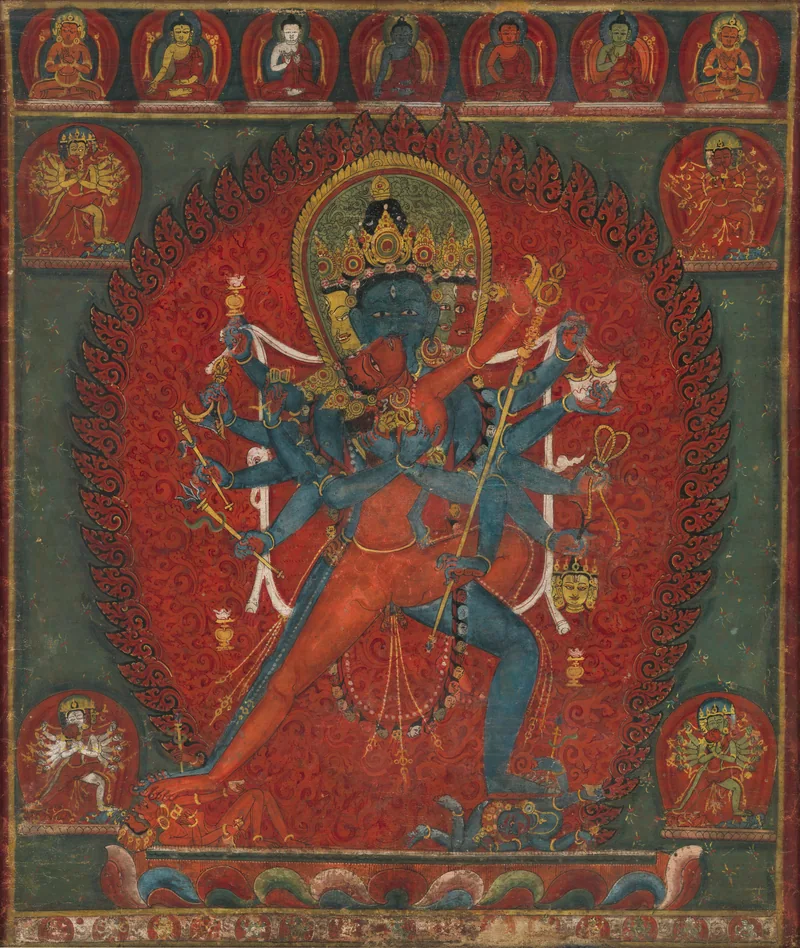
One particularly distinctive gesture appears in the Khechari form of Vajrayogini associated with Naropa. In the Rubin Museum’s late nineteenth-century painting from Kham, eastern Tibet, the cup is raised toward her lips. The knife and long staff complete a more specific arrangement than the word skull cup can convey on its own.
This is why the direction of a hand matters. A cup brought toward the mouth creates a different action from one held steadily at chest or lap level. The surrounding posture, the knife, the staff and the figure’s appearance help distinguish the form. Not every image of Vajrayogini or Vajravarahi repeats the same gesture.
Mahakala: a cup within a protector image
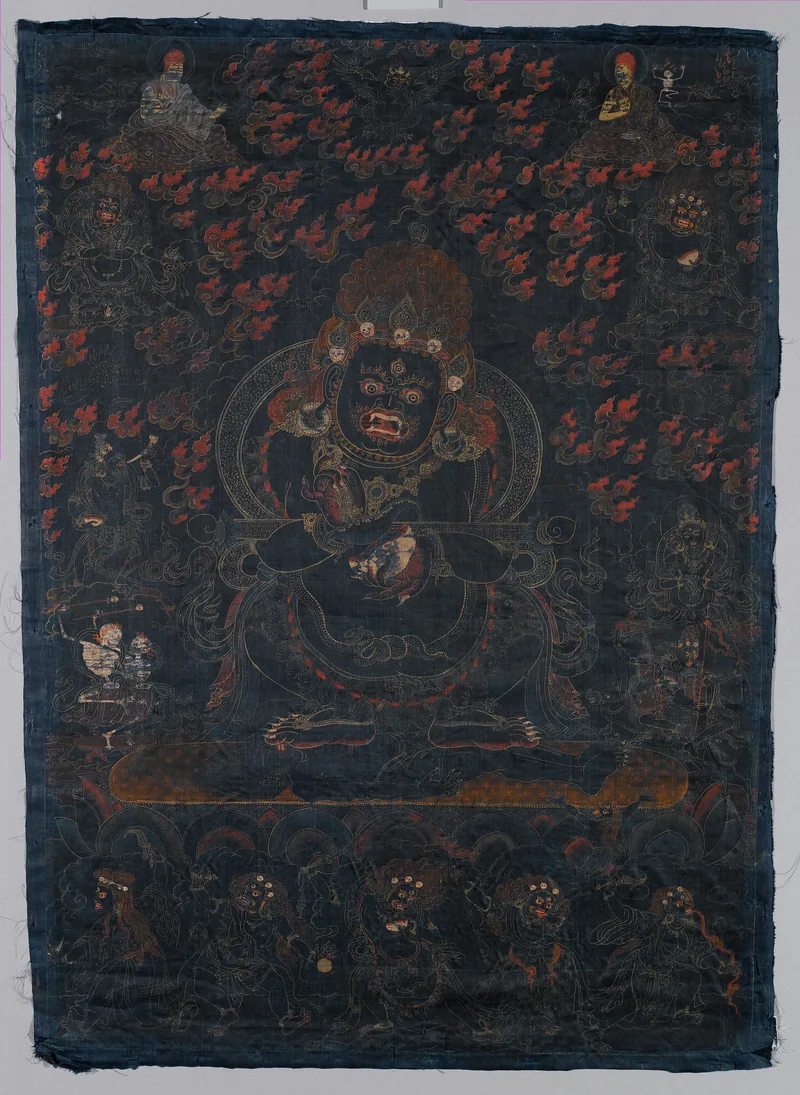
In this Tibetan painting of Mahakala, Protector of the Tent, dated around 1650, the cup belongs to a compact group of attributes around the central figure. Fine light contours make the hands and held objects legible against the dark ground. The cup is one part of a figure surrounded by flames, other beings and ritual imagery.
The comparison with Vajrayogini is useful. Both can hold a skull cup and a curved knife, but the shared objects do not make them the same deity. Number of arms, posture, surrounding figures and the overall arrangement remain important. The fuller Mahakala guide follows those differences across several protector forms.
Padmasambhava: the cup in a master’s hands
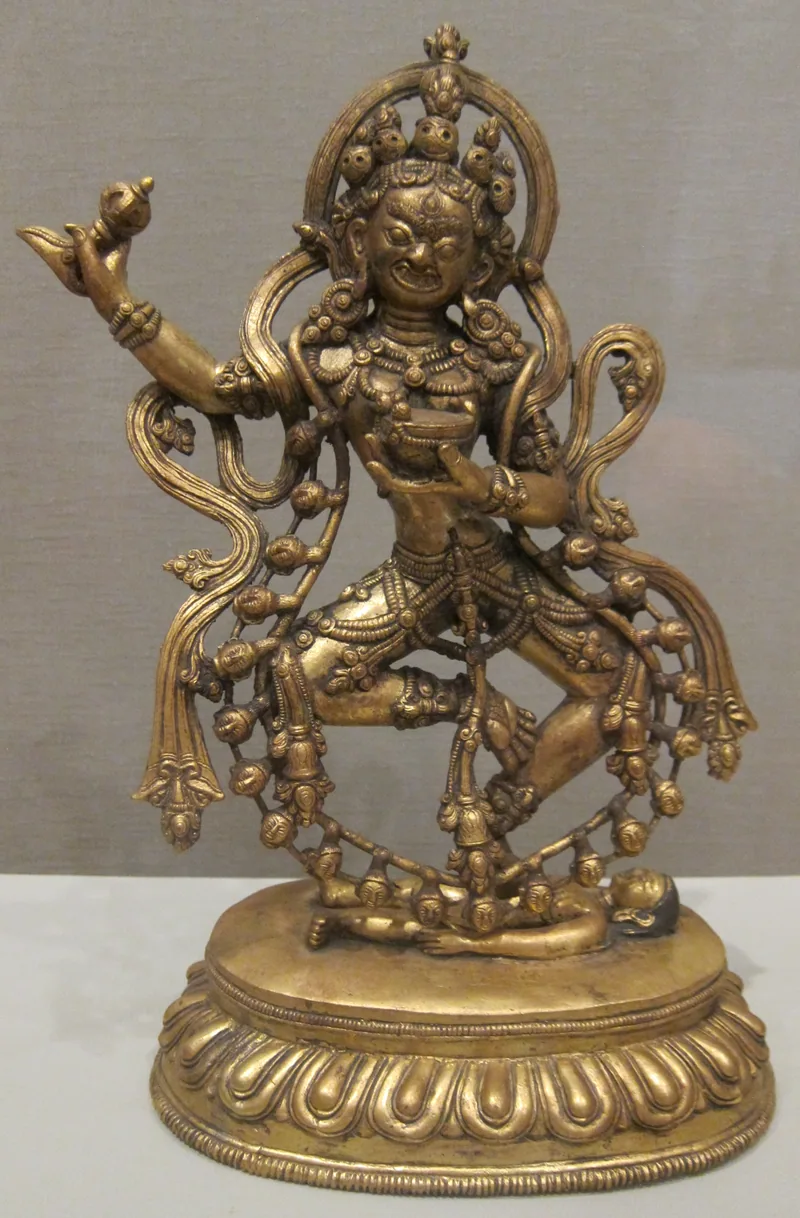
A skull cup is not confined to wrathful deities. This fourteenth-century portrait of Padmasambhava, from Western Tibet or Ladakh, presents an attentive seated master. The kapala rests low in his hands, while a vajra is held upright. The hat, robes and posture place these attributes in the portrait of a religious teacher.
The cup reads as detachment and the vajra as clarity of Buddhist thought. The sculpture dates centuries after the eighth-century master it represents. The figure’s life, the date of the object and the meaning of an attribute each tell a different part of the story.
Seen beside the protector painting, the sculpture makes a useful distinction visible: the same class of object can belong to a very different figure. The Padmasambhava article explores the master’s names and images in more detail.
A kapala is not every bowl in Buddhist art
Buddhas, monks and other figures also hold bowls. A begging bowl belongs to a different visual vocabulary from a skull cup, even when both are shown as a small rounded vessel. A smooth bowl in the lap of a seated Buddha should therefore be read together with the figure’s other attributes and setting. Colour or size alone is a weak clue.
The most revealing comparison is often a simple one: where is the vessel, how is it held, and what appears beside it? A covered museum ensemble shows the object’s fittings. Vajrayogini’s raised cup shows an action. Mahakala’s attributes place it within a protector image, while Padmasambhava’s portrait gives it another setting. Together, these examples turn a striking shape into a more precise reading of Buddhist art.
Questions and answers
Is a kapala always made from a human skull?
The name refers to the skull form, and historical examples include vessels made from part of a human cranium. Metal and resin versions also exist. The word alone does not establish the material of an individual object.
What is included in a kapala set?
A mounted ensemble can have the cup, a separate lid and a stand, as in the opening photograph. Arrangements vary. Bells, drums and phurbas are separate ritual implements rather than parts of the cup itself.
Why do Vajrayogini and Mahakala both hold a skull cup?
The object is shared across several tantric images. Its gesture, paired attributes and surrounding figure give it a particular context; a shared cup does not identify the two figures as the same deity.
What is the difference between a kapala and a begging bowl?
A kapala is a skull cup or a vessel representing that form. A begging bowl is associated with receiving food and with monastic imagery. In a painting, the figure, gesture and other attributes help distinguish them.
Does holding a kapala mean a figure is wrathful?
No. Padmasambhava can hold a kapala in a seated master’s portrait, as the Met sculpture illustrates. The cup is one attribute within a larger image.