Discover / Subjects & Meaning
Guru Rinpoche (Padmasambhava): Names, Images and Eight Forms
Who is Guru Rinpoche? Understand Padmasambhava’s names, place in Tibetan Buddhism and eight forms, then look closely at a bronze portrait and a fierce thangka.
In this story
Guru Rinpoche and Padmasambhava are names for the same revered Buddhist master. The first is a title meaning “Precious Guru”; the second is usually translated as “Lotus-Born.” Remembered for his role in eighth-century Tibet and especially important to the Nyingma tradition, he appears in art as a teacher, a king, a monk and a fierce figure. Recognising the name is the beginning. The form of the image tells us which part of that tradition we are seeing.
Padmasambhava, Guru Rinpoche and Pema Jungne
Padmasambhava is a Sanskrit name. Pema Jungne is a Tibetan rendering associated with the lotus-born master; English catalogues also use Padma Jungne and Padmakara. Guru Rinpoche is the honorific most familiar to many Tibetan Buddhist communities. Different labels can therefore refer to the same teacher rather than to several unrelated people.
Names become more specific within sets of images. Pema Jungne may identify a particular form among the eight manifestations; Tsokye Dorje, usually translated as “Lake-Born Vajra,” occurs in other naming arrangements. The relationship between these labels depends on the text and object. First match the general identity, then read the name in the context of the complete set.
A teacher in history, a master in sacred biography
Padmasambhava is traditionally associated with the establishment of Buddhism in Tibet during the reign of Trisong Detsen in the eighth century. Later accounts connect him with the Indian abbot Shantarakshita and the foundation of Samye. In those accounts, his tantric activity makes the landscape ready for Buddhist teaching. This is a religious explanation of his role, not a contemporary report of each event.
Surviving early references are limited. Fuller life stories developed over later centuries, including the Copper Island biography associated with the twelfth-century treasure revealer Nyangrel Nyima Wozer. Other biographies emphasise different episodes. The lotus birth, journeys, encounters and teachings belong to this rich history of remembrance.
The Nyingma tradition traces important teachings to Padmasambhava. Terma, or “treasures,” are teachings and objects understood within that tradition as having been concealed for later discovery. That continuing relationship helps explain why he is addressed as a present source of guidance, and why some communities call him the “second Buddha.” It is a devotional title, not a claim that he and Shakyamuni are the same historical person.
Look at the cap, hands and seated body
The fourteenth-century sculpture above, from western Tibet or Ladakh, is titled The Spiritual Master Padmasambhava. It is made of copper alloy with copper and silver inlay. The cap, the vajra held near the chest and the skull cup in the other hand bring his familiar teacher form into a compact, seated composition.
Its base records a royal patron, Kunga Gyalpo. That inscription anchors this particular object in a history of patronage. It does not date the master’s life to the fourteenth century: the sculpture was made centuries after the period with which he is traditionally associated.
In many paintings, a lotus-shaped hat, vajra, skull cup and khatvanga staff appear together. The staff may rest along the shoulder; a vase may be placed in the cup. Here, the overall identity remains clear without a complete painted array of those objects. Other Nyingma teachers can wear related hats, and several tantric figures share these implements. Their combination, the composition and the object record provide the stronger identification.
The eight forms: one documented arrangement
The “eight names of the guru” connect different appearances with activities in Padmasambhava’s sacred biography. They are not eight separate historical teachers. The arrangement below follows an art catalogue. It is useful for recognising broad appearances; other texts and collections can use different names or correspondences.
- Orgyan Dorje Chang — a peaceful deity form, also spelled Orgyen Dorje Chang.
- Shakya Sengge — a Buddha-like appearance that can resemble Shakyamuni.
- Nyima Oser — a siddha or accomplished yogin form; Nyima Ozer is another spelling.
- Pema Jungne — a monastic or scholarly appearance in this grouping.
- Loden Chogse — a royal-looking form; often written Loden Chokse.
- Pema Gyalpo — the Lotus King, with royal appearance.
- Sengge Dradog — a fierce form, also spelled Sengge Dradrok.
- Dorje Drolo — another distinct fierce form, often recognised through its posture, mount and implements.
A set of figures is not always a timeline
In some eight-form paintings, Buddha-like and monastic figures occupy the upper part, royal figures the middle, and fierce figures the lower part. That is a hierarchy of appearances within a Buddhist composition. It is not necessarily a left-to-right or top-to-bottom account of the master’s life. Narrative paintings can arrange episodes differently.
A carved group gives the central master the names Padmasambhava, Pema Jungne and Tsokye Dorje, while surrounding forms use other labels. That example explains why adding every name found online can produce a misleading ninth or tenth “manifestation.” Follow the catalogue for the individual work rather than combining several lists into one supposedly universal system.
A fierce thangka with the master above it
This eighteenth-century Tibetan painting is titled Guru Dragpo, Padmasambhava’s Fierce Emanation. Its large central figure raises a vajra, holds a blue scorpion, wears a skull crown and stands within flames. Padmasambhava himself appears in the upper row at the right, wearing a yellow hat. Looking at both positions makes the relationship clearer than reading the central face alone.
Guru Dragpo belongs to a particular Nyingma meditational and treasure tradition. It is not simply another spelling of Dorje Drolo, nor should it automatically be added to the eight-name arrangement above. A general connection with Padmasambhava does not make all of his fierce forms the same subject.
The contrast with the bronze is striking: a seated teacher becomes a large, active figure with very different attributes. Yet both records point to the same wider religious world. The painting’s smaller figures, its border and the space around the flames remain important; cropping to the central body would remove part of the explanation.
Prayer, mantra and a painting’s place
The Vajra Guru mantra and Seven-Line Prayer are closely associated with devotion to Guru Rinpoche. A commonly printed Sanskrit-based mantra is “Om Ah Hum Vajra Guru Padma Siddhi Hum”; Tibetan phonetic spellings may differ. A thangka can be part of that devotional setting, supplying a remembered form alongside words and teaching.
Accounts of blessings and the clearing of obstacles belong to the traditions that teach them. They are not guarantees attached to buying a painting. Formal practice follows the relevant teacher and lineage; looking at art can begin with the visible form, its name and the work’s documented history.
Return to the particular thangka
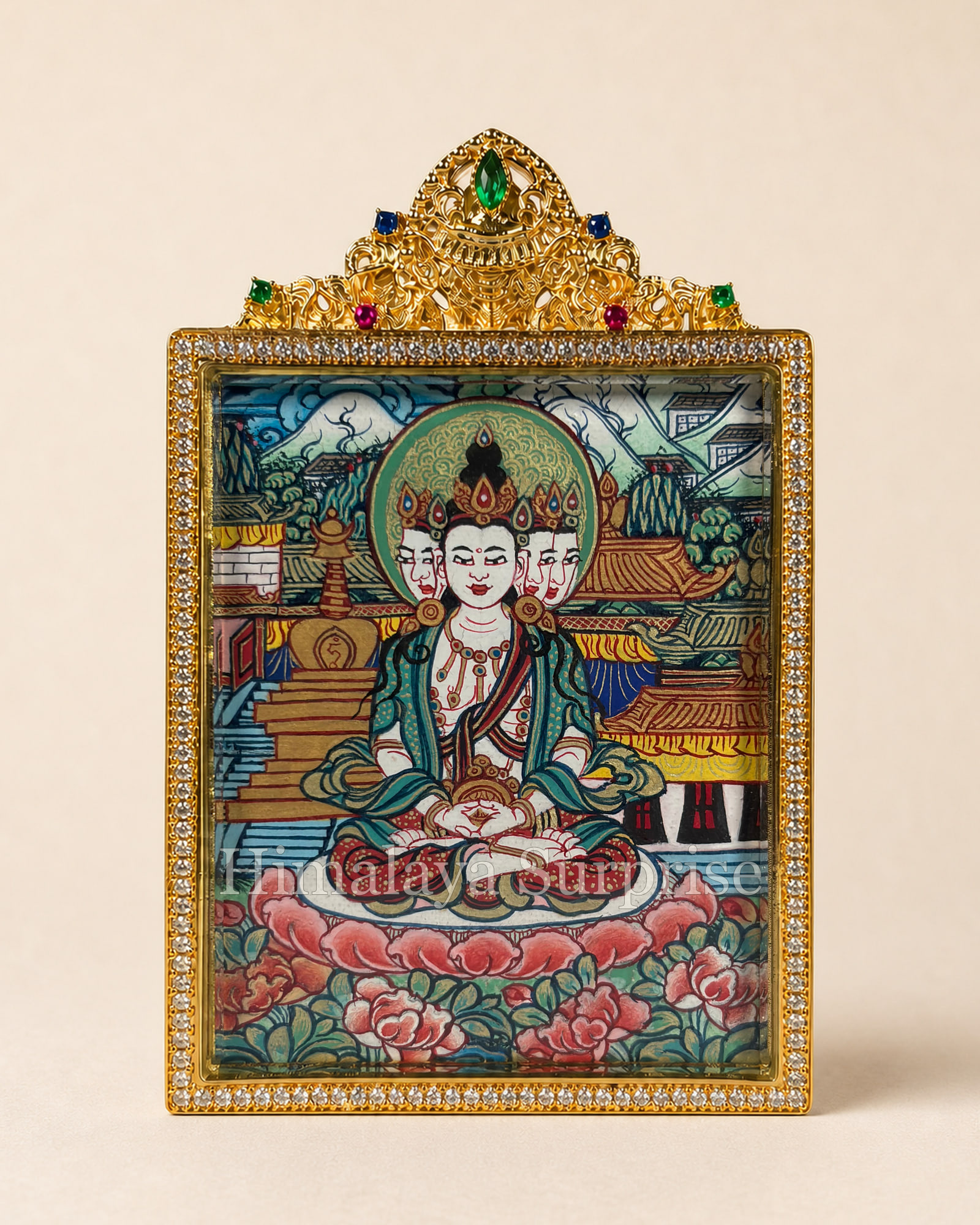
After establishing the subject, notice how the painter has made it legible. Does the cap retain its shape at the work’s actual size? Can you distinguish the hand from the vajra, and the edge of the cup from the robe? How do the smaller figures lead the eye through the surrounding space? In a miniature thangka, these relationships can be especially demanding.
A full image, close views, painted dimensions and a clear maker or provenance record answer different questions. Together they help you assess a work without letting a familiar title do all the explaining. The general name tells you where to begin; the individual painting rewards the closer look.
Questions and answers
Is Guru Rinpoche the same person as Shakyamuni Buddha?
No. Guru Rinpoche refers to Padmasambhava, traditionally associated with eighth-century Tibet. Shakyamuni is the historical Buddha. The honorific “second Buddha” expresses Padmasambhava’s religious importance within particular traditions, rather than an identical historical biography.
Does every Rinpoche refer to Padmasambhava?
Rinpoche, meaning “precious,” is a title used for many respected teachers. “Guru Rinpoche” conventionally refers to Padmasambhava in this context. The title alone should not be used to identify every portrait of a Tibetan teacher.
Does a lotus hat prove that a figure is Padmasambhava?
It is a helpful clue, especially beside a vajra, skull cup and khatvanga. Other teachers may wear related hats, however. Compare the complete figure, attendants, title and inscription before deciding on a specific identity or manifestation.