Discover / Subjects & Meaning
The Lotus Flower in Buddhism: Meaning and Clues in Thangka Art
Understand the lotus as a Buddhist symbol, then distinguish a flower held in the hand, a lotus throne, an offering and a blossom supporting a book.
In this story
In Buddhist art, the lotus is associated with purity and awakening: a flower rises above the muddy water in which it grows. Yet its role in an image depends on where it appears. A blossom held beside a shoulder, a throne under a figure and a flower supporting a book are doing different things. Reading that placement turns a familiar symbol into a useful way of looking at a thangka.
Why a flower growing in mud became a sacred image
The contrast between the plant’s growing environment and its open flower makes the symbol memorable. Buddhist explanations connect it with the possibility of awakening within the conditions of ordinary life. The image is not a promise that difficulty disappears. It expresses a relationship between the world one inhabits and the clarity one seeks.
The image has different emphases in different teachings. In the Nichiren Buddhist explanation published by Buddhability, the flower and seed-pod express the simultaneity of cause and effect. That is a particular doctrinal reading, rather than a claim that every lotus in a Tibetan painting teaches the same lesson. Lotus imagery is also important in Hindu art, so a flower by itself does not establish an object’s religious identity.
Lotus flowers can also be offered at shrines and celebrations. A flower in an offering arrangement, however, is not automatically the identifying attribute of the nearby figure. Before interpreting the symbol, notice whether it is being held, presented, sat upon or repeated as decoration.
Follow the stem before assigning a meaning
Begin at the hand. A stem held between the fingers connects a blossom to a particular figure; petals beneath the body create a seat. A flower standing among bowls or other offerings has another role. These relationships are visible even when the image is too small to name every detail.
Then look above the blossom. It may support a book or another implement. The object on the flower can be more informative than the flower’s colour. When several stems overlap, follow one whose outline remains clear instead of guessing from an isolated patch of pink or blue.
A single painting can combine these uses. A bodhisattva may hold a flowering stem, sit on a lotus throne and receive a floral offering. Repeated petals along a border can also form part of the design. Reading each flower in its place is more useful than giving the whole image one symbolic label.
Two Taras, two lotus seats
The painting at the top of this article brings the distinction into focus. White Tara and Green Tara, made in Guge in western Tibet around 1450–1500, shows two lotus thrones rising from pools within a mountainous setting. White Tara sits with her legs folded; Green Tara lets one leg hang down. The two figures have lowered, boon-giving hands.
Look below the cushions. The large petals establish a place for each body, while stems continue toward the water. The seat is doing more than filling the lower edge of the figure: it connects the sacred body to the surrounding landscape. The two figures share a floral setting without becoming interchangeable.
A lotus pedestal is the support beneath a figure; the lotus position describes an arrangement of the legs. This painting makes that distinction easy to see. For their other identifying features, continue to our Green Tara and White Tara comparison.
The book on Manjushri’s flower
In this Chinese Ming-dynasty painting, dated around 1500–1550, the white figure sits within an elaborate throne. A flower by his left shoulder supports a book. The book-and-lotus combination is a clue to Manjushri, the bodhisattva of wisdom. His teaching hands offer another point of comparison.
Notice how the flower gives the book a place beside the body rather than forcing it into a hand. The attribute remains visible within an ornamental setting of green, red and gold. This is a Chinese silk hanging scroll, not a Tibetan thangka, but it makes the relationship between flower and text especially clear.
Other figures also hold flowers. In a familiar four-armed Avalokiteshvara form, an outer hand holds a lotus while another holds prayer beads, and the middle pair meets at the heart. Compare the whole combination. A flower alone cannot distinguish every Tara, Avalokiteshvara or Manjushri form; posture, hands and the work’s record remain part of the reading.
Colour is a clue, not a universal dictionary
Popular introductions often connect white flowers with purity, red with compassion and blue with wisdom. Such associations can be helpful within a stated tradition, but they are not a universal identification key. Colour may also work with the figure’s palette and the painting’s overall design. Begin with the flower’s role and its surrounding attributes before assigning a fixed message to its colour.
Names need similar care. Art descriptions may distinguish padma, commonly translated as lotus, from utpala, also rendered as a lily or blue lotus. Painted examples do not always follow the colour a beginner expects: a documented nineteenth-century Manjushri painting has a pink utpala supporting the wisdom text. Use the named form and the actual image together, rather than turning a translated flower name into a botanical test.
Buds and open flowers can also be used as metaphors for progress toward awakening. They are not a universal scale for judging the spiritual attainment of a painted figure. A bud may belong to a named attribute or balance an open blossom in the composition. Read the documented form before turning its stage of growth into a diagnosis.
A symbol can enter stories, texts and decorative art
Padmasambhava’s name means Lotus-Born, and sacred accounts of his appearance connect him with a lotus. That narrative is different from a figure merely sitting on a floral throne. Lotus imagery also appears in accounts of the Buddha’s early life and in the title of the Lotus Sutra. These uses share a visual vocabulary while belonging to different stories and teachings.
A Japanese Lotus Sutra handscroll preserved by Kyoto National Museum places a small lotus pedestal beneath each written character. The characters are treated like sacred figures on seats, expressing reverence for the scripture. The flower can therefore give meaning to writing as well as to a body. This is a particular decorated manuscript, not a rule for all copies of the Lotus Sutra.
A closer way to look at lotus details in a thangka
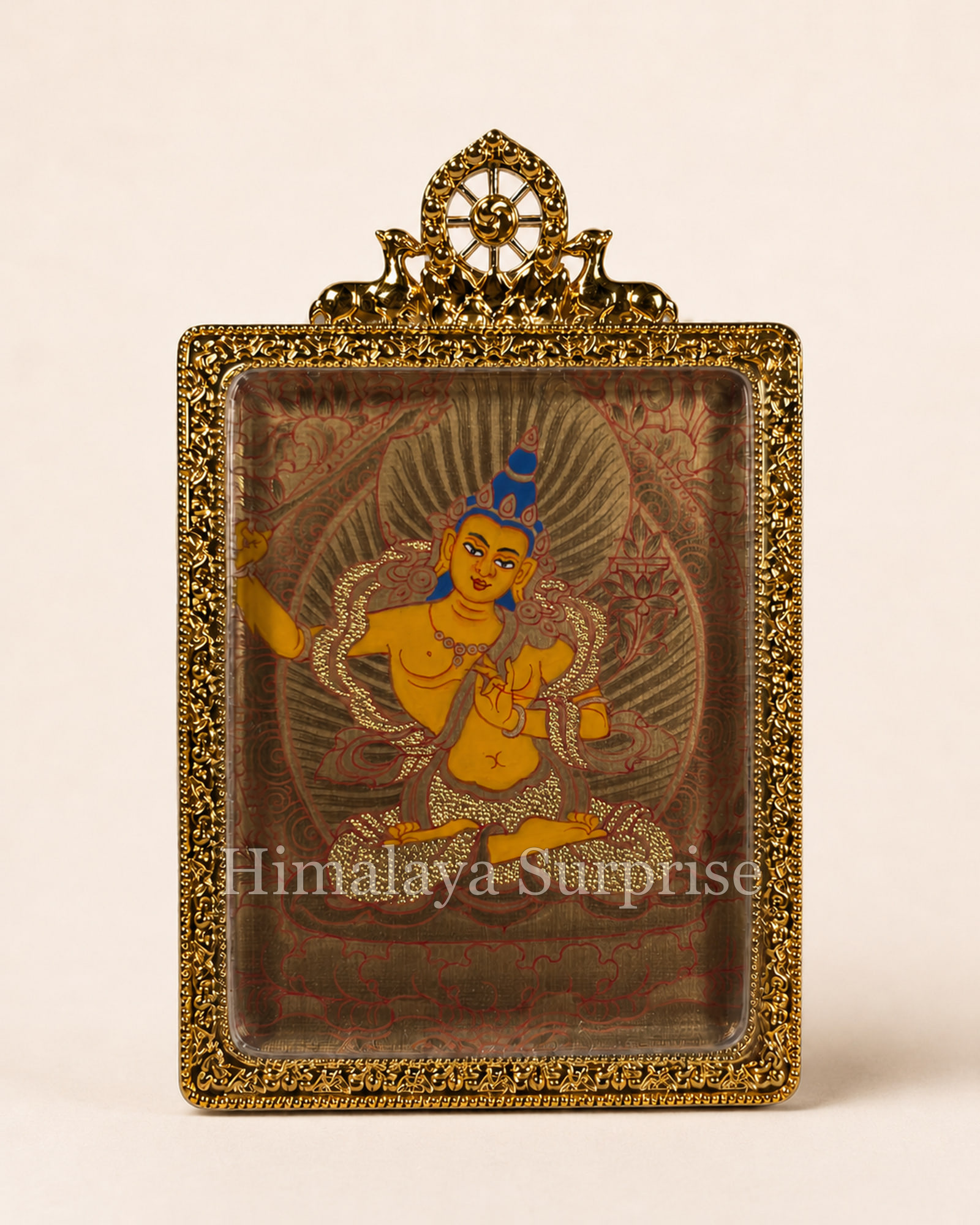
Choose one flower and follow it from stem to blossom, then return to the whole composition. Compare the spacing of the petals, the continuity of the contour and how the flower meets a hand, a book or the edge of a seat. In a small work these relationships may be compressed into very few strokes; a clear detail photograph helps you see how they remain legible.
To explore the figures further, begin with four-armed Avalokiteshvara, Manjushri or the Green Tara and White Tara comparison. The flower becomes more interesting when it leads back to a complete image, instead of remaining an isolated emblem.
Questions and answers
What does the lotus symbolize in Buddhism?
Purity and awakening are central associations, often explained through a flower rising above muddy water. Its particular role depends on the figure, text or ritual setting.
Does holding a lotus identify Avalokiteshvara?
Not by itself. Compare the hands, other attributes, posture and documented form; several different figures hold flowers.
Are padma and utpala always the same flower?
Art records can distinguish them. Translation and stylization vary, so use the specific iconographic description rather than colour alone.
Is a lotus throne the same as the lotus position?
A throne or pedestal is the support beneath a figure. Lotus position refers to the arrangement of the legs. Both may appear in one image.