Discover / Subjects & Meaning
Chenrezig: compassion and the four-armed Avalokiteshvara
Who is Chenrezig? Understand Avalokiteshvara, his four arms and Om Mani Padme Hum, then look closely at historical paintings and a bronze with a missing rosary.
In this story
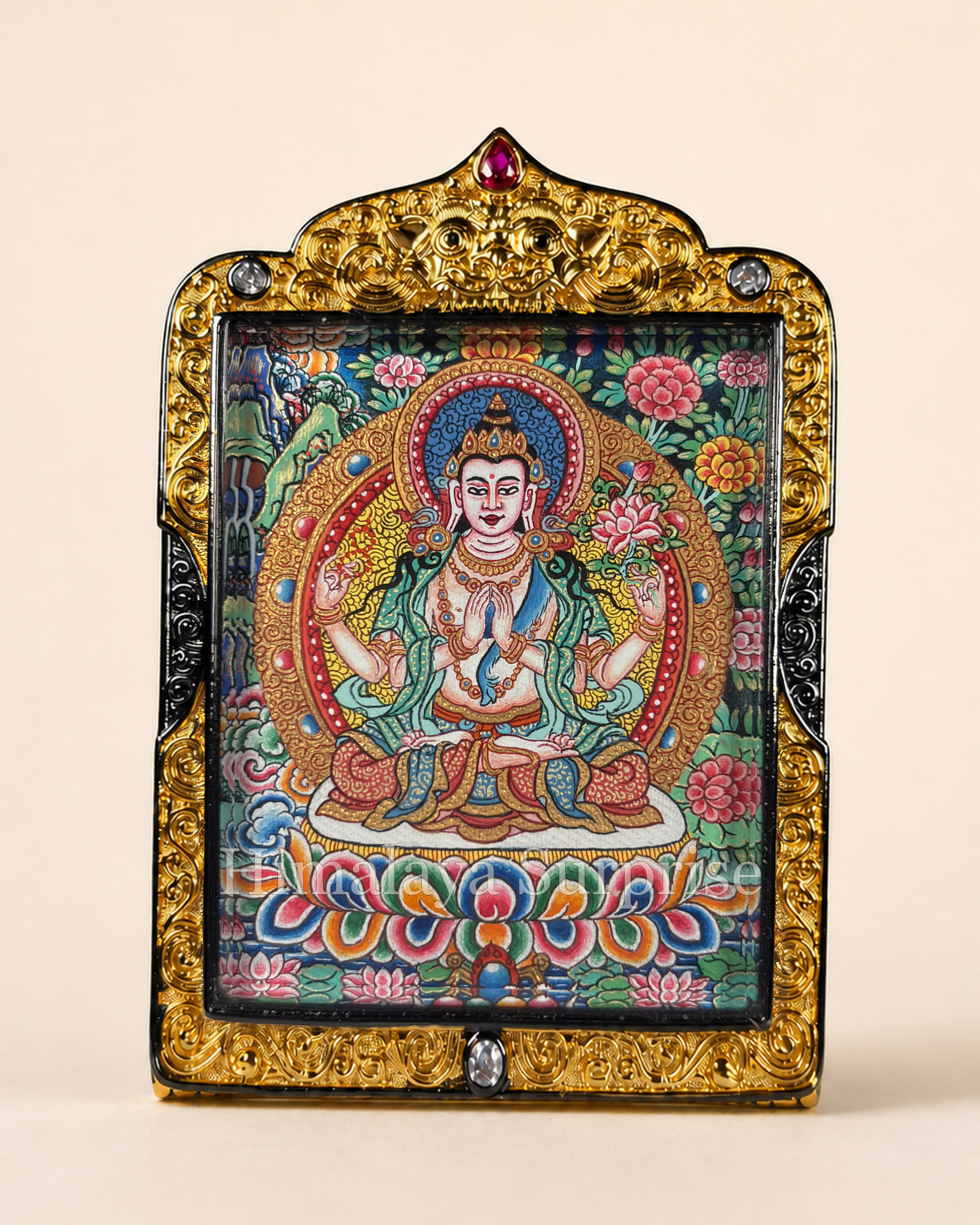
Chenrezig is the Tibetan name for Avalokiteshvara, the bodhisattva of compassion. In his familiar four-armed form, two hands meet at the heart while the other two hold a rosary and a lotus. That clear outline makes a useful beginning. Historical works add a richer story: attendants gather around him, gold changes the appearance of his body, and a surviving bronze can leave one hand empty.
Who is Chenrezig?
Chenrezig, also written Chenresig, is Avalokiteshvara in Tibetan Buddhist usage. Guanyin in China and Kannon in Japan are names associated with this same bodhisattva across different traditions. The shared identity does not make every image look alike: a crowned four-armed figure and a flowing-robed Guanyin belong to different histories of representation.
Compassion is the central idea. In the introduction to a 2006 Nyungne retreat, Khenchen Palden Sherab Rinpoche and Khenpo Tsewang Dongyal Rinpoche explain Chenrezig as awakened compassion appearing in bodhisattva form. This helps with a common question: why does one text say “bodhisattva” while another says “Buddha of Compassion”? The titles follow the teaching’s perspective, rather than necessarily naming two different beings.
Why four arms?
The additional arms give compassion a visible reach beyond the limits of an ordinary human body. Lama Döndrup Drölma’s explanation in Lion’s Roar links the four arms to loving-kindness, compassion, sympathetic joy and equanimity, the four immeasurables. This is a teaching about the image’s meaning, rather than four separate characters in a scene.
The familiar name Shadakshari, sometimes written Sadaksari, points to six syllables. It refers to the associated mantra, not the number of arms. Keeping these two counts separate removes an easy source of confusion: a four-armed image can be called Six-Syllable Avalokiteshvara.
Read the hands from the figure’s side
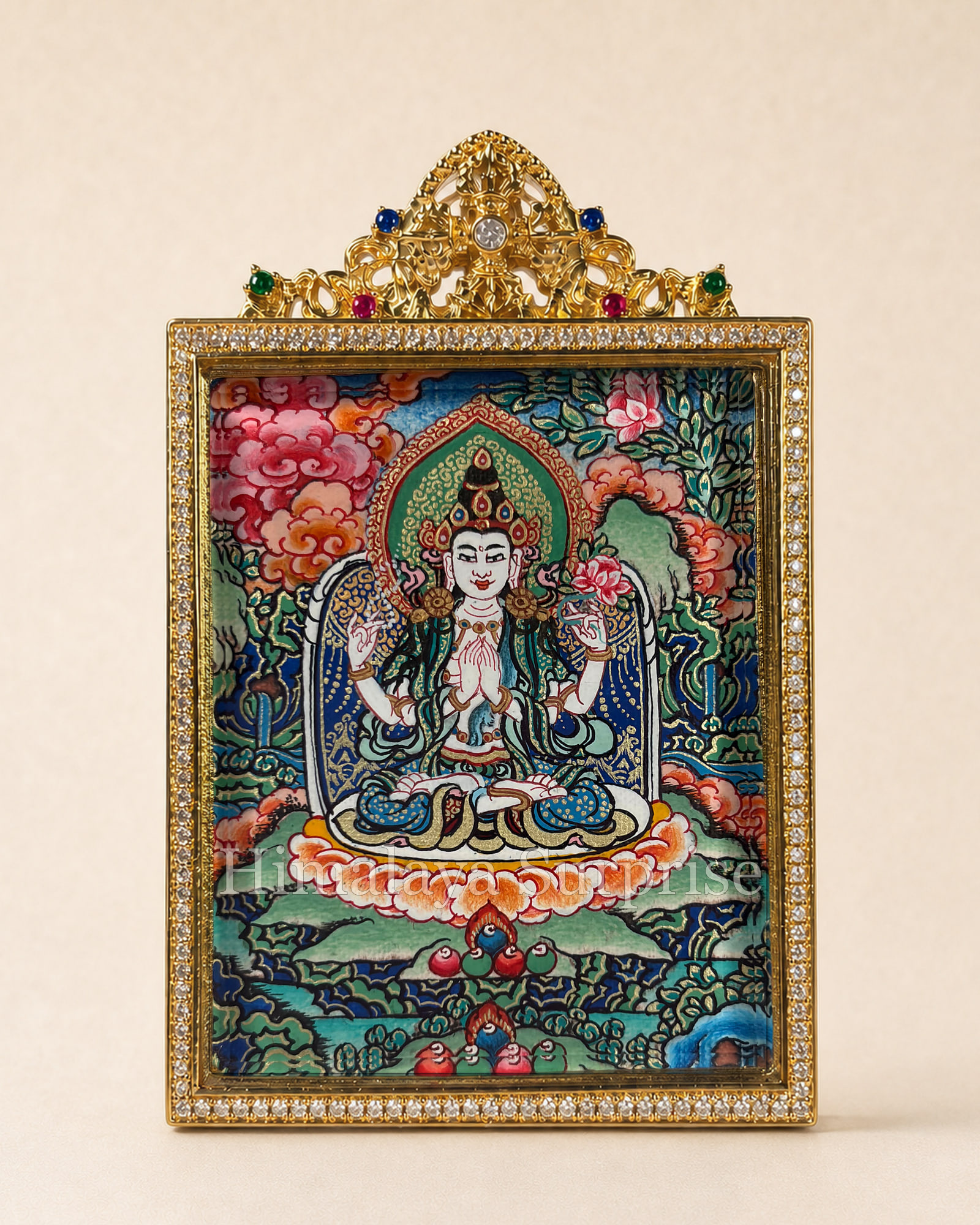
Begin with the pair joined in front of the chest. Then follow the remaining arms: the figure’s right hand, on your left, holds the mala or rosary; the figure’s left hand, on your right, holds a lotus. This arrangement appears in a description by Bari Lotsawa. Saying whose left and right we mean is more useful than an unqualified list of “left-hand” and “right-hand” symbols.
A wish-fulfilling jewel is often described between the joined hands. In a small photograph it may be covered by the fingers or too slight to distinguish. Look at what the actual image shows before adding a precise object to your description. The same applies to a tiny seated Buddha in the crown: a close view and the work’s record can clarify a detail that disappears at thumbnail size.
The figures beside the central bodhisattva
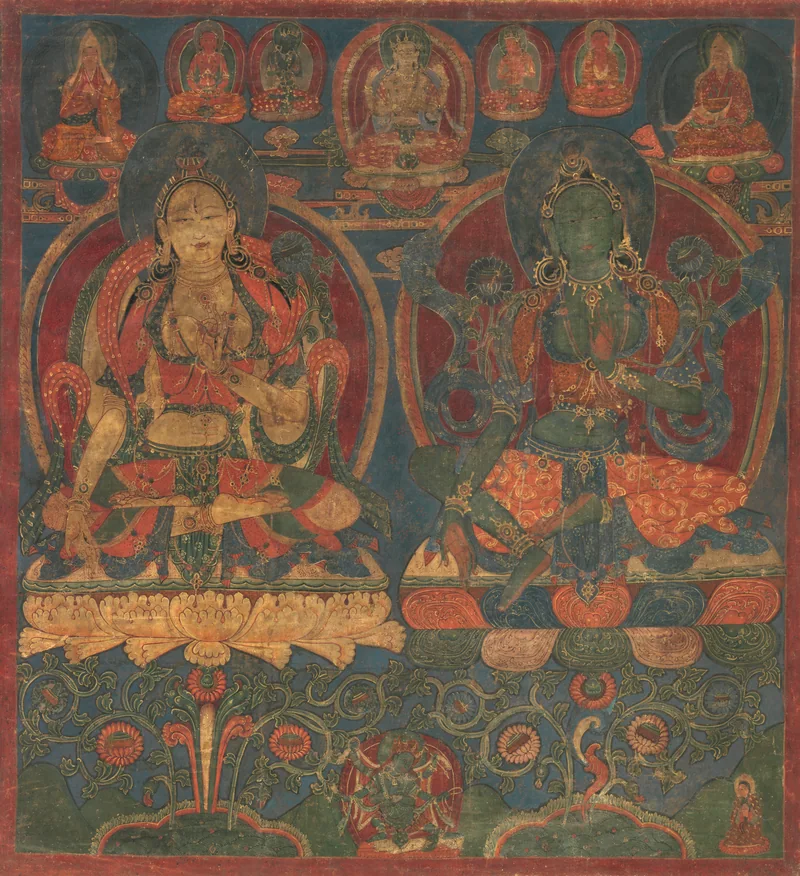
The painting above, from the Walters Art Museum and dating to the late twelfth or thirteenth century, places white, four-armed Avalokiteshvara between two attendants. The yellow figure on the viewer’s left is Manidhara and the white figure on the right is Shadakshari. Their gestures and colours reward looking beyond the largest face.
A three-figure composition needs its own identification. It is not automatically the Western Triad of Amitabha, Guanyin and Mahasthamaprapta. Another early painting has differently coloured attendants; there are also versions with different arm counts. These variations make the title and complete composition valuable companions to a close photograph. Our Amitabha and Western Triad guide follows that separate subject.
An empty hand with a history
This Tibetan bronze offers a useful test of the familiar outline. Its front hands join at the heart and a lotus survives at the back, but the Walters record states that the rosary is missing. The head of Amitabha emerges from the piled hair, a variation on his usual small representation in the crown.
An empty hand can therefore tell us about the object’s survival, rather than a new form of the deity. Before deciding that a work contradicts an iconographic description, examine condition, attachments and the object’s documentation or the seller’s account. With an old sculpture, a lost attribute is a question about the individual object. With a new painting, an unclear hand may simply need a better photograph.
When the body is painted in gold
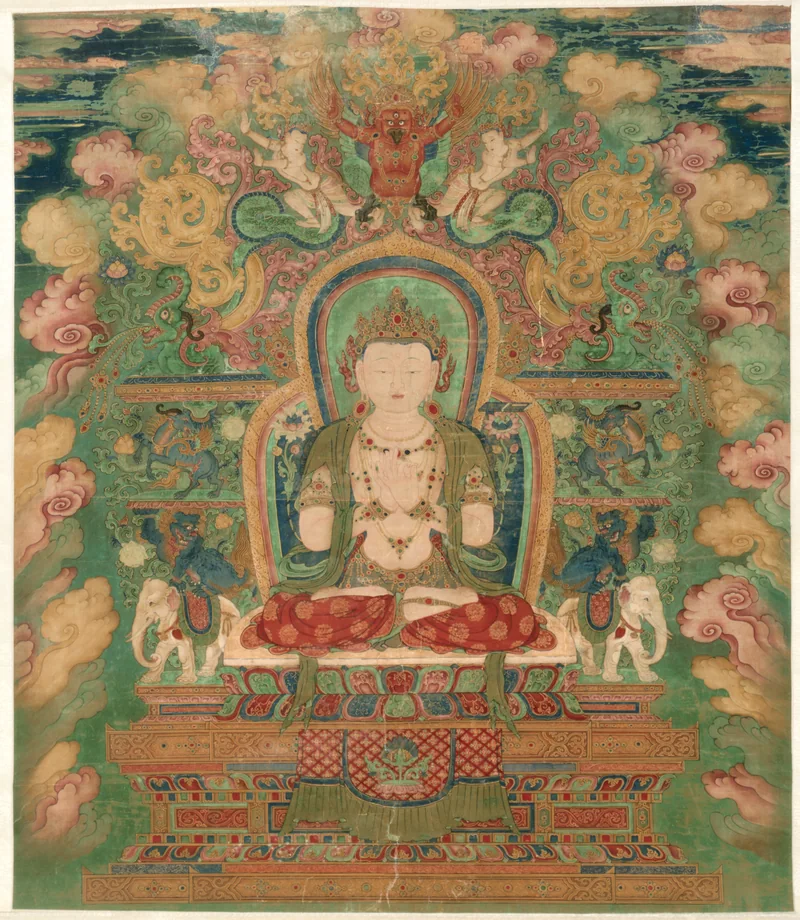
White is familiar in descriptions of four-armed Chenrezig, yet colour alone cannot identify every work. In this late-fifteenth-century Tibetan painting at The Met, the body and ground are rendered in gold. The surrounding figures give the central bodhisattva a fuller setting than a single isolated silhouette.
Follow the joined hands and the raised attributes before comparing the colour. Then step back to see the surrounding assembly. This order of looking preserves the relationship between a recognisable form and an artist’s treatment of the whole surface. “Gold” may describe pigment, metal leaf, a painted ground or the effect of a photograph; a product’s material specification should explain which is meant.
Om Mani Padme Hum and the six syllables
Om Mani Padme Hum is closely associated with Avalokiteshvara. Tibetan pronunciation is often written Om Mani Peme Hung. In the explanation accompanying The Met’s painting, mani is connected with compassion and method, padme with wisdom, and hum with their inseparability. That is an interpretation of the practice; a short English slogan cannot contain the entire meaning of the mantra.
Hrih can appear as an additional seed syllable in a practice text. Its presence does not change the familiar six-syllable name. FPMT’s resource library distinguishes the short mantra from longer dharanis and provides different texts and recordings. If your interest is pronunciation or a complete practice, a resource belonging to the relevant teaching tradition is a clearer next step than a decorative transcription in a shop description.
Four arms, a thousand arms and the same compassionate subject
Chenrezig is represented in more than one form. The thousand-armed form often has eleven heads and eyes in the hands; it needs to be read as its own composition. Lama Zopa Rinpoche’s Nyung Nä commentary gives a religious narrative of Avalokiteshvara’s vow and Amitabha restoring his broken form. It explains the expanded body through compassionate resolve, not as an ordinary historical event.
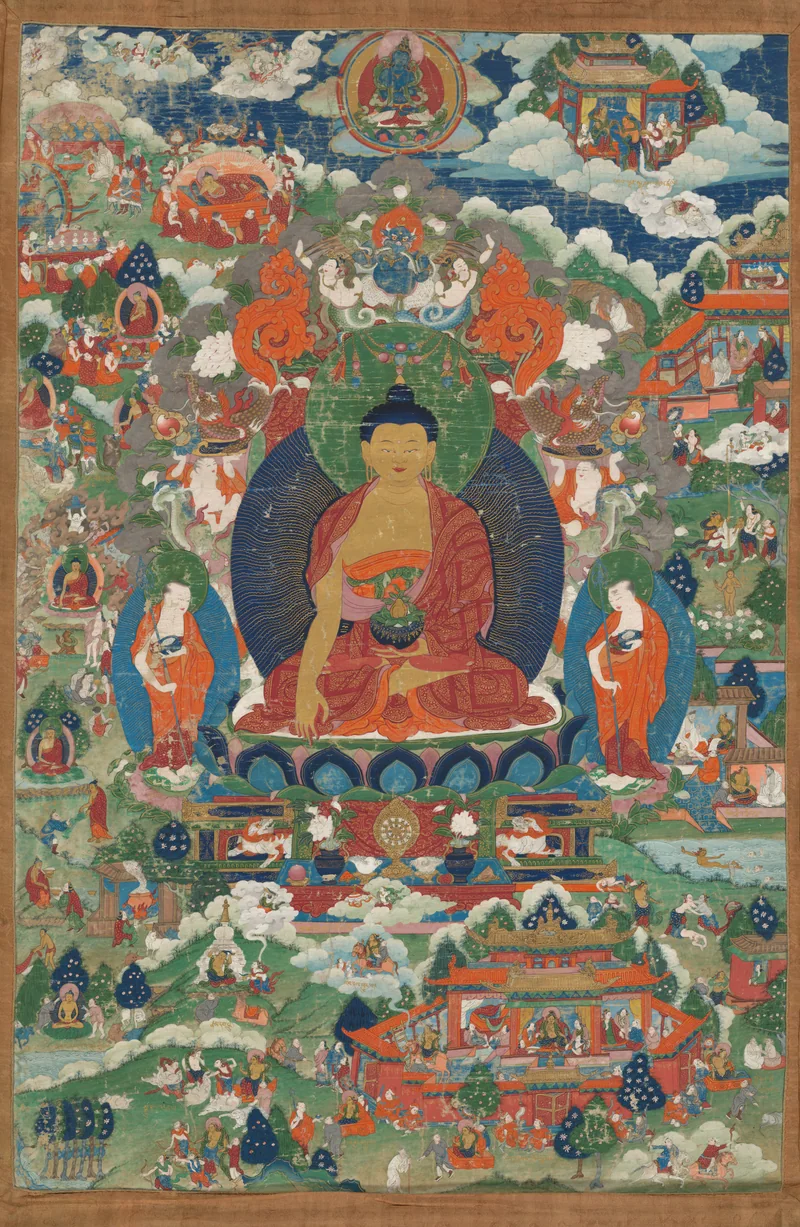
A painting’s use also depends on its context. In a Tibetan home shrine, sacred images such as four-armed Avalokiteshvara can stand alongside texts and stupas. Elsewhere the same subject is approached through art history, daily devotion or a particular retreat. A photograph can introduce the subject, while a formal visualisation or ritual follows the instructions of its own tradition.
Choosing a four-armed Chenrezig thangka
Ask first for the complete painted area and a close photograph of the hands. In a miniature, the joined fingers, loop of beads and lotus stem should remain understandable at the actual painted size. Larger compositions may add teachers, attendants or a wider sacred assembly. Decide whether you want the clarity of a single figure or the experience of exploring a more crowded painting.
Compare those photographs with the artist’s name, dimensions, materials and condition. A small artwork is not less demanding because it contains fewer centimetres: a convincing line at the heart or shoulder can require close control. Our online thangka buying guide develops the practical checks. The selection below leads to actual shop works, whose own photographs and details should determine a purchase.
Questions and answers
Is Chenrezig the same as Guanyin?
Both names refer to Avalokiteshvara in their respective traditions. The shared identity includes different visual forms; a Chinese Guanyin painting need not have the four arms of this Tibetan form.
Why is a four-armed figure called Six-Syllable Avalokiteshvara?
Six-Syllable refers to Om Mani Padme Hum. Four counts the arms, while six counts the syllables of the associated mantra.
Is the Dalai Lama associated with Chenrezig?
Tibetan Buddhist tradition regards the Dalai Lamas as manifestations of Avalokiteshvara. That is a religious understanding, and it does not mean every portrait of a lama represents the four-armed form shown here.