Discover / Subjects & Meaning
Green Tara vs White Tara: Posture, Seven Eyes and Meaning
Compare Green Tara and White Tara through body colour, the extended leg, seven eyes, hands and lotus. Three historical paintings make their shared features and differences visible.
In this story
One seems ready to rise; the other sits with both legs folded. Green Tara and White Tara belong to the wider Tara tradition, sharing a compassionate subject while giving it different visual expression.
Green Tara: a seated figure ready to move
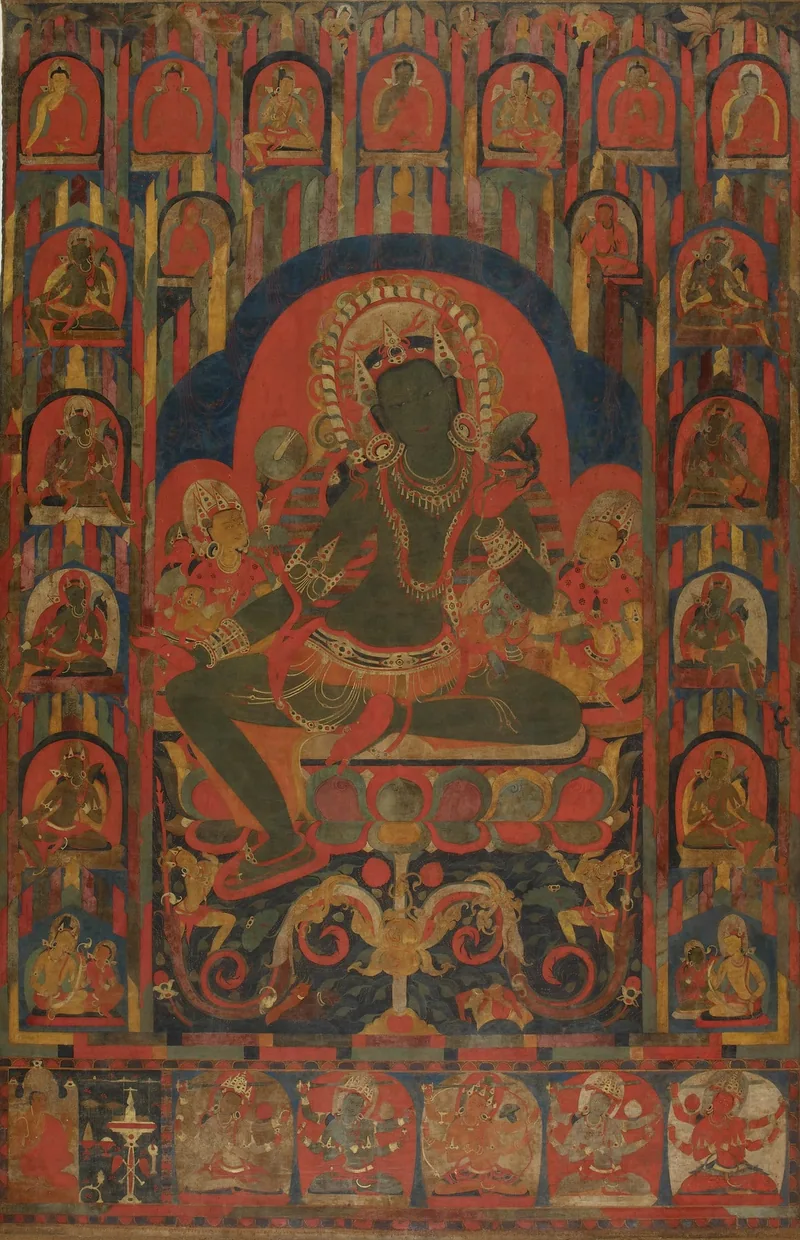
In the common Green Tara image, the left leg folds onto the seat while the right leg extends down towards a smaller lotus. The upper body remains composed. One part of the figure rests; another seems ready to move. This combination resonates with the traditional association of Green Tara with swift assistance and the overcoming of fears and obstacles.
Her right hand commonly opens in a giving gesture, while the left holds a flower stem near the chest. Follow the stem to the blossom beside the shoulder, then notice the curve of the torso and the drapery around the pendant leg. Descriptions use the figure’s own left and right: in a front-facing image, they lie opposite the viewer’s sides.
The early painting illustrated here, from the 1160s–1180s, gives Green Tara a strong central presence. Smaller emanations at the sides depict rescue from the eight great fears, turning a single seated figure into a wider narrative of compassionate activity. The separate Green Tara guide follows those surrounding stories in more detail.
White Tara: seven eyes and a settled posture
White Tara commonly sits with both legs folded in the vajra posture. Where Green Tara’s pendant foot leads the eye outwards, White Tara’s folded legs gather the figure into a compact, balanced seat. Flowers, scarves and jewellery can still move around her, but the body establishes a quieter rhythm.
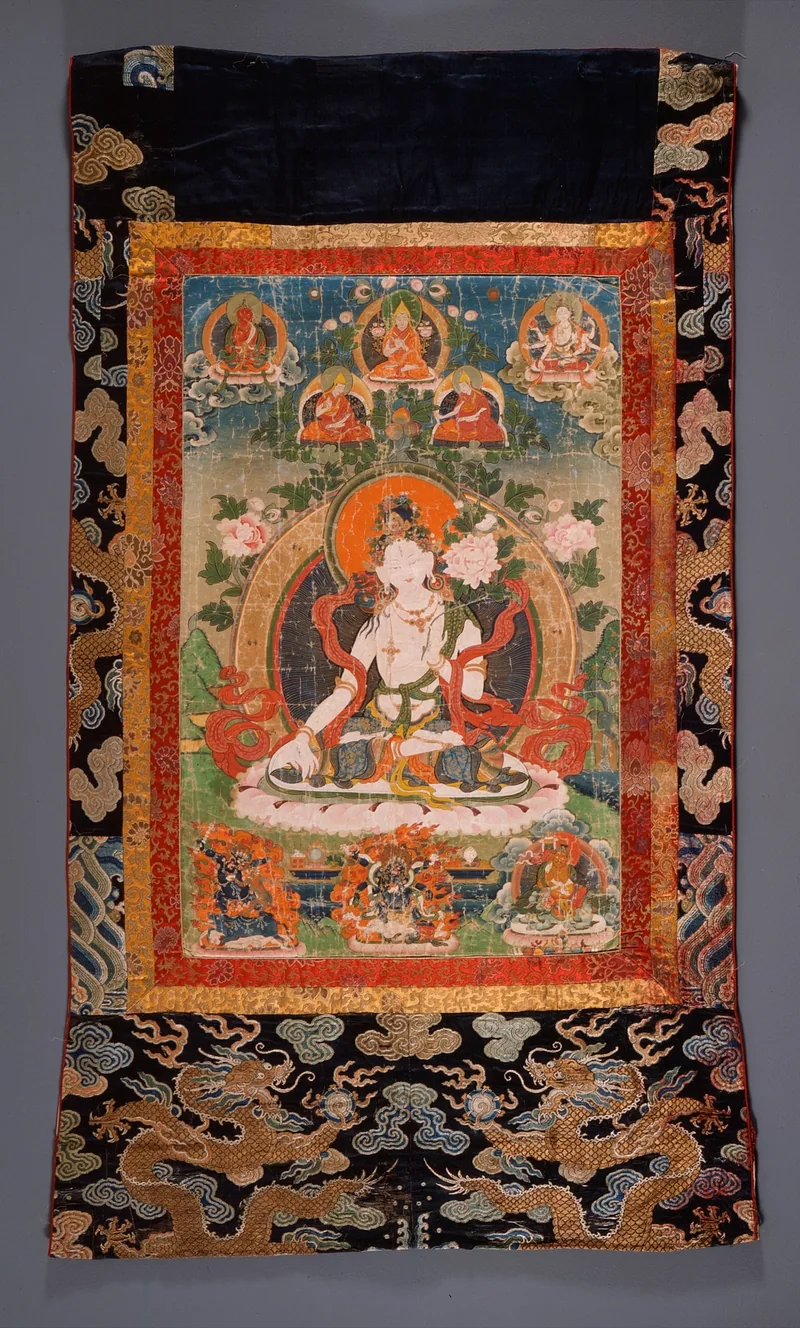
Seven eyes are her clearest familiar feature: the usual pair on the face, one on the forehead, one on each palm and one on each sole. They express attentive compassion extending beyond ordinary sight. In a detailed painting, the palm and sole eyes occupy very little space. Enlarging those areas connects the serene face with the fine marks distributed across the body.
The nineteenth-century White Tara shown here retains a broad silk surround. Teachers and other deities occupy smaller positions above and below the main figure. The full hanging work gives the folded posture a different setting from the earlier Green Tara panel: fabric, border and surrounding figures all participate in the image. The White Tara guide explores her long-life context and related figures.
Two Taras in one landscape
The paired painting at the opening of this article brings the comparison into one scene. White Tara sits on the left of the image and Green Tara on the right. White Tara’s folded legs form a contained silhouette; Green Tara’s pendant leg opens the outline below the seat. Their separate lotus thrones rise from pools, while a mountain landscape links the two figures.
Look from the feet to the hands, then up to the faces. Both have an open lower hand, flower stems and elaborate adornment. Those similarities make the differences in posture especially clear. Colour introduces the pairing, but the movement of the body tells more. Gold and the appearance of an aged surface can make a complexion warmer than the name “White Tara” might suggest.
How different works change the comparison
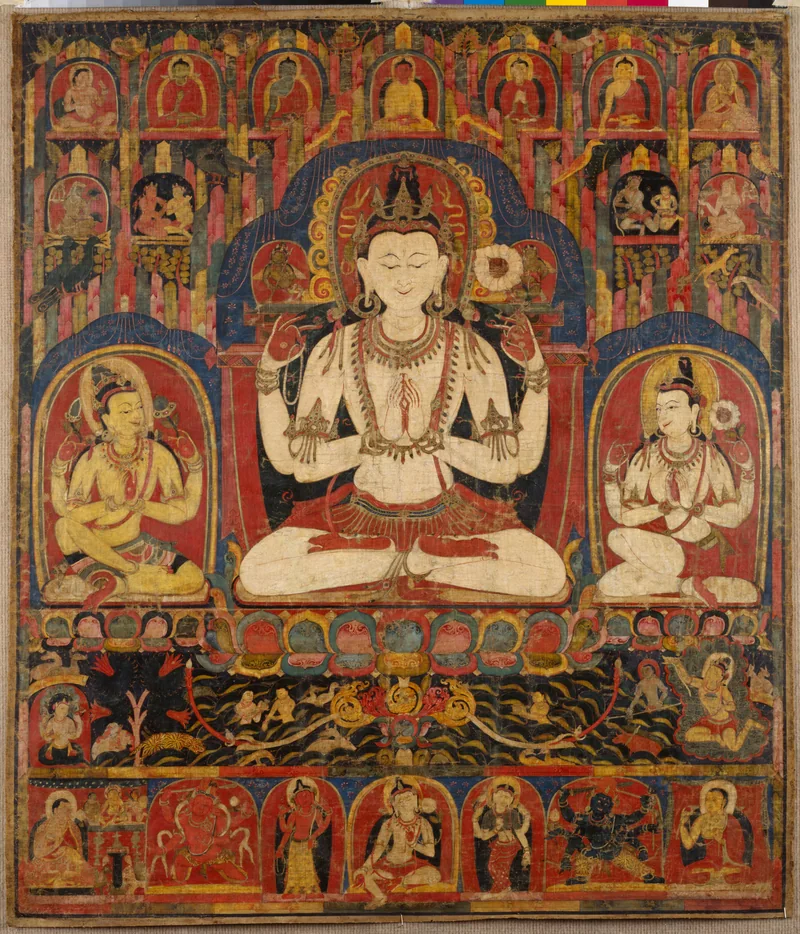
The three paintings span different centuries and settings. One concentrates a seated Green Tara inside a dense red-and-gold composition; another presents two Taras together in a landscape; the later White Tara is surrounded by figures and textiles. A background, frame or border can therefore change the impression of stillness or movement even when the central posture remains familiar.
Photographs introduce further differences. A close crop may remove the pendant foot, palm eyes or surrounding teachers. A small image can merge a fine eye with a nearby line, and a horizontally flipped photograph reverses the visible sides. These are reasons to enjoy a detail alongside the complete work: each view reveals something the other cannot.
What their traditional associations mean
Green Tara is closely associated with active, swift compassion. White Tara is closely associated with long-life aspirations and practices. Both belong to a religious world in which stories, prayers and teachings give the image meaning. The contrast is between forms of compassionate activity, rather than a competition between a powerful figure and a weaker one.
These meanings also shape the act of looking. The extended leg becomes more than a lively contour; the extra eyes become more than unusual decoration. They connect a visible form with a tradition of attention and response. A painting can embody those associations without promising a particular outcome to everyone who owns or views it.
Return to the gesture that first caught your eye
After noticing the differences, return to the whole image. An open palm, a foot touching a lotus or a fine eye drawn on a hand may now hold your attention differently. Green Tara and White Tara share enough to invite comparison, yet each sets its own pace. Knowing the details can deepen the first impression without replacing it.
Questions and answers
Are Green Tara and White Tara the same deity?
They are commonly understood as two forms within the wider Tara tradition. Texts and communities may explain the relationship with different emphasis, while paintings share many features and still distinguish the forms through posture, eyes, colour and attributes.
Does White Tara always have seven eyes?
Seven eyes are characteristic of the familiar White Tara form. In a small photograph, eyes on the palms and soles may be difficult to see; other forms and representations of Tara also exist. Look at the whole body and the finer details together.
Which Tara is more powerful?
A visual comparison should not rank them. Green and White Tara have different traditional associations and practice contexts; the useful question here is how their images are constructed and read.
Can colour alone identify Green Tara or White Tara?
Colour is a useful first clue. Posture, the eyes, hands, flowers and surrounding figures make the identification more specific. Gold, lighting and the appearance of an aged painting can also shift the colour seen in a photograph.