Discover / Subjects & Meaning
Green Tara Meaning: Compassion and Symbols
Meet Green Tara through her extended leg, open hand and lotus, then look at historical paintings to understand the eight fears, related forms and artistic variations.
In this story
Green Tara represents compassion ready to act. In Tibetan Buddhism, she is revered as a female Buddha and liberator, and is also described as a bodhisattva. Her familiar image brings together a green body, an extended right leg, a lowered hand offering generosity and a lotus held beside the shoulder. Those details make more sense when you follow them through an actual painting.
Who is Green Tara?
Tara is known in Tibetan as Drölma, often translated as the liberator. Her association with rescue reaches from worldly fears to the obstacles encountered on the Buddhist path. Devotees turn to her in prayers for help, courage and freedom from suffering. Her female form also has a particular importance in accounts of awakening: wisdom and compassion are not restricted to a male body.
The title Mother of Buddhas points to enlightened wisdom, through which awakening becomes possible. Teachers connect this title with the perfection of wisdom, Prajnaparamita. In meditation, Tara may be a yidam, a chosen meditational deity whose form supports the cultivation of awakened qualities. These different descriptions belong to the ways Buddhist communities understand and practise with her.
Green Tara is especially associated with awakened activity. Teachers explain her green colour through activity and the wind element; modern descriptions sometimes add growth and renewal. The central idea is compassionate response. A painting gives that idea a visible form, while the prayers and practices surrounding it provide its religious setting.
Why is her right leg extended?
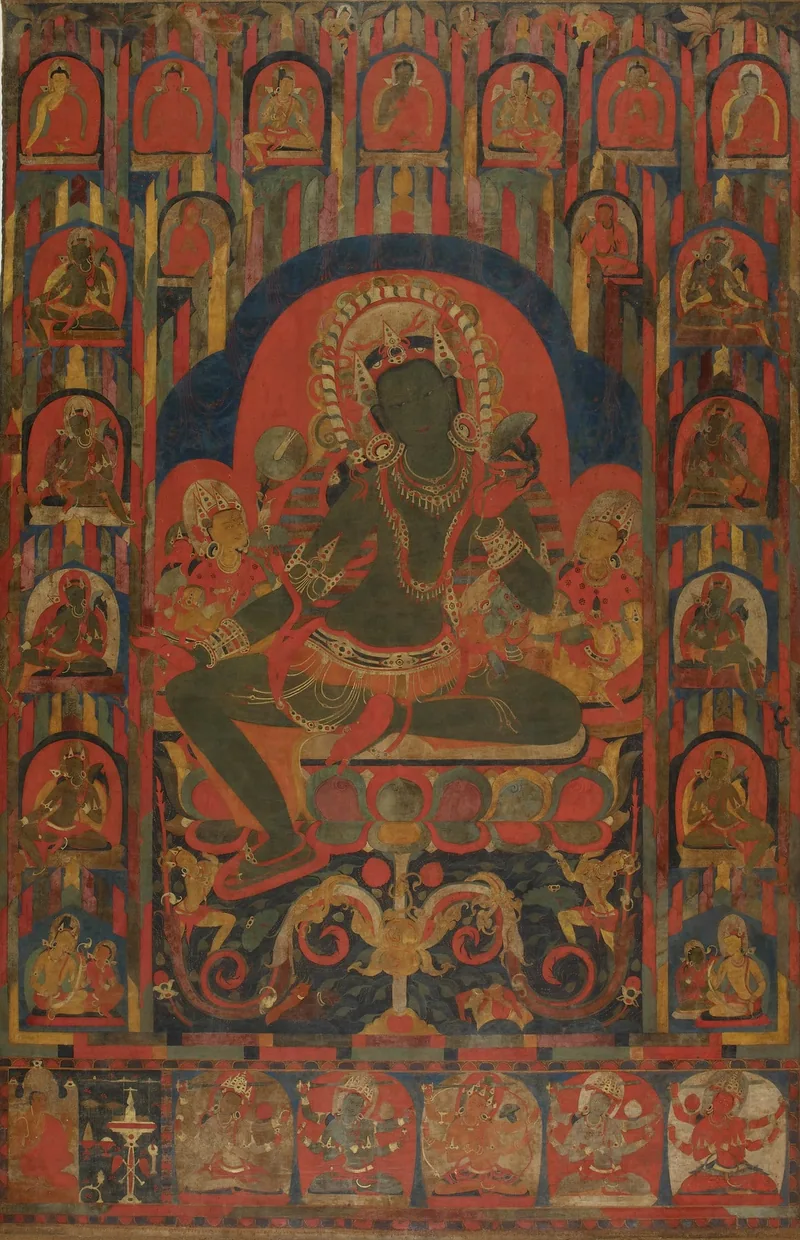
Begin with the large Tara in the opening painting. Her left leg rests across the seat, while her right leg extends towards a smaller lotus below. In a frontal image, her own right is on your left. This distinction matters when following a description of her feet or hands: a reversed photograph can otherwise make a familiar form look unfamiliar.
The pose is often interpreted as readiness to rise in response to suffering. The folded leg and lowered foot bring composure and movement into the same figure. It is a widely recognised clue for Green Tara, but the degree of extension varies between paintings and sculptures. A small painted panel may condense the space around the knee and foot.
To recognise a work, follow the whole arrangement: face, arms, hand gestures, flowers and seat. The extended leg alone is insufficient, since other Buddhist figures also adopt relaxed or pendant-leg postures. If the lower part is cropped, ask for the complete image before drawing a conclusion.
The open hand and the shoulder-height flower
In the familiar two-armed form, Tara’s right hand reaches down across the knee, palm open, in varada mudra: the gesture of generosity or granting a boon. Her left hand is raised near the heart and holds the stem of an utpala flower. The stem carries your eye upwards to the blossom beside her shoulder.
The raised hand is explained in some teachings as refuge in Buddha, Dharma and Sangha. It should be read together with the fingers and flower stem, rather than assigning every upright hand the same name. Green Tara images also exist in which the right hand turns upwards in a gesture of protection. That variation is useful to know when an image differs from the most familiar pattern.
Utpala is commonly described as a blue or night lotus. Tara may hold one flower or appear with blossoms at both shoulders. Historical artists did not always paint those flowers the same colour. The lotus carries associations of purity and awakened qualities, but it is shared by many figures in Buddhist art. Our guide to lotus imagery follows how a flower can become an attribute, seat or part of the landscape.
What can colour and ornament tell us?
Green Tara paintings can range from a deep green to a cooler turquoise. Painted shading, the age of the surface and the photograph’s lighting also change what we see. The early work shown here has a dark central figure against strong red and gold passages. Its identity is supported by the posture, surrounding scenes and documented inscriptions, as well as the colour.
A crown, earrings, necklaces and flowing garments create a richly adorned figure. Buddhist teachings offer symbolic interpretations of these ornaments, while artists work out their shapes, colours and arrangement within a painting. The precise hue of a scarf or halo is not a reliable universal key. Look closely at those choices as part of the painter’s work, without expecting every decorative detail to carry one fixed meaning.
An early painting, front and back
The opening thangka dates to the 1160s–1180s. Around the principal Tara, eight smaller appearances show her rescuing devotees from dangers. These include lions, elephants, fire, snakes, thieves, imprisonment, floods and demons. They are paired with pride, delusion, hatred, envy, false views, greed, lust and doubt.
The picture invites two kinds of attention: a scene of danger in the world, and an affliction that obstructs the mind. Look for the small figures and their surroundings before relying on a list. Lists and interpretations can vary by text and tradition; the explanation above belongs to this recorded work.
The back adds another layer of evidence. Its inscriptions are associated with Chason Dru-o, a Kadam master who died in 1175, and refer to the deity of Reting monastery. A title such as Green Tara therefore opens onto a particular history of devotion. The image is more than a generic illustration of green colour.
Stories of her origins
One account describes Tara arising from a lotus formed from Avalokiteshvara’s tears of compassion. Another tells of the princess Wisdom Moon, who rejects the suggestion that she must become male to awaken and vows to work for beings in female form. Buddhist teachers use these narratives to express compassion and the possibility of awakening beyond gender.
These are sacred narratives, rather than dates for the beginning of every Tara image. A dated painting and its inscriptions answer a different question: where and how a particular community used the image. Holding the story and the object’s history together lets us appreciate both without turning a devotional account into an archaeological date.
Green Tara and White Tara in one painting
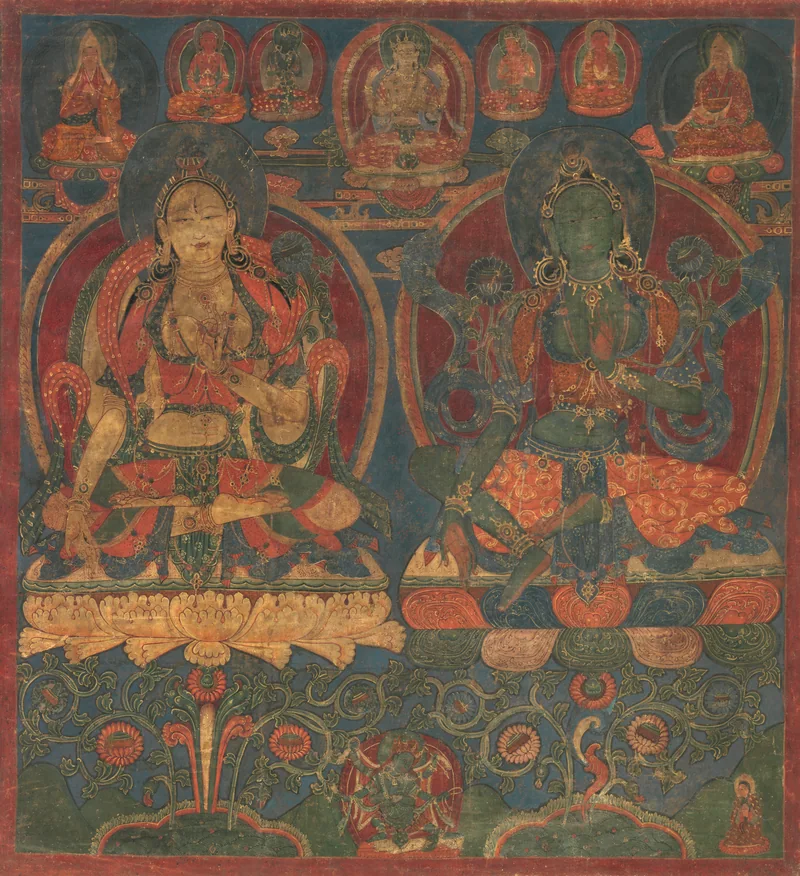
In this late-fifteenth-century painting from Guge, White Tara sits on the viewer’s left and Green Tara on the right. The Met identifies White Tara’s additional eyes and meditation posture; Green Tara has one leg pendant. Both lower a hand in generosity. The comparison shows why one familiar hand gesture cannot distinguish the two on its own.
White Tara is often shown with seven eyes: three on the face and one on each palm and sole. She is closely associated with longevity practices. Green Tara is especially associated with activity and rescue. They share compassionate qualities, and their religious roles should not be reduced to a competition over which is more powerful. The Green Tara and White Tara comparison explores their forms more fully.
How do the twenty-one Taras fit in?
The Praises to the Twenty-One Taras is a widely recited prayer. Its visual interpretations belong to several systems, including those associated with Atisha and Suryagupta. Their figures do not share a single universal sequence of colours, faces, arms and attributes. A list of twenty-one colour names without a stated lineage is a poor guide to a historical painting.
The eight-fears arrangement in the opening work is a distinct system. Counting smaller Taras can begin an investigation, but the composition and record still need to be checked. Some multi-figure paintings also include teachers and attendant deities. Read their positions and attributes before treating every surrounding figure as another Tara.
Mantra, practice and choosing an image
The familiar Tara mantra is often written Om Tare Tuttare Ture Soha; a Sanskrit transliteration ends with svaha. It belongs to a tradition of calling upon Tara, accompanied by praises, prayer or meditation. Its words should not be turned into a promise that recitation, a pendant or a purchased painting guarantees a particular outcome.
Public prayer and detailed deity-yoga instructions have different scopes. For formal practice, follow a qualified teacher and the requirements of the particular lineage. An illustrated introduction can help you recognise the subject and appreciate its setting; it does not replace that relationship.
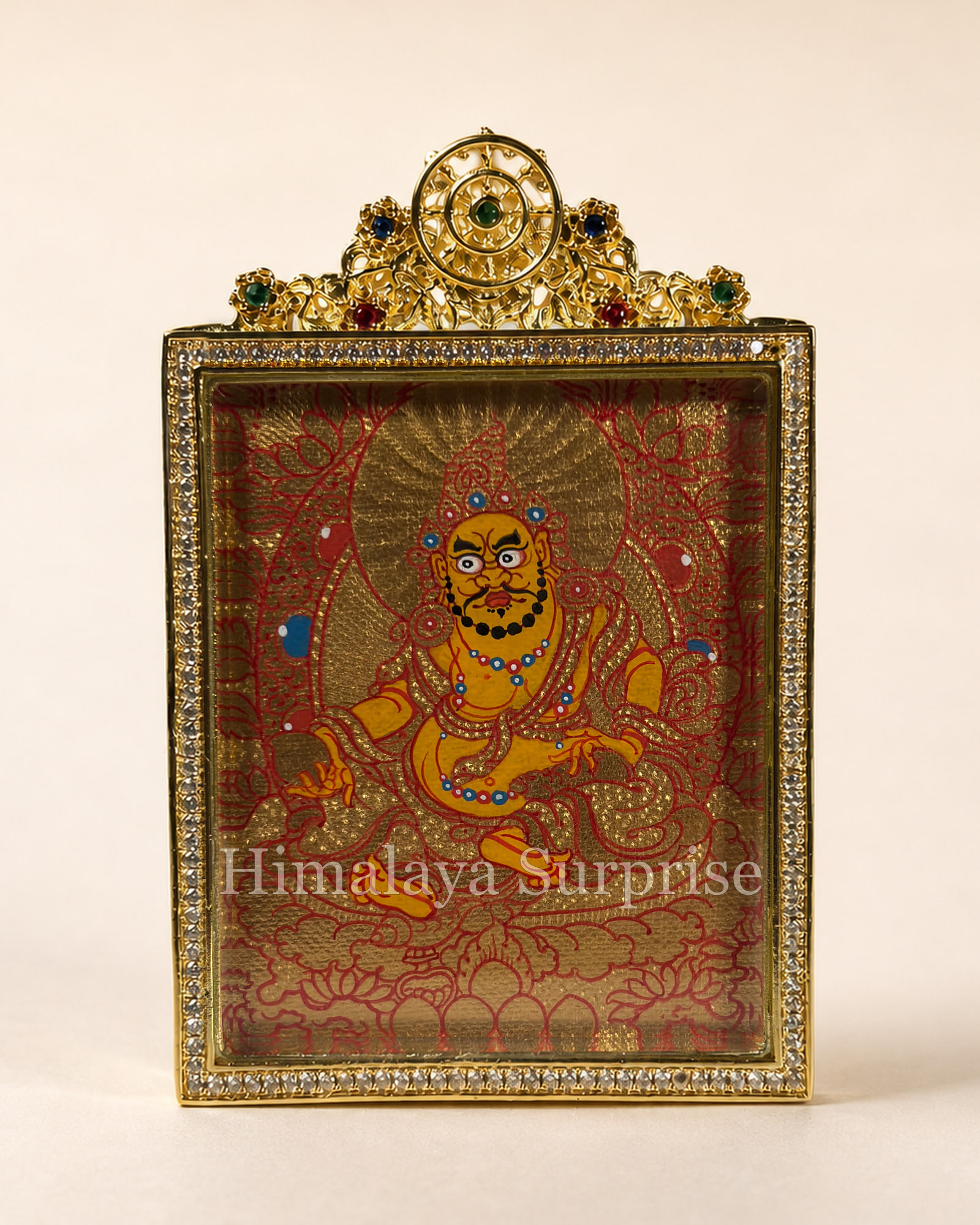
When choosing a Green Tara thangka, compare the complete image with clear details of her face, hands, flowers and feet. Read the painted dimensions separately from the frame or housing dimensions, and ask what is documented about the maker and materials. A small work can preserve these details beautifully; colour or price alone tells you little about how it was made. How to read a thangka offers a wider route through the composition.
Questions and answers
Does every Green Tara image have two lotuses?
No. One or two flowers occur, and their placement and painted colours vary. Follow the hands and stems, then read the whole form and its record.
Is a green female figure always Green Tara?
No. Colour is only one clue. Other Buddhist figures can be green and hold flowers. Check the face, arms, gestures, posture, surrounding figures and title together.
Must a Green Tara painting be consecrated before I can appreciate it?
You can study and appreciate its art without assuming consecration. If you need an image for religious use, discuss the requirements with your teacher and confirm the individual work’s status separately.