Discover / Subjects & Meaning
Green Tara Mantra: Meaning and Traditional Benefits
Understand Om Tare Tuttare Ture Soha, its traditional benefits and the difference between reciting a mantra, chanting the Tara praises and a formal practice.
In this story
Om Tare Tuttare Ture Soha is the short mantra widely associated with Green Tara. Its traditional benefits concern protection, freedom from fear and the path to awakening. Understanding those words begins with the compassionate purpose of the practice.
The words of the Green Tara mantra
A familiar written form is Om Tare Tuttare Ture Soha. In scholarly Sanskrit transliteration, it appears as Oṃ Tāre Tuttāre Ture Svāhā. The final word is often written “Soha” in Tibetan Buddhist materials, reflecting Tibetan pronunciation. These spellings point to the same familiar short mantra, rather than two competing versions.
The syllable groups can be followed as Om · Ta-re · Tut-ta-re · Tu-re · So-ha. A written guide helps with the sequence; a teacher’s recording helps with its sound and rhythm. Wildmind’s Green Tara guide provides a public introduction and pronunciation resources. Chanting styles vary, so the mantra need not have the melody heard in a particular online video.
A traditional explanation of its meaning
A mantra does not always translate like an ordinary sentence. Calling Tara by name, the force of the invocation and a teacher’s explanation of the path belong to different layers of understanding. A symbolic explanation should therefore not be presented as a word-for-word Sanskrit dictionary translation.
In Lama Zopa Rinpoche’s explanation, reproduced by YoWangdu, Tare is connected with liberation from samsara; Tuttare with release from the eight fears; and Ture with freedom from suffering, including the ignorance at its root. Soha is explained through establishing the path in the heart. This reading moves from immediate fear toward a deeper freedom.
Other teachers may organise the explanation differently. Keeping the teacher and context visible allows these interpretations to be appreciated without turning one teaching into the only possible meaning of every syllable.
What are the traditional benefits?
Tara is invoked for protection, help with obstacles and relief from fear. In Buddhist teaching, these concerns sit within the larger aims of liberation and awakening. The mantra’s significance is not exhausted by asking for a favourable outcome in one difficult situation.
In FPMT’s published excerpt from The Power of Mantra, Lama Zopa Rinpoche places bodhicitta at the centre: the wish to awaken for the benefit of others. Compassion gives the practice its direction. Remembering someone else’s suffering, or responding to it with patience and care, connects that intention with daily conduct.
Traditional accounts include powerful stories of rescue and answered prayers. They express faith and devotion; they do not establish guaranteed results for health, wealth or physical safety.
How the eight fears appear in a painting
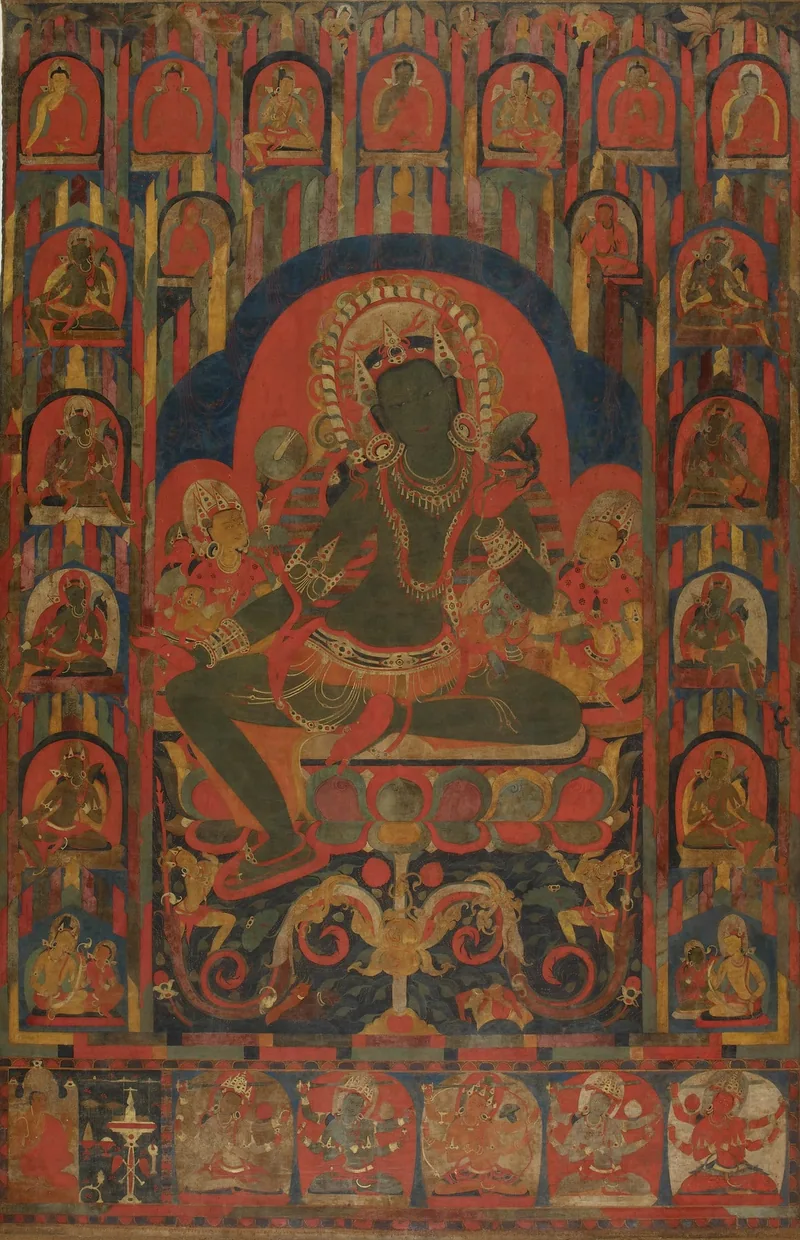
The painting above, dating to the 1160s–1180s, gives the language of protection a visible form. Smaller manifestations of Tara flank the central figure, rescuing devotees from lions, elephants, fire, snakes, thieves, imprisonment, floods and demons.
The museum pairs these dangers with pride, delusion, hatred, envy, false views, greed, lust and doubt. The scenes can therefore be read both as dangers encountered in the world and as afflictions of the mind. This particular work gives a historical form to that relationship.
Our Green Tara guide explores the posture, hand gestures and flowers in her images. Here the surrounding rescue scenes illuminate the language of fear and liberation used in the mantra’s traditional explanation.
The mantra and the Praises to the Twenty-One Taras
The short mantra and the Praises to the Twenty-One Taras are different texts. A prayer may contain homage, descriptions and petitions across its verses; the short mantra is a compact recitation. Their presence in the same practice does not make them interchangeable.
Nor do twenty-one praises require every painting to show twenty-one identical Taras. The eight-fears composition above has its own subject. Different Tara traditions also have their own prayer and practice texts, so shared syllables should not be taken as permission to substitute one complete practice for another.
Public recitation and formal practice
FPMT’s general practice questions state that reciting the Tara mantra or praises does not require empowerment. The answer recommends receiving an oral transmission when possible, while explaining that recitation without it is not a fault.
The same answer distinguishes recitation from generating oneself as the deity. A formal text can carry requirements for empowerment, transmission and instruction. This distinction helps a beginner choose a public prayer or recitation without assuming that every online visualization script has the same status.
There is also a history of images used within specific communities. The Walters museum interprets the reverse inscriptions of this painting as linking it with the Kadam master Chason Dru-o, who died in 1175, and Reting monastery. The image belonged to a setting of devotion and teaching, as well as to the history of painting.
Must the mantra be recited 108 times?
A mala and a chosen count can give recitation a steady structure. The FPMT question above arose from an appeal asking for 108 Tara mantras for the establishment of Sravasti Abbey. That number belongs to the request’s context; it is not evidence of a universal minimum for everyone who encounters the mantra.
Where a teacher or a practice text gives a count, follow that instruction in its setting. The schedule and number belong to the particular practice. Regular attention and its compassionate intention offer a steadier beginning than rushing to finish a tally.
The practice returns attention to how we meet fear and suffering. Its words can be remembered in a moment of uncertainty; their compassionate direction can also be carried into an ordinary act of kindness.
Questions and answers
Are Soha and Svaha different mantras?
In this short Tara mantra, Soha reflects the familiar Tibetan pronunciation of the Sanskrit Svāhā. They are written forms of the same ending, not different promises or levels of power.
Can the Green Tara mantra be recited without empowerment?
FPMT’s published answer allows ordinary Tara mantra and praise recitation without empowerment, and recommends oral transmission when possible. Self-generation and formal deity practices have their own requirements.
Is chanting once a day for 108 repetitions mandatory?
The 108 appeal discussed here concerns a specific community project. A teacher may give a particular commitment; that is different from a universal rule for every reader.
Is the mantra the same as the Twenty-One Tara praises?
No. The mantra is a short recitation, and the praises are a longer prayer. They may be used together, but are different texts.
Does recitation guarantee that a wish will be fulfilled?
Traditional teachings express aspirations for help, protection and awakening. Their religious meaning is not a guaranteed worldly outcome or a promise attached to an artwork.