Discover / Subjects & Meaning
White Tara Meaning: Seven Eyes and Long Life
Read White Tara through her seven eyes, open palm and lotus, then explore a long-life painting and an early manuscript that reveal different ways of picturing her.
In this story
White Tara represents compassionate awareness and is especially associated with long-life prayers in Tibetan Buddhism. Her familiar form is a white, richly adorned figure with seven eyes, seated with both legs folded. In a thangka, those features belong to a larger picture: flowers, teachers and other deities help explain what kind of image we are looking at.
Who is White Tara?
White Tara is a female enlightened figure revered as a Buddha and also described as a bodhisattva. Tara is Drölma in Tibetan, a name associated with liberation; Sita Tara is her Sanskrit name as White Tara. Tibetan names include Drölkar, an abbreviated form of White Drölma. These names point to the same widely recognised subject, although its visual forms and practices are not identical in every tradition.
Her association with long life gives compassion a particular emphasis. Devotees pray for their teachers, loved ones and others facing illness or difficulty. A longer life is valued as an opportunity to practise, deepen wisdom and help beings. Healing language belongs to this religious setting; a painting or prayer does not provide a medical treatment or guarantee an outcome.
Where are the seven eyes?
In the familiar seven-eyed form, two eyes are in their usual place, one is on the forehead, and another appears on each palm and each sole. That gives three on the face, two on the hands and two on the feet. Follow her own right hand down towards the knee, on the viewer’s left, then look at the raised hand and folded feet. The palm and sole eyes can be much smaller than the facial eyes.
Teachers interpret the additional eyes as wisdom and awareness of beings’ suffering. Lama Palden, for example, relates the seven eyes to perception through the three doors of liberation. Other introductions emphasise watchful compassion. These are religious interpretations, rather than a claim that every eye in every painting has a separately fixed meaning.
A small photograph may conceal the eyes on the hands and feet. Yet seven eyes are not the only form: White Tara traditions include different numbers of eyes, faces and arms. The Rinjung Lhantab collection includes a three-eyed form associated with Bari’s tradition. Check a work’s full image and identification before deciding that an absent detail is a painter’s mistake.
The giving hand and the lotus stem
The lowered right hand opens in varada mudra, the gesture of generosity or granting a boon. The left hand, raised near the heart, holds the stem of a flower that opens beside the shoulder. Read the hand together with the stem and blossom. Calling the left hand simply a meditation gesture misses its connection with the flower.
White Tara’s flower is commonly a white utpala. Some descriptions specify three branches or flowers at different stages, interpreted through Buddhas of the three times. The fingers holding the stem also vary. The consistent relationship is between the hand and the flower; the exact finger arrangement should follow the work and its tradition.
The lotus also forms her seat, often with a moon disc above it. A flower held in the hand and a lotus beneath the body perform different roles in the composition. Both evoke purity and awakening, but neither identifies White Tara on its own. The lotus in Buddhist art offers a closer look at these uses.
A painting of the three long-life deities
The opening thangka, held by the Los Angeles County Museum of Art, comes from a Geluk monastery in central Tibet and is dated to the nineteenth century. Around White Tara, the composition makes her religious setting visible. In the upper corners are red Amitayus on the viewer’s left and the multi-armed Ushnishavijaya on the right. Together with White Tara, they form the familiar long-life triad.
At the top centre are Tsongkhapa and two principal disciples, wearing yellow hats. Below the main figure are Yama, Mahakala and Vaishravana as protective deities. A viewer who stops at the seven eyes would miss the teachers and protectors that connect this painting with a community and its devotional world.
Amitayus is closely related to Amitabha, but the names should not make two different triads interchangeable. Amitabha with Avalokiteshvara and Mahasthamaprapta belongs to a Pure Land grouping. White Tara with Amitayus and Ushnishavijaya belongs to the long-life grouping. Follow the figures actually present, rather than treating every red Buddha above Tara as the same pictorial relationship.
An earlier White Tara on a manuscript leaf
A palm-leaf manuscript at The Met presents a different encounter with White Tara. Made in India, in Bihar or West Bengal, in the twelfth century, the leaf comes from a dispersed Perfection of Wisdom manuscript. The painting occupies a small space within a long field of writing. The figure is White Tara, seated in royal ease on a cushioned throne.
The object reminds us that White Tara imagery belongs to more than Tibetan hanging scrolls. A manuscript leaf and a mounted thangka have different sizes, surfaces and places within devotional life. This early seated figure also cautions against turning the crossed legs of a familiar Tibetan form into a rule for every White Tara image. The object’s identification and the complete composition give the comparison its footing.
Origin stories and the history of an image
In a well-known devotional account, Tara appears from Avalokiteshvara’s tears of compassion. Another narrative tells of the princess Wisdom Moon, who vows to benefit beings in female form. These stories express compassion and the possibility of awakening beyond gender; they do not date the manuscript or painting shown here. The object’s identification and a religious narrative answer different questions.
White Tara practice travelled through particular teachers and lineages. Atisha is important in accounts of its transmission to Tibet, while other masters are associated with additional traditions. This is why an individual painting’s teachers, inscriptions and recorded lineage can be more informative than a broad statement that White Tara has always looked one way.
White Tara beside Green Tara
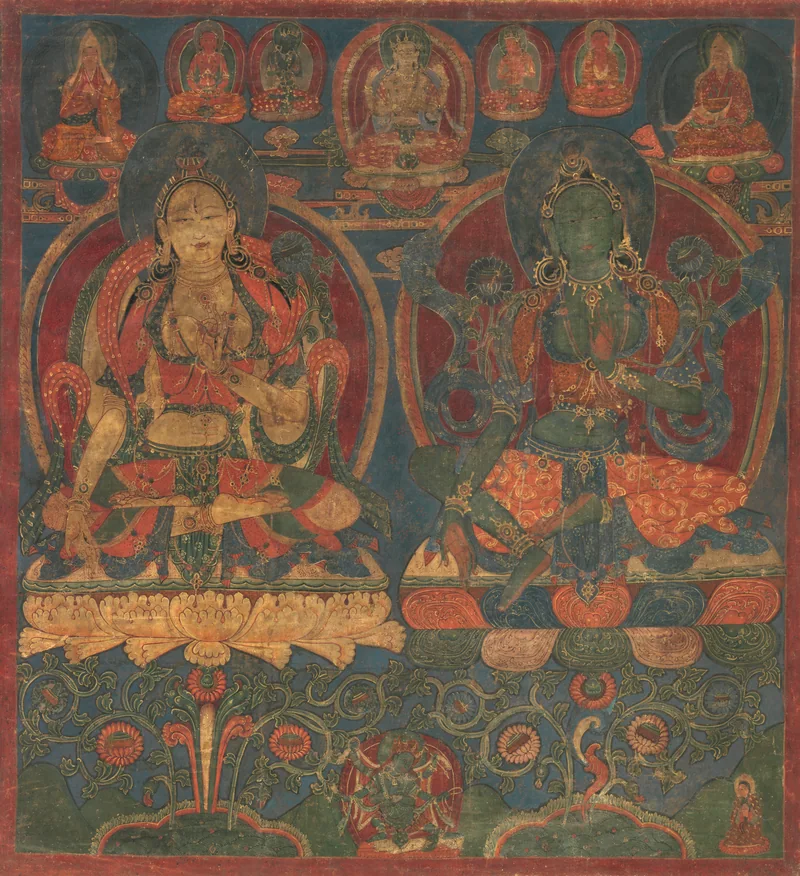
In this fifteenth-century painting from Guge, White Tara sits on the viewer’s left and Green Tara on the right. White Tara’s additional eyes and folded legs contrast with Green Tara’s pendant leg. Both offer a lowered hand in generosity. Looking at the two within one work makes the shared gesture and different forms easier to see.
Green Tara is particularly associated with compassionate activity and rescue; White Tara is especially associated with long-life practice. Both embody awakened compassion. Their meanings overlap, so the distinction is more useful as a way of reading forms and practices than as a ranking of power. The fuller Green Tara and White Tara comparison has its own page.
What does the White Tara mantra ask for?
A familiar transliteration is Om Tare Tuttare Ture Mama Ayuh Punya Jnana Pushtim Kuru Svaha. You may also see Tibetan-style spellings such as Soha at the end. The extended phrase names life, merit and wisdom: ayuh, punya and jnana. It places long life alongside the qualities that make a life beneficial, rather than reducing the prayer to the number of years lived.
Bodhipaksa’s explanation at Wildmind reads pushtim kuru as a request to increase or enrich those qualities. In this grammatical context, kuru is an imperative, not a reference to a legendary place bearing the same name. Transliteration and pronunciation can differ; for detailed White Tara meditation, use instructions appropriate to the teacher and lineage rather than assembling a practice from fragments online.
Choosing a White Tara thangka
Start with a complete photograph, then look more closely at the face, palms, soles and flower. Ask which form is represented and what is known about the artist and materials. A declared title is helpful, but the photographed work should support it. If the image follows an unfamiliar lineage, the seller should be able to explain the identification or provide its source.
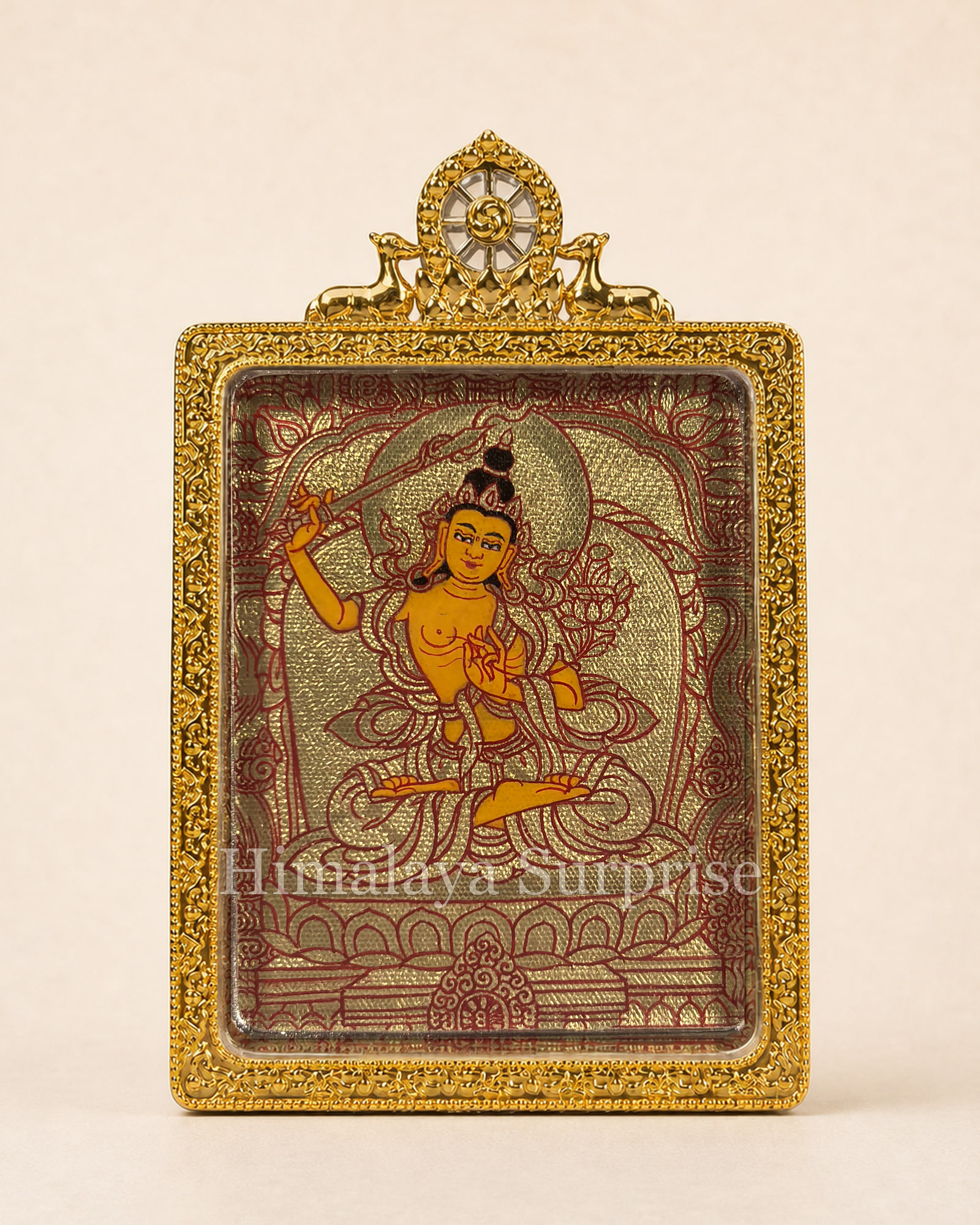
Read the painted dimensions separately from the frame or housing size, particularly for a miniature. A finely drawn eye or lotus may occupy only a few millimetres, making a clear detail photograph useful. The front, reverse and mounting tell different parts of the object’s story. Our guide to reading a thangka follows those clues through the wider composition.
Questions and answers
Is every white female deity White Tara?
No. Other Buddhist figures also have white bodies. Read the face, arms, eyes, gestures and attributes together, and compare the work with a reliable identification.
Does White Tara always have seven eyes?
Seven eyes are familiar, but other forms are documented. A photograph may hide small palm or sole eyes, and some traditions genuinely specify another form. Check both the image and its lineage before concluding that an eye is missing.
Are the three long-life deities the same as the Pure Land triad?
No. White Tara, Amitayus and Ushnishavijaya form the long-life triad. Amitabha, Avalokiteshvara and Mahasthamaprapta form a Pure Land grouping. Their identities and relationships should be read separately.