Discover / Subjects & Meaning
Red Tara Meaning: Forms, Symbolism and Kurukulla
Red Tara is more than one red figure. Explore peaceful Tara, four-armed Kurukulla and eight-armed Heroic Tara, with a close look at Buddhist artwork.
In this story
A red figure may sit quietly with a lotus, dance with a flower bow, or hold eight different attributes. All three can appear in discussions of Red Tara, yet they belong to different visual and religious settings. The colour draws the eye; the posture, hands and surrounding figures make the identity clearer.
Who is Red Tara?
Red Tara refers to red forms of Tara in Tibetan Buddhist traditions. Tara is a female enlightened figure associated with compassionate activity. Rakta Tara is a Sanskrit name readers may encounter; Drolma Marmo is a Tibetan name meaning Red Tara. These names establish a useful starting point, but they do not specify one posture, number of arms or transmission.
Some red forms belong to the Twenty-one Taras; others follow separate traditions. Kurukulla, often called Red Tara in English, is part of this wider discussion, but the two names are not interchangeable in every context. A peaceful seated Tara and a dancing, four-armed Kurukulla can both be red without being the same form.
What does the red colour mean?
In an important tantric classification, red is associated with powerful or magnetizing activity. White can correspond to pacifying activity and yellow to increasing activity, while dark blue or black can mark fierce activity. These are religious ways of organizing enlightened action, rather than a universal colour code for every Buddhist painting.
Magnetizing is often translated into the language of attraction. Within Buddhist interpretation, its purpose is connected with bringing beings and circumstances toward the path, and with transforming desire through wisdom and compassion. That setting gives the imagery more depth than a promise of romantic success or personal influence. A red Tara image is not evidence that a painting will produce a particular outcome.
Colour is also affected by the artwork itself. Red, orange and maroon forms can be difficult to separate when pigments have aged or when a painter has followed a particular palette. The rest of the image often carries the more decisive clues.
The peaceful, two-armed forms
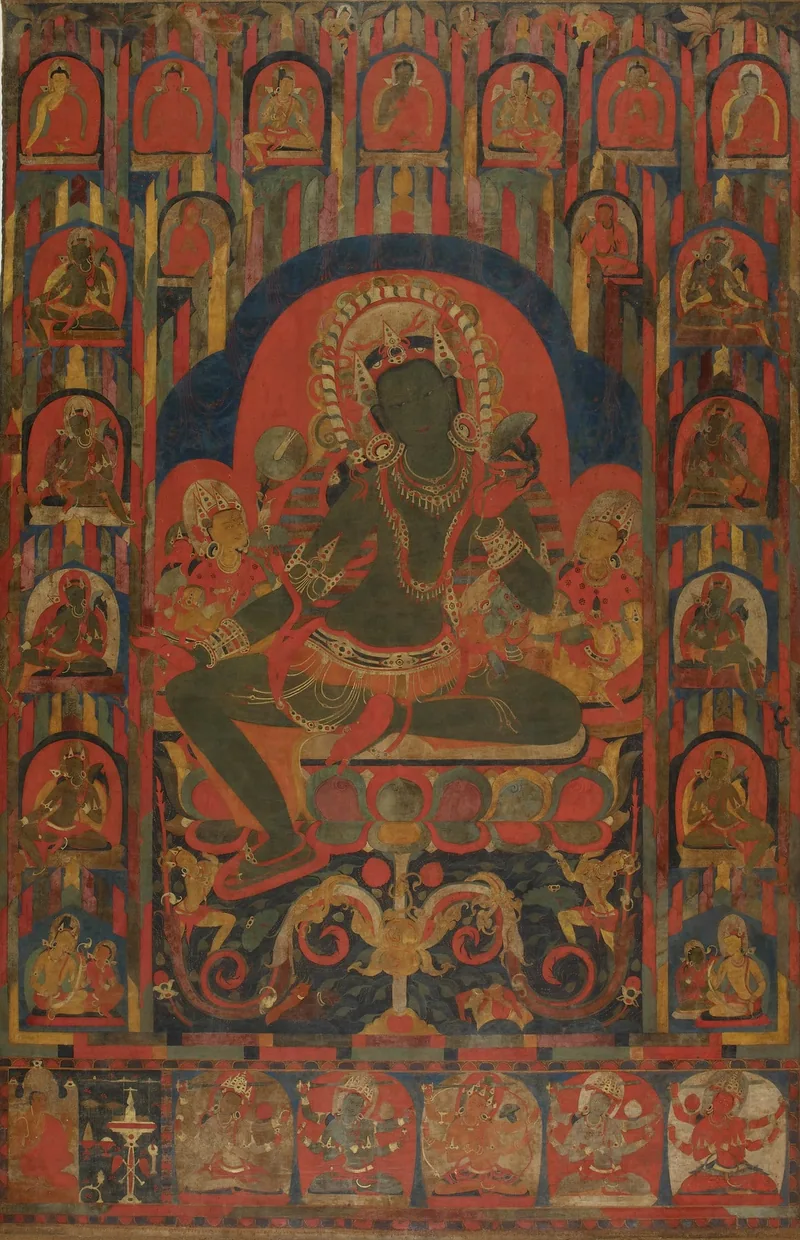
A peaceful Red Tara can resemble the familiar seated Tara: one face, two arms, jewels and flowing garments, a lotus stem held near the heart, and one leg extending from the seat. In an eighteenth-century Tibetan example, a teacher appears above her and a naga makes offerings below. The small surrounding figures connect the central image with a more specific religious and artistic setting.
Other two-armed red forms have different attributes. Several traditions can also produce very similar figures, so the presence of a lotus or an extended leg does not settle the lineage. An inscription, the teachers arranged above the deity, or a known series can clarify what the central figure alone leaves open.
Kurukulla: the dancing figure with a flower bow
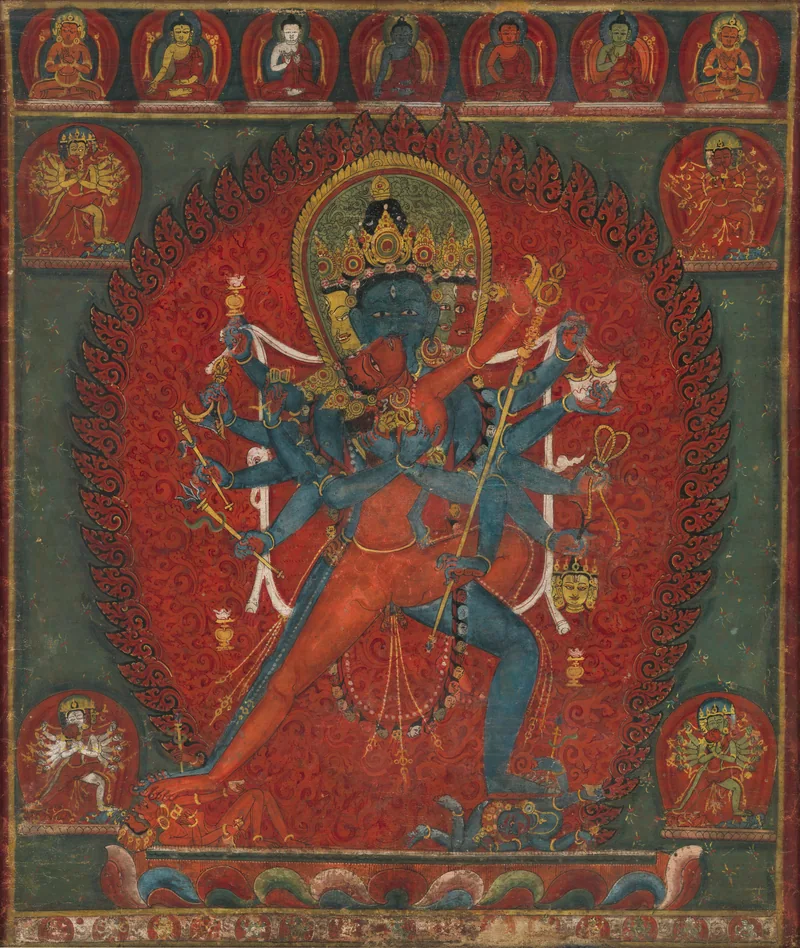
The opening artwork presents a very different figure. Kurukulla is red and four-armed, with a lively dancing posture and a bow drawn across the body. The flower-tipped arrow gives the weapon an unusual delicacy. Skull and bone ornaments surround her face and body, while fierce figures occupy the lower part of the composition.
This nineteenth-century Tibetan work is a large textile image, made with appliquéd satin, brocade and damask, embroidered silk and painted details. Its red figure stands out against a blue field. The assembled fabrics carry both patterned surfaces and the outlines of the body, showing how a Buddhist image can be built in cloth as well as painted on it.
Kurukulla is connected with Tara in some traditions, and her red colour is also associated with Amitabha. The wider category includes forms with other religious connections. Identifying this four-armed dancing figure as Kurukulla is therefore more precise than treating every red female deity as the same Red Tara. Her relationship with the dakini imagery also opens another way to understand the energetic posture.
Heroic Red Tara and the Twenty-one Taras
Heroic Tara, or Pravira Tara, is the first Tara in the Suryagupta system of the Twenty-one Taras. In this form she is seated, red, one-faced and eight-armed. A vajra and bell are held above the head; the other hands carry a bow and arrow, a wheel and conch, and a sword and noose. The number and arrangement of these attributes distinguish her from the dancing Kurukulla.
The Atisha and Suryagupta systems organize the Twenty-one Taras differently. In the Atisha-related images, seated two-armed figures can be differentiated through colour and attributes; the Suryagupta forms vary more extensively in faces, arms and posture. A red figure’s place in a set matters. There is no single list of red Taras that explains every twenty-one-figure painting.
Red Tara beside Green and White Tara
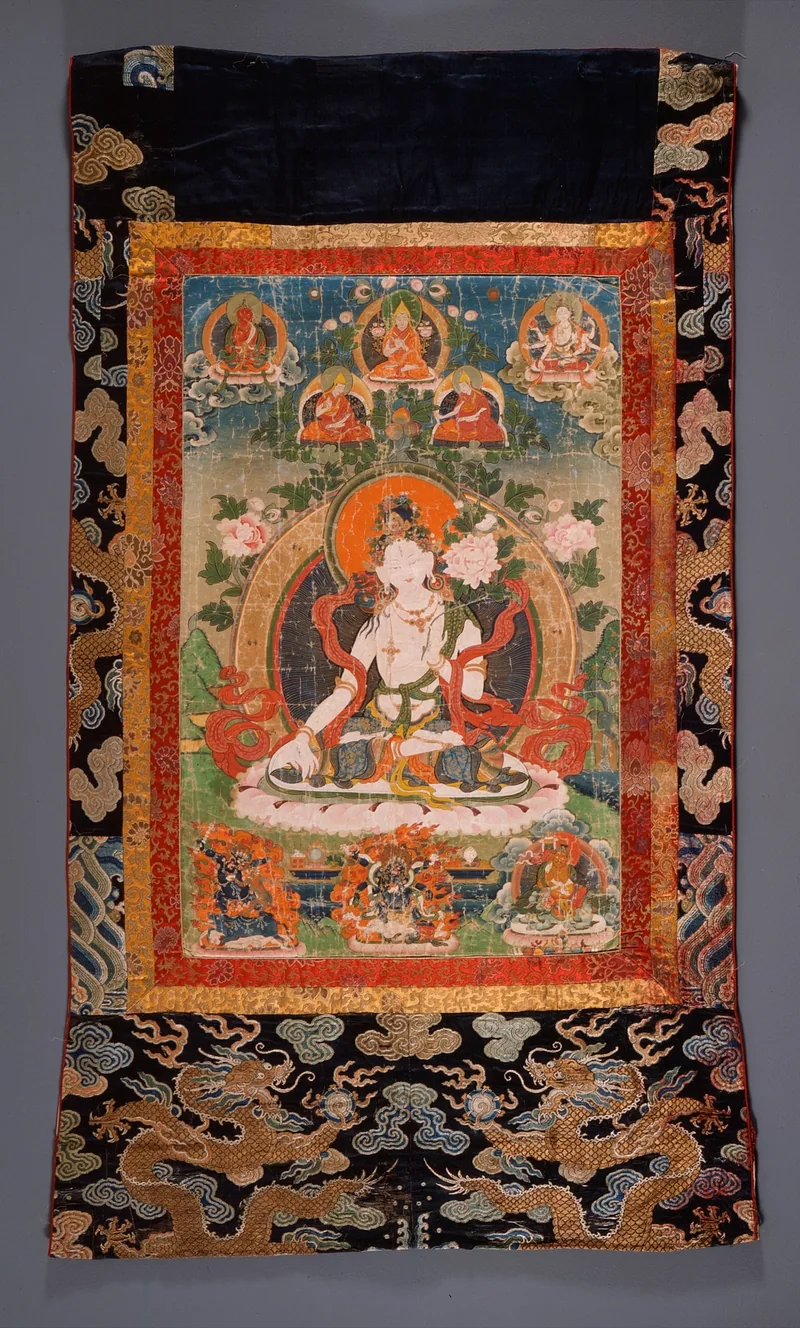
The painting here places White Tara and Green Tara side by side, each above a lotus seat. Their similar scale and shared landscape bring out the difference in their bodies and gestures. It is a useful comparison with the red, dancing Kurukulla in the opening image: colour, posture and attributes work together rather than acting as separate labels.
Green Tara is particularly associated with swift compassionate activity; White Tara with long life and a characteristic seven-eyed form. Red Tara brings several further visual traditions into that larger family. These differences are not a ranking of one deity’s value over another, nor do they make every image of a given colour identical. The Green and White Tara comparison follows the familiar pair in more detail.
Looking at a Red Tara image
Begin with the figure’s action. Is she seated or dancing? How many faces and arms are visible? A lotus held near the heart suggests a different arrangement from a flower bow drawn across the body, while eight hands create another set of relationships. Follow those details outward to the smaller teachers, attendants and companion deities.
The flower bow of Kurukulla, the lotus-bearing peaceful figure and the eight-armed Heroic Tara show how much variety one colour can contain. Each invites attention to a different gesture and composition. That is where Red Tara becomes more than a name: in the particular way a work gives form to enlightened activity.
Questions and answers
Are Red Tara and Kurukulla the same?
Kurukulla is often called Red Tara, and some of her forms are connected with Tara. Red Tara also includes other forms, such as peaceful seated figures and the eight-armed Heroic Tara. The names overlap, but are not universally interchangeable.
Does every Red Tara have four arms?
No. Peaceful two-armed forms, four-armed dancing Kurukulla and eight-armed Heroic Tara can all appear in this subject. Each belongs to a more specific iconographic and religious setting.
What does Red Tara symbolize?
Red is associated with powerful or magnetizing activity in a tantric classification. The meaning of a particular figure also depends on her tradition, gestures and attributes. It should not be reduced to a promise of love, wealth or control over other people.
Why do Red Tara mantras and practices differ?
The name covers different forms and transmissions. A practice associated with Kurukulla need not be the same as one for Heroic Tara or another Red Tara tradition. The title of a video or painting alone does not establish which practice it presents.
Can red colour alone identify Tara?
No. Other Buddhist figures can also be red, and some Tara paintings shift toward orange or maroon. Faces, arms, posture, held objects and surrounding figures provide a more useful combined reading.