Discover / Subjects & Meaning
Amitabha Buddha: Infinite Light, the Pure Land and the Western Triad
Who is Amitabha Buddha? Explore his meaning, Pure Land vows and name recitation, then read the Western Triad and different forms through historical artworks.
In this story
Amitabha is the Buddha of Infinite Light in Mahayana Buddhism, closely associated with Sukhavati, the Western Pure Land. His name is familiar in prayers, and his image can fill an entire painted paradise. Following a seated Buddha through a Tibetan landscape, a Chinese welcoming figure and a Korean bronze triad shows how much that familiar name can contain.
Who is Amitabha Buddha?
The Sanskrit name Amitābha means infinite or immeasurable light. The Chinese name Amituofo and the Japanese Amida refer to this Buddha; the Tibetan Öpakmé also means immeasurable light. He is an awakened Buddha, rather than a bodhisattva awaiting Buddhahood. In accounts of his earlier path, however, he appears as the bodhisattva Dharmakara. The different titles describe stages within a religious narrative.
Amitabha is central to Pure Land traditions and is also honoured in Tibetan Buddhism. His story belongs to Mahayana scriptures and their interpretation, rather than a recoverable human biography like the conventional account of Shakyamuni. When looking at art, the useful starting point is the figure’s name, the tradition of the work and the world the artist has assembled around him.
The vows behind the Western Pure Land
The Larger Sutra on Amitayus tells of Dharmakara making forty-eight vows and becoming the Buddha who presides over Sukhavati. The vows describe the realm he sought to establish and the help offered to beings aspiring to be born there. In Pure Land teaching, that birth provides favourable conditions for continuing towards awakening. Sukhavati is therefore more than a picturesque garden or a pleasant mood.
Three scriptures give different entrances to this subject. The Larger Sutra develops the vows; the Contemplation Sutra describes visualisations of the realm and its figures; the shorter Amitabha Sutra describes the land and encourages aspiration and remembrance of the Buddha. Traditions explain their relationship in different ways. This helps account for the variety of devotional images, from one figure to an expansive assembly.
A whole world around one Buddha
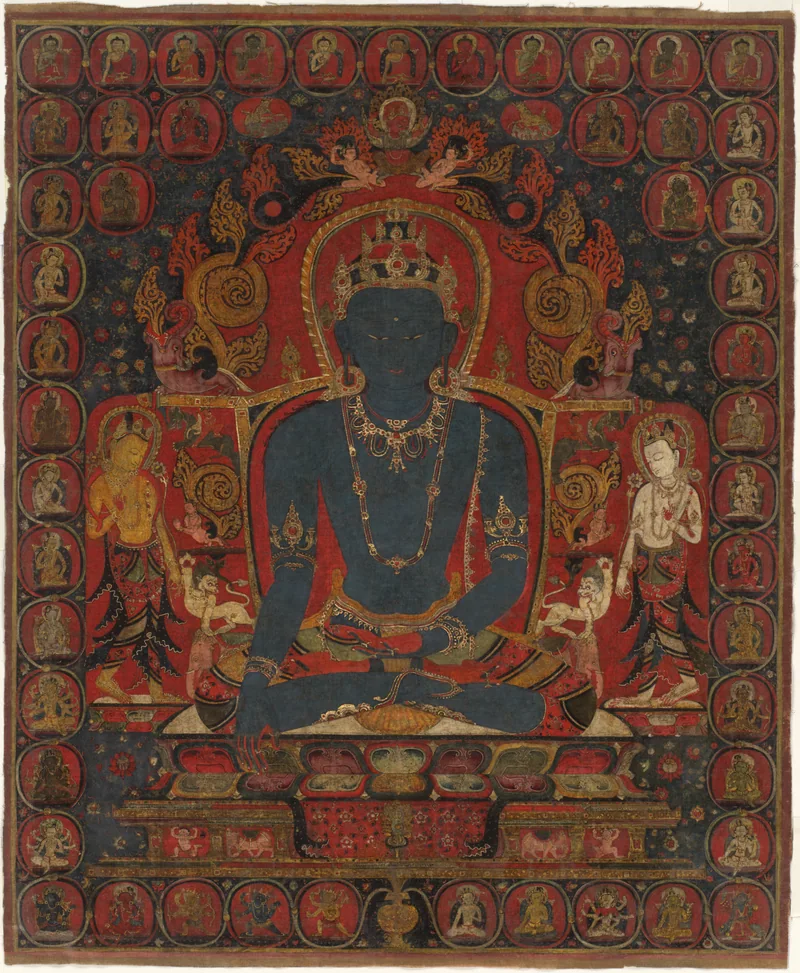
In the Tibetan painting above, made around 1700 and now at The Met, a seated Buddha forms a calm centre beneath an enormous flowering tree. Around him, the eye moves between gathered figures, offerings and pools. Eight great bodhisattvas appear in the assembly, with lotus births in the lower part of the paradise.
Try looking at it in three passes. First follow the large central figure and tree; then notice how the smaller figures face or gather around that centre; finally explore the paths, water and densely painted margins. This is a way to slow down the viewing, not a rule for every Sukhavati composition. A tightly framed photograph of the Buddha’s face would lose much of what makes this particular painting intelligible.
Who are the three figures in the Western Triad?
The familiar East Asian Western Triad brings Amitabha together with Avalokiteshvara, or Guanyin, and Mahasthamaprapta, known in Chinese as Dashizhi. The central Buddha and the two bodhisattvas belong to one sacred assembly. Their identities matter: any two figures beside a Buddha cannot simply be renamed Guanyin and Dashizhi.
Tibetan Pure Land paintings need their own reading. A named Namcho arrangement places four-armed Avalokiteshvara and peaceful Vajrapani beside Amitabha, with other bodhisattvas and teachers around them. This variation belongs to a named tradition. It does not supply a universal cast for all Tibetan paintings, or turn every three-figure group into the East Asian Western Triad.
A triad with a different attendant
This fifteenth-century Korean bronze provides a concrete example of variation. Amitabha sits at the centre; Guanyin occupies the viewer’s right, while the shaved-headed figure on the left is Ksitigarbha, or Dizang. Ksitigarbha takes the place of Mahasthamaprapta. It remains an Amitabha triad, with a different pair of attendants.
The photograph makes that distinction visible. Look at the small Buddha in Guanyin’s crown, then the smooth head and raised hand of Ksitigarbha. The three seats rise from a shared branching support. Reading the figures together gives more information than counting them: there are three, but the number alone does not identify the group.
A standing Buddha coming to welcome devotees
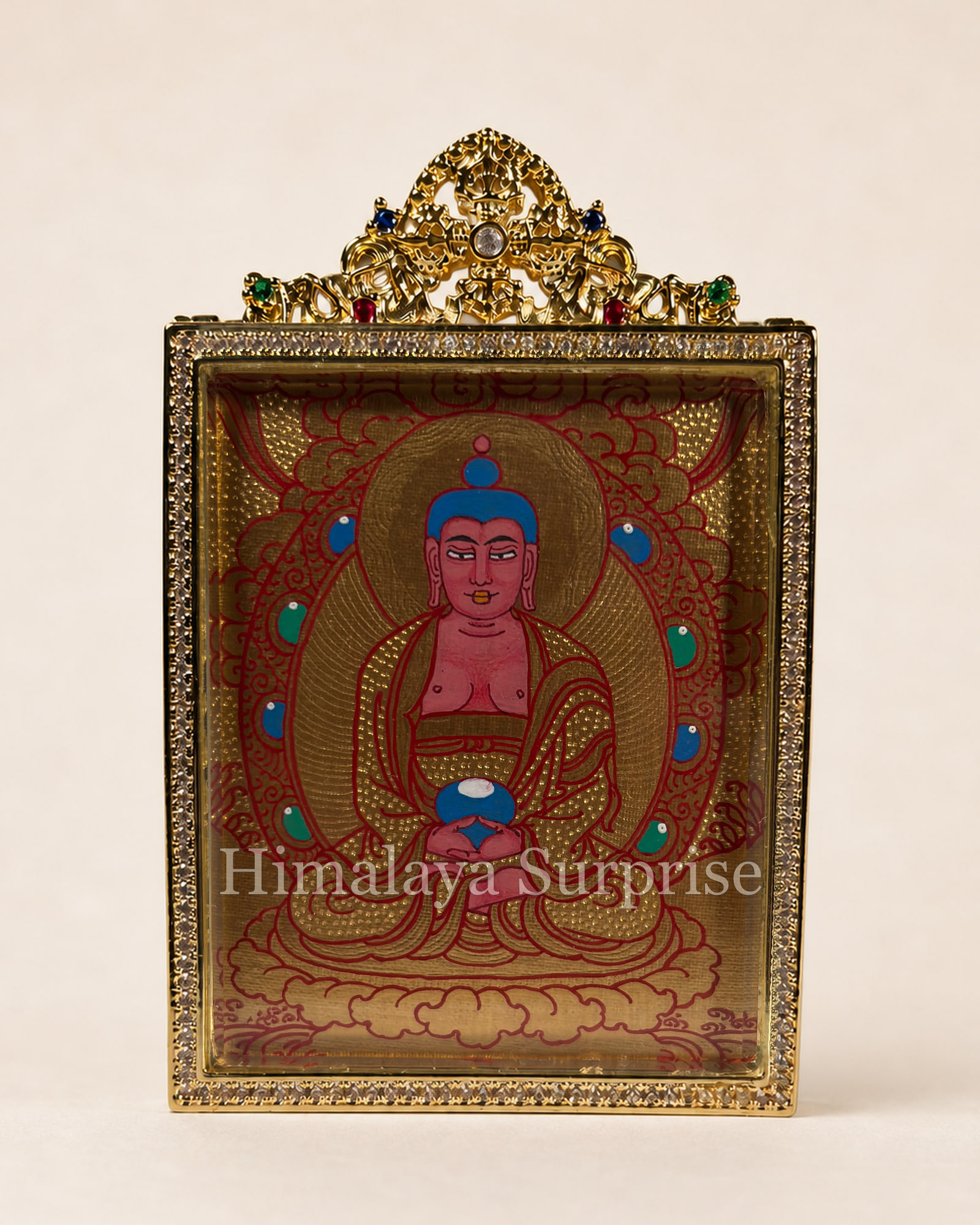
Amitabha is often seated in meditation in Tibetan thangkas, with a bowl supported by the hands in the lap and a red body. These are useful clues, not features that every representation must share. This thirteenth-century Chinese painting shows a standing Buddha, with one hand raised near the chest and the other reaching down. Its museum identification is Amitabha descending from his Pure Land to welcome devotees.
Here, the changing folds of the robe and the quiet inclination of the head shape the encounter. A partly erased inscription, recovered with infrared photography, names Qingyuanfu, a historical name for Ningbo used from 1195 to 1277. That inscription contributes to the dating. The artist is listed as unidentified: an old attribution should not become a certainty merely because it is repeated.
Amitabha and Amitayus: related names, different forms
Amitayus means immeasurable life, while Amitabha means immeasurable light. The two names are closely connected in Buddhist texts and traditions. In Himalayan art, Amitabha is commonly shown in a monk’s robes, while the long-life form Amitayus wears a crown and ornaments and holds a longevity vase. A bowl and a vase should be examined as different objects.
This distinction helps when two red figures seem alike. Read the clothing and hands, then check the title and context of the whole work. The comparison is about how the subject is represented, rather than a reason to treat connected names as two unrelated gods. Our guide to Shakyamuni, Amitabha and Medicine Buddha extends the question to three frequently encountered Buddha subjects.
Why people say “Amituofo”
In Chinese Pure Land practice, nianfo means recollection of the Buddha and often takes the form of reciting his name. Namo Amituofo expresses homage to Amitabha Buddha; the Japanese Namu Amida Butsu belongs to the related practice of nembutsu. The familiar sound can carry an aspiration for birth in Sukhavati, as well as devotion in daily life. It is not simply a word used only when someone has died.
Name recitation and a Tibetan mantra should be introduced in their respective settings. A prayer by the Fifteenth Karmapa invokes Amitabha and Avalokiteshvara and concludes with a mantra rendered as om ami dhewa hrih. That specific text shows one Tibetan devotional form; it should not replace the Buddha-name recitation of all East Asian traditions. A painting can accompany prayer or attentive looking, while formal practices follow the guidance of their own tradition.
Choosing an Amitabha thangka
Decide first what you want to spend time with: a single Buddha, a small assembly or a densely painted Pure Land. With an expansive composition, ask for a photograph of the complete painted area and close views of the central figure and margins. In a miniature, the clarity of hands, faces and fine lines can matter more than the number of figures included.
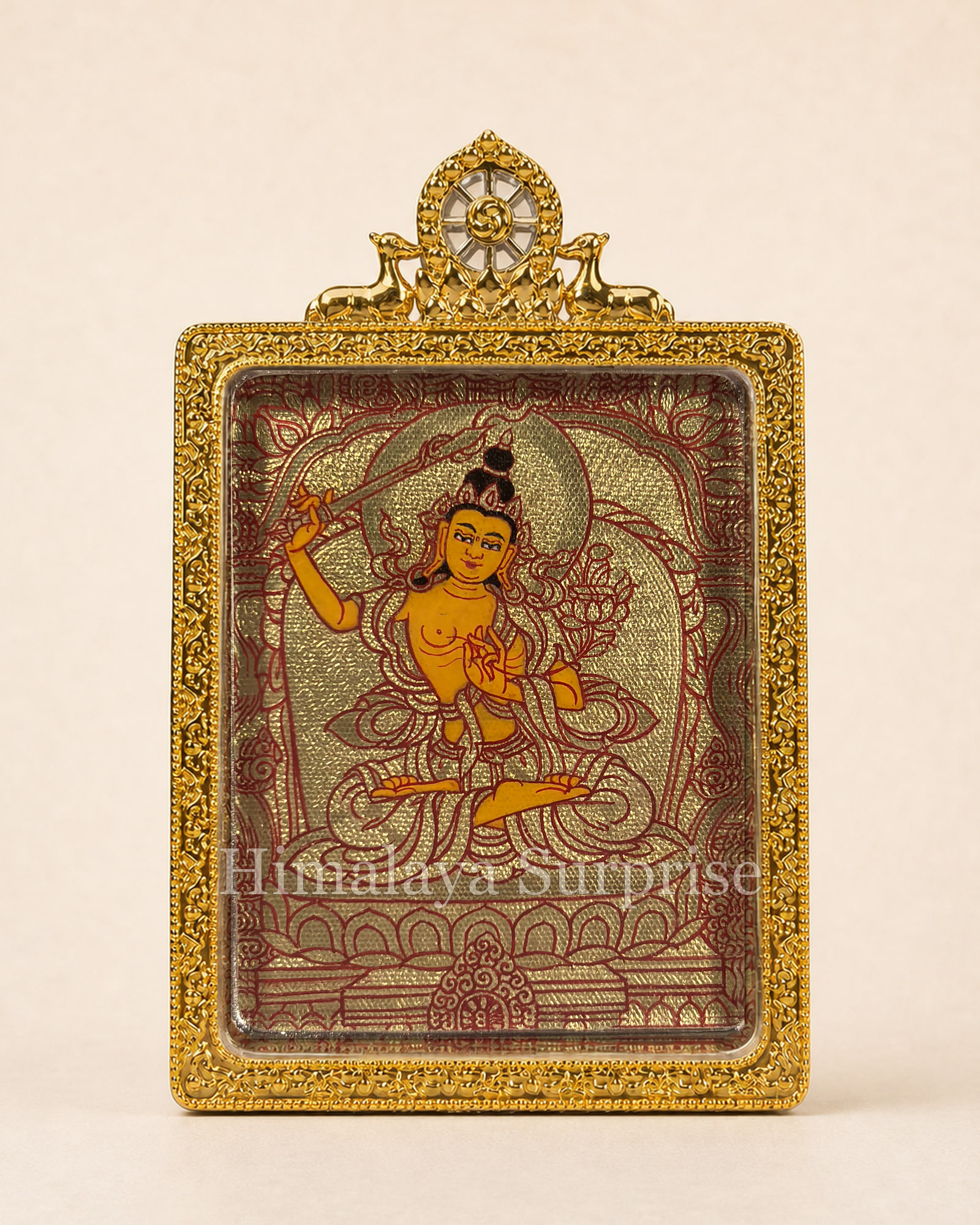
Compare the artist, painted dimensions, materials and condition alongside the image. Separate paintings of Amitabha, Guanyin and Dashizhi are individual works; they do not automatically form one historical triad or a matched set. The thangka buying guide develops these practical questions. The selection below offers a way to explore actual works after reading, with each product’s photographs and details on its own page.
Questions and answers
Is Amitabha a Buddha or a bodhisattva?
He is a Buddha. Dharmakara is the bodhisattva name used in the scriptural account of his path before Buddhahood. These refer to different stages of that account.
Does every Amitabha triad include Mahasthamaprapta?
No. The familiar East Asian Western Triad includes Guanyin and Mahasthamaprapta, but other Amitabha triads have different attendants. The Korean bronze shown here includes Ksitigarbha. Identify the specific figures from the work and its record.
Must Amitabha be red and hold a bowl?
Those are familiar Tibetan features, but the standing Chinese painting above shows another form. Colour and a single attribute should be read with posture, clothing, setting and the documented title.