Discover / Art & History
Tibet and Buddhism: Beliefs, History and the Art of Thangka
Understand Tibetan Buddhist beliefs, history and major traditions, then explore how lineage, patronage and wisdom take shape in thangka paintings.
In this story
Buddhism began in South Asia. In Tibet, centuries of translation, teaching and artistic exchange gave rise to a tradition that joins philosophical study with meditation, ritual and a remarkably rich visual culture. To understand the connection between Tibet and Buddhism, it helps to follow both the teachings and the images made around them. A thangka can hold the portrait of a teacher, a vision of awakening and the memory of the person who commissioned it—all on one piece of cloth.
What Tibetan Buddhism teaches
Tibetan Buddhism belongs to the Mahayana Buddhist tradition and includes Vajrayana forms of practice. Its foundations are shared with the wider Buddhist world: suffering has causes, those causes can be understood, and conduct, meditation and wisdom can help bring suffering to an end. The Four Noble Truths give this inquiry its basic shape. Karma concerns intentional actions and their consequences; it is not a verdict that a person’s future is already fixed.
The bodhisattva ideal brings the welfare of other beings into the centre of this path. Compassion is the wish for beings to be free from suffering; wisdom examines how things exist. In teachings on emptiness, things do not possess a permanent, independent essence. This does not mean that nothing exists or that actions have no consequences. Compassion and wisdom are cultivated together.
Vajrayana adds particular uses of mantra, visualisation and ritual, transmitted through teachers. These practices help explain why images matter so much: a figure can embody a quality of awakening and become a focus for recollection or meditation. Some practices require instruction and initiation. A public introduction to a painting can explain what is represented without pretending to supply the practice itself.
How Buddhism took root in Tibet
Buddhist connections strengthened during the Tibetan Empire of the seventh to ninth centuries. Royal support, visiting teachers and translation into Tibetan helped turn imported texts into a sustained intellectual and religious life. Samye, established in the late eighth century, became a landmark of this early period. Its importance lies in the institutions of learning and transmission that gathered around it.
Political disruption in the ninth century weakened imperial Buddhist institutions, but it did not erase every community or teaching. From the late tenth century, new journeys by translators and teachers helped renew transmission. Indian and Nepalese connections remained important. This later period brought new texts, monasteries and lineages alongside traditions that preserved the earlier teachings.
Paintings belong to this history of movement. Teachers needed images for teaching and devotion; patrons commissioned works; artists brought skills across regions. Tibetan Buddhism also took root in places including Bhutan, Mongolia and Ladakh, and has communities around the world today. The tradition represented in a picture, the artist’s origin and the place where the work was made need not be identical.
Why a teaching becomes a painting
A thangka is a portable sacred image, commonly painted on cloth and finished with a textile mounting. It can support devotion, teaching and meditation. Some works centre on a Buddha or bodhisattva; others depict a teacher, a sacred realm, a mandala or episodes from a life. A single painting can hold more than one of these functions.
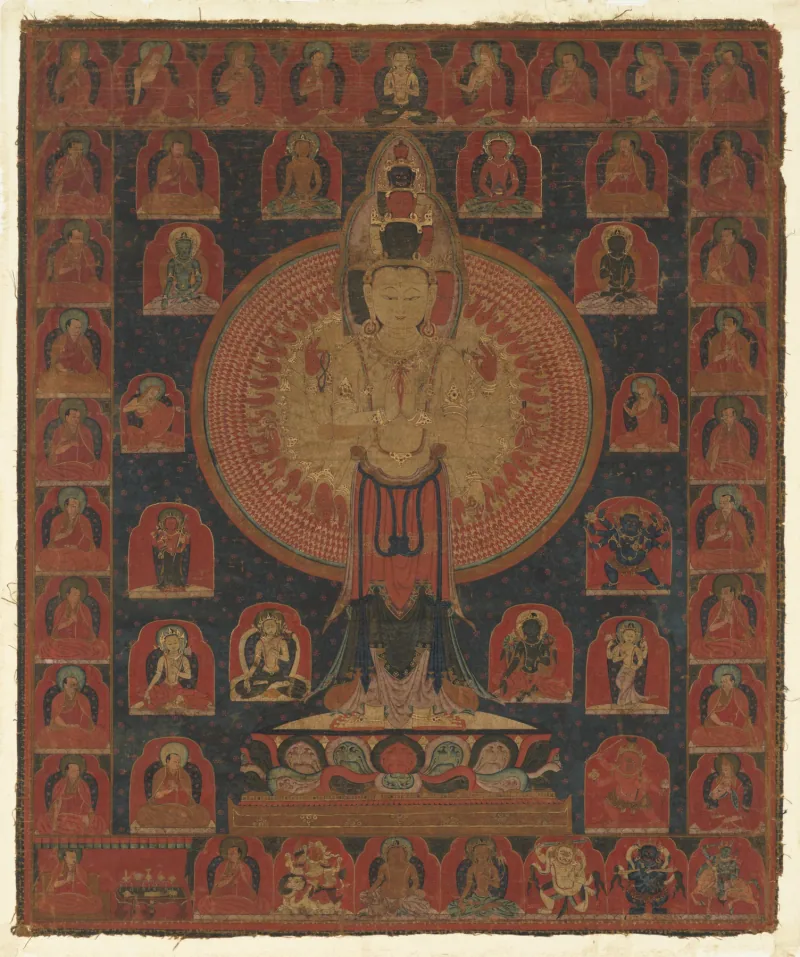
The larger central figure usually draws the eye first. Smaller figures around it may identify teachers, attendants or patrons. Those relationships are often more revealing than an isolated symbol. The historical paintings below show how much a composition can tell us when we read its people and its history together.
A teaching lineage, arranged around Amitabha
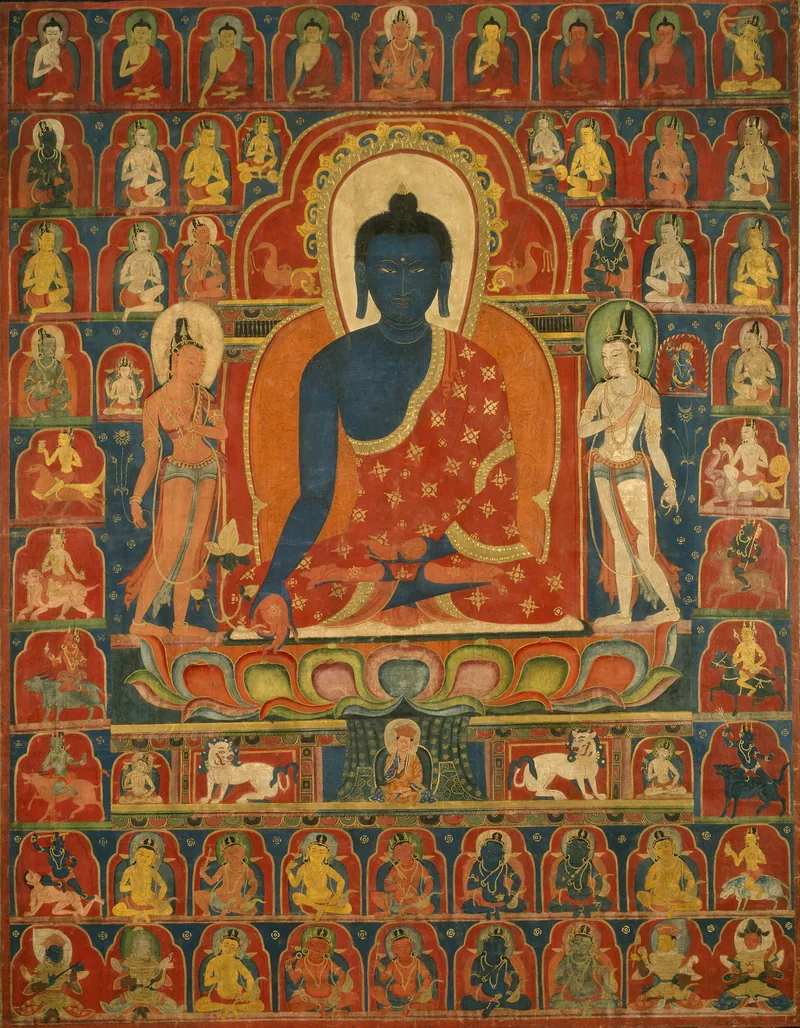
In this painting from around the twelfth century, Amitabha sits between two bodhisattvas. Two rows of monks occupy the upper part; six adepts appear below. The composition places the Buddha alongside those who transmit and practise the teachings. Three flaming jewels before the throne evoke Buddha, Dharma and Sangha.
The unfinished areas also leave the underlying ink drawing visible. Looking between the central figure and the surrounding rows reveals both a religious structure and an artist’s working lines. The small figures are part of the painting’s subject, not simply a decorative border.
Four traditions, many shared teachings
The teachers shown in paintings belong to histories of transmission. Nyingma, Kagyu, Sakya and Gelug are the four tradition names most often encountered in introductions. They share Buddhist foundations, and each contains more variety than a single label suggests. Their histories and teacher lineages offer a useful way to begin.
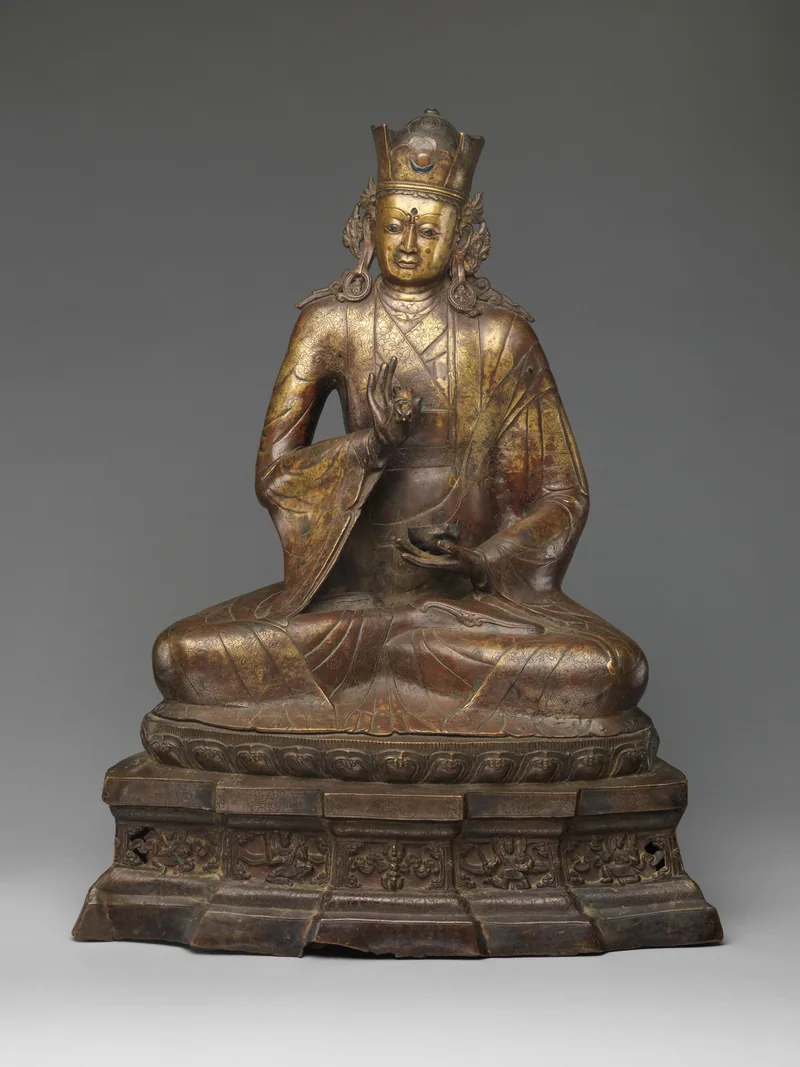
Nyingma preserves teachings associated with the early transmission. Padmasambhava, also known as Guru Rinpoche, holds a central place in its religious history. His portraits and life stories make him a frequent subject in Tibetan Buddhist art.
Kagyu includes lineages associated with Marpa, Milarepa and Gampopa, with an important place for meditation and the relationship between teacher and student. Paintings of successive teachers can make that relationship visible across generations.
Sakya developed around the Khön family and Sakya Monastery from the eleventh century. The Lamdre, or Path and Result, teachings are central to its tradition. Portraits of Sakya teachers often connect a painting to a particular history of instruction and patronage.
Gelug grew from the teaching of Tsongkhapa around the turn of the fifteenth century, emphasising disciplined monastic life and rigorous study. The Dalai Lamas are associated with this tradition; they are not the heads of all Tibetan Buddhist schools. Jonang and other lineages also belong in a fuller account of Tibetan Buddhism.
A painter, a patron and a travelling tradition
This Green Tara, dated to the 1260s, is associated with Central Tibet and attributed to Aniko, a Nepalese artist active in Tibet. The attribution connects one work to a wider history of artistic exchange.
Beneath Tara’s right hand is a tiny monastic figure: the person who commissioned the painting. Mantras also survive on its reverse. A closer look therefore adds people and use to the image of the deity. The picture has a subject, but also a history of commissioning, use and preservation.
Wisdom on a smaller scale
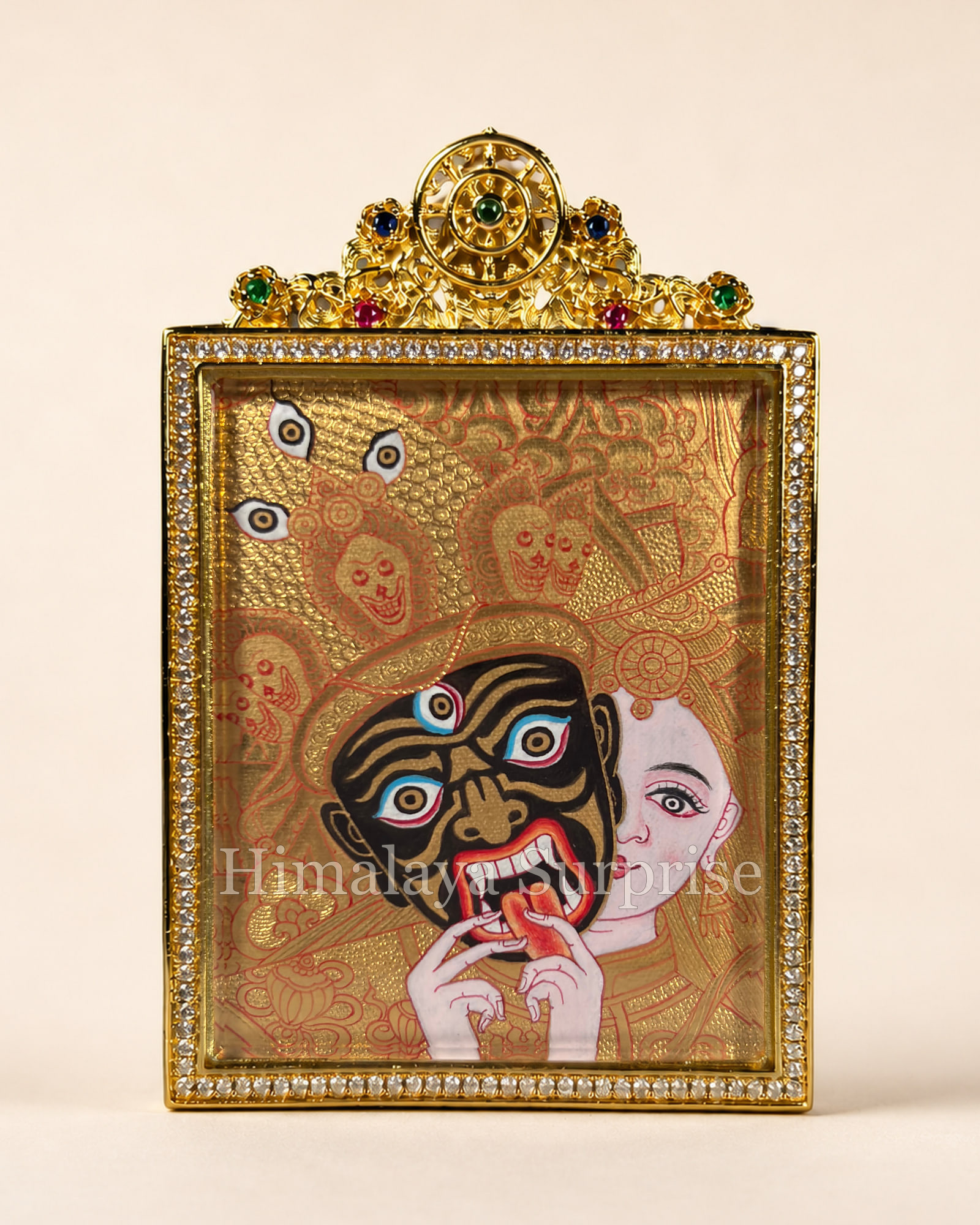
The same attention to a figure and its attributes can guide us with a contemporary miniature. In this gold-ground Manjushri thangka, the painted image measures 4 × 5 cm. The raised sword and the scripture supported by a lotus are the main details to look for. In Manjushri’s iconography, the sword is associated with cutting through ignorance; the book connects wisdom with the perfection of wisdom teachings.
At this scale, the space around a hand or a lotus becomes especially noticeable. Follow the red outlines against the gold ground and see how the painter keeps the attributes distinct. This is a useful point at which meaning and workmanship meet: understanding the subject gives us more precise things to look at.
Returning to the whole painting
A Buddhist painting rewards more than one kind of attention. We can follow its religious subject, the people who carried its teachings, or the choices of the painter. Knowing a school’s name is a beginning; seeing how a teacher, a donor or an attribute is actually placed in a work takes us further.
That is the value of approaching Tibet and Buddhism through thangka art. History and ideas become easier to remember when they meet an image we have taken time to look at. And the next painting becomes an invitation to notice something new.