Discover / Subjects & Meaning
Medicine Buddha: Meaning, Symbols and How to Read a Thangka
Who is Medicine Buddha? Explore his names, twelve vows, blue body, bowl and medicinal fruit through two historical paintings, and learn what distinguishes his thangkas.
In this story
Medicine Buddha, or Bhaiṣajyaguru, embodies the Buddhist wish to relieve suffering through compassion and wisdom. In many Tibetan thangkas, that wish takes a familiar form: a blue Buddha in monastic robes, holding a bowl and a medicinal fruit. The small things in his hands tell us who he is; the figures around him reveal a much larger religious and artistic world.
Who is Medicine Buddha?
Bhaiṣajyaguru is usually translated as “Medicine Master” or “Medicine Guru.” In Tibetan contexts he is often called Sangye Menla; in Chinese, Yaoshi Fo, or more fully Yaoshi Liuliguang Rulai, the Medicine Buddha of Lapis Lazuli Radiance. These names belong to the same subject, rather than to a different Buddha for each language.
Medicine Buddha is a fully awakened Buddha in Mahayana Buddhist tradition, associated with an eastern pure land. He is distinct from the historical Buddha, Shakyamuni, and from Amitabha, whose western pure land is a different subject. A painting may place several of them together, but their names and attributes remain meaningful.
The twelve vows: an overview of their themes
The Medicine Buddha sutra tradition describes twelve great aspirations made before his awakening. They concern light and wisdom, guidance on the Buddhist path, relief from illness and hardship, and necessities such as food and clothing. Read together, they place care for suffering beings within the larger aim of awakening.
This explains why “healing” in this imagery has more than one register. Medicine and the relief of bodily suffering matter, while ignorance, attachment and aversion are also understood as sources of suffering. The image can express both practical care and the Buddhist metaphor of the teaching as medicine.
Follow the hands to the bowl and fruit
In the familiar Tibetan form, Medicine Buddha has a deep-blue body, one face and two arms, and wears the robes of a monk. His left hand rests in his lap in meditation, supporting a bowl. His right hand extends over the knee in a gesture of giving and holds a myrobalan fruit or a fruit-bearing plant. Right and left here refer to the figure’s own hands.
Myrobalan is commonly identified as the fruit of Terminalia chebula, called haritaki in Sanskrit and arura in Tibetan. Its place in traditional medicine helps explain its role as a religious attribute. In a small painting it may appear as a tiny fruit, a stem or a leaf-bearing branch, so the hand and plant need to be looked at together.
The bowl is often described in ritual texts as containing nectar. A painted rim or a few coloured shapes cannot establish what a real vessel contained, but their arrangement can show the painter’s care: the curve of the palm, the bowl’s opening, and the space between the vessel and robe make a very small object legible.
The people around a fourteenth-century Buddha
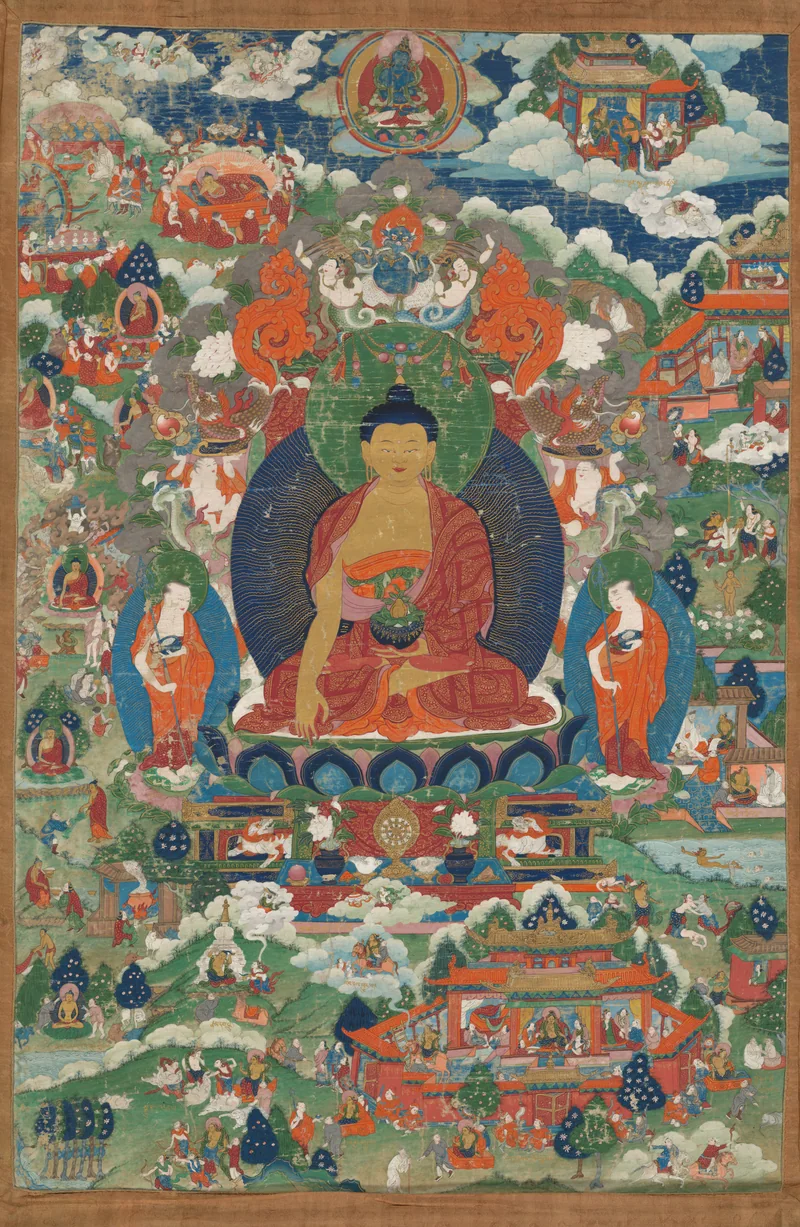
The Tibetan painting above, now in the Art Institute of Chicago, dates to the fourteenth century and is painted with pigment and gold on cotton. The blue central Buddha is flanked by the sun and moon bodhisattvas, Suryaprabha and Chandraprabha. Their contrasting colours and positions make the central group stand out within the dense arrangement.
The bottom rows include twelve yaksha generals; the four guardian kings occupy the corners. Padmasambhava appears directly beneath Medicine Buddha. The reverse also bears prayers invoking Padmasambhava, suggesting a connection with the Nyingma tradition. An individual painting can therefore carry both its principal subject and the devotional circumstances of its making.
Different traditions use “Seven Medicine Buddhas” and “Eight Medicine Buddhas” in different ways. Some refer to the seven tathāgatas described in the sutra; others count Medicine Buddha with seven related Buddhas, or include Shakyamuni in an eight-tathāgata assembly. A painting’s title and ritual context help establish which arrangement it follows. The twelve yaksha generals are a separate group within the retinue. A single-figure thangka may omit the surrounding assembly.
Blue is a clue, not the whole identification
The deep blue connects the figure with his name and the radiance described in the religious tradition. It does not tell us which pigment a painter used. A blue-painted body should not become a claim that a thangka contains ground lapis lazuli without material evidence for that particular work.
Akshobhya can also be blue. In a familiar form, his right hand reaches down in the earth-touching gesture and his left supports a vajra. Medicine Buddha’s giving hand with its medicinal plant and his bowl offer a different combination. When details are indistinct, the title, surrounding figures and a reliable object record help resolve what colour alone leaves open.
For a broader comparison, Shakyamuni, Amitabha and Medicine Buddha brings gesture, dress and context together. Those relationships are more useful than memorising one colour for each Buddha.
The same subject, a different visual language
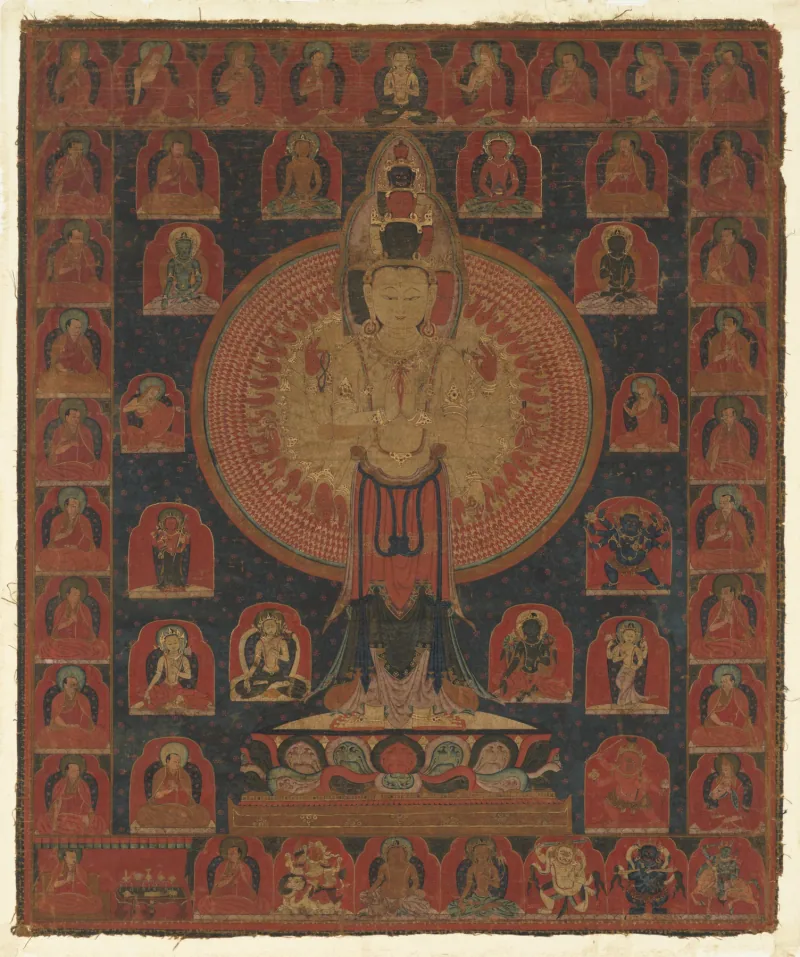
This Chinese mural of about 1319, now at The Metropolitan Museum of Art, once belonged to the Lower Guangsheng Temple in Shanxi. Its central Buddha wears red and green garments and is surrounded by a large assembly. The white moon and red sun identify the attendant bodhisattvas, while two smaller figures carry a monk’s staff and a medicine bowl. Here, identifying attributes are distributed through the scene.
Compared with the Tibetan thangka above, the colour, scale and placement of attributes change. The comparison gives a useful answer to a common question: Medicine Buddha need not always look like a solitary blue Buddha holding both objects himself. First recognise the tradition and composition you are looking at, then apply its visual clues.
Why a thangka appears alongside prayer and mantra
Medicine Buddha images are used in Buddhist prayer, study and visualisation. A thangka gives the practitioner a stable image to return to: posture, hands, attributes and the surrounding assembly can all be part of that remembered form. The use of the painting depends on the tradition and the person; it can also be studied as a work of art.
One commonly encountered Tibetan phonetic rendering of the mantra is “Tayata Om Bekandze Bekandze Maha Bekandze Radza Samudgate Soha.” Other publications use Sanskrit spellings such as bhaiṣajye and svāhā. These differences need not indicate a different subject, but pronunciation and practice should follow the teaching being used rather than a commercial page’s improvised word-by-word translation.
Religious teachings may speak of blessings, purification and healing. Those are statements within a tradition, not evidence that purchasing an image treats an illness. Prayer and art can be meaningful companions to care; they do not replace medical assessment or treatment. Formal practices may also require a teacher’s guidance or empowerment.
What to look for in an individual thangka
Once the subject is clear, look at how the painter has made it visible. Can you follow the plant from the hand to its tip? Does the bowl keep its shape at the painting’s actual size? Do the face, robes and lotus remain distinct, and do the smaller figures have a clear place in the composition? These are questions about the work in front of you, not about the amount of gold or the force of a sales description.
A useful work description names the subject and gives the painted dimensions, materials and maker where known. A full image shows the arrangement; a closer view shows how the smallest attributes were handled. Begin with the identity, then stay with the looking. The bowl and fruit are small, but a painter’s choices around them can say a great deal.
Questions about Medicine Buddha
Is Medicine Buddha the same as Shakyamuni?
They are distinct Buddhas in Buddhist tradition. Shakyamuni is the historical Buddha; Medicine Buddha is Bhaiṣajyaguru, associated with medicine-related aspirations and an eastern pure land. They can appear together in a larger composition.
Does every Medicine Buddha painting include twelve generals?
No. A single-figure painting may omit them. Larger mandala compositions can include the twelve yaksha generals, other Buddhas and bodhisattvas. The surrounding assembly varies with the composition and tradition.
Where can a Medicine Buddha thangka be displayed?
A clean, stable position where the painting can be seen comfortably is a good starting point. Protect it from direct sunlight, damp, smoke and nearby flames. A devotional setting follows the owner’s tradition; an art display can focus on clear viewing and the work’s care.