Discover / Subjects & Meaning
The Five Dhyani Buddhas: Names, Meanings and Himalayan Art
Meet the Five Dhyani Buddhas and their colours, gestures and family emblems. A ritual crown, an early Tibetan thangka and a mandala show how the five appear in art.
In this story
The Five Dhyani Buddhas are Vairocana, Akshobhya, Ratnasambhava, Amitabha and Amoghasiddhi. Often called the Five Wisdom Buddhas or Five Tathagatas, they express different qualities of awakening in Vajrayana Buddhism. Their familiar white, blue, yellow, red and green colours make the group memorable. In Himalayan art, however, the five can occupy a crown, a mandala or a set of separate paintings. Their relationships are as interesting as their individual names.
What does a Buddha family mean?
A Buddha family is a way of bringing awakened qualities, figures and symbols into relation. The Sanskrit names commonly encountered are Tathagata or Buddha, Vajra, Ratna, Padma and Karma: the Buddha, vajra, jewel, lotus and action families. Each has a presiding Buddha, but a family extends beyond that one figure to related deities and qualities. It is a religious classification rather than a biological family tree.
The fivefold system is especially important in Yoga and Anuttarayoga tantra. It is not the only classification used in Buddhism: Kriya and Charya systems commonly use three families. “Dhyani Buddhas” is a familiar English label for the five, not a count of every Buddha or a single traditional name used everywhere. Five Transcendent Buddhas and Five Symbolic Buddhas are other names found in discussions of this group.
Vairocana: the Buddha family
Vairocana, also spelled Vairochana, is the white Buddha of the familiar fivefold arrangement, usually placed at its centre. A wheel is the Buddha family’s emblem. His hands often make a teaching gesture associated with turning the Dharma wheel; other forms use different arrangements. The Vairocana guide looks more closely at those variations.
Akshobhya: the vajra family
Akshobhya means the Immovable One. He is commonly blue, associated with the east and the vajra family. His right hand often reaches toward the earth, while the vajra supplies a further identifying attribute. Shakyamuni can use the same earth-touching gesture, so the hand becomes more informative alongside body colour, emblems and the surrounding group.
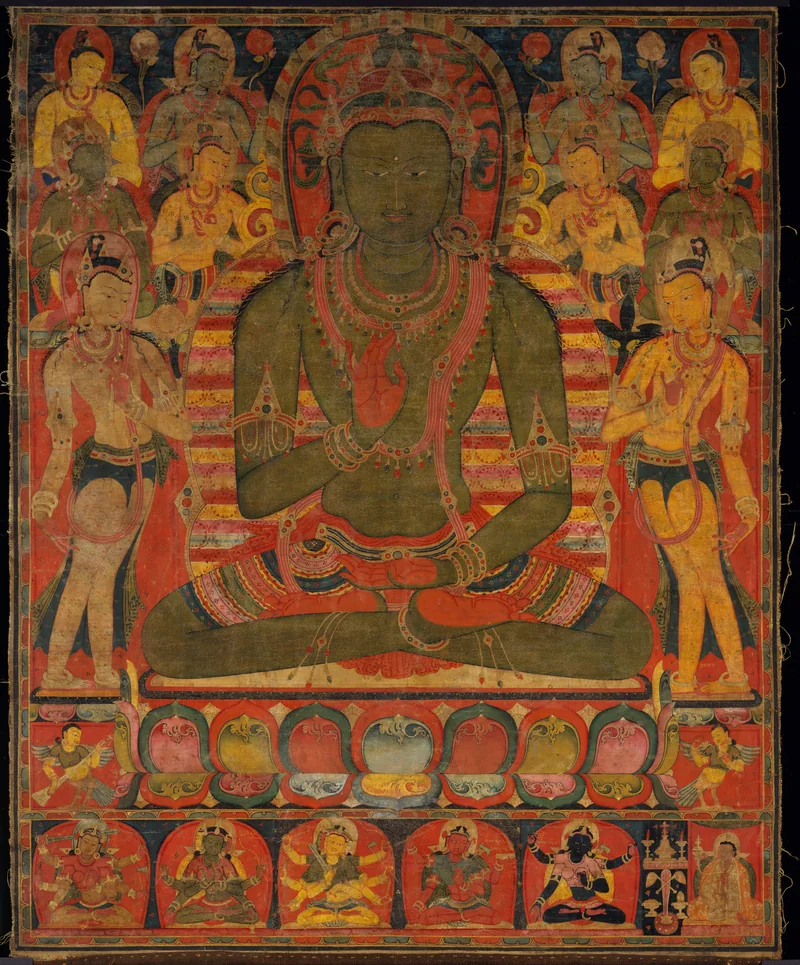
In the early Tibetan painting above, the large blue Akshobhya wears a crown and jewellery, sits between two attendants and is surrounded by small repeated figures. A vajra appears before the throne. This is an adorned Buddha, not a bodhisattva simply because he wears a crown. The painting’s scale and framing create a powerful individual presence within a wider five-Buddha setting.
Ratnasambhava: the jewel family
Ratnasambhava, the Jewel-Born Buddha, is commonly yellow or gold and associated with the south. The family emblem is a jewel. His right hand often extends downward with its palm open in varada, the gesture of giving. This outward palm distinguishes generosity from the inward-facing earth-touching hand familiar in Akshobhya images. The left hand may rest in the lap or accompany a jewel.
Amitabha: the lotus family
Amitabha, the Buddha of Infinite Light, is commonly red and associated with the west. Padma, the lotus, names his family and its emblem. The hands frequently rest in meditation in the lap. He is also central to Pure Land traditions, where Sukhavati is his western paradise; that broader devotional setting reaches beyond a five-family diagram. Our Amitabha and Pure Land guide follows those paintings and their attendants.
Amoghasiddhi: the action family
Amoghasiddhi is associated with unfailing accomplishment. In the familiar grouping he is green, belongs to the north and presides over the Karma or action family. A crossed or double vajra is a common emblem; some presentations use a sword. His raised open palm often makes the gesture of fearlessness, abhaya. Together, these attributes give visual form to wisdom expressed through action.
Why are they called the Five Wisdom Buddhas?
The five give visual form to qualities of awakened awareness. Common explanations name the wisdom of the dharmadhatu, mirror-like wisdom, equality, discernment and accomplishment. They concern seeing the nature of phenomena, reflecting clearly, recognising equality, distinguishing without clinging and acting effectively. Colours and emblems help make these ideas visible and memorable.
A widely used explanation pairs Vairocana with ignorance transformed into dharmadhatu wisdom, Akshobhya with anger and mirror-like wisdom, Ratnasambhava with pride and equality, Amitabha with attachment and discernment, and Amoghasiddhi with jealousy and accomplishment. Particular tantric explanations can assign the correspondences differently. The scheme describes transformation in a religious teaching; it is not a personality test based on a favourite colour.
Five images carried on a ritual crown
This late-fourteenth- to early-fifteenth-century Tibetan crown carries the five on separate painted panels. In this object’s documented order, from right to left, they are Ratnasambhava, Amitabha, Vairocana, Amoghasiddhi and Akshobhya, with Vairocana in the middle. The panels curve around the head, so a frontal photograph shows the central image more clearly than those at the sides.
Monks wore such crowns in rituals, and they could also form part of ceremonial dance costumes. The five-family grouping therefore belongs to objects used and worn, as well as images hung on a wall. Here the repeated panel shape binds different figures into a single object, while their colours and gestures distinguish them.
One thangka can belong to a five-painting set
The Akshobhya painting at the beginning dates to the thirteenth or early fourteenth century in Central Tibet. It functioned as one of a set of five paintings, typically venerated in a mandala configuration. The five did not have to share one painted surface to form a connected group. Each scroll could give its own Buddha a large, detailed setting.
A single surviving painting can consequently carry both an individual subject and a place in a larger ensemble. Repeated figures around its border do not turn it into a complete five-Buddha set. Nor does collecting five broadly similar paintings establish an original historical grouping. The set is part of this work’s documented context.
Why the centre can change
A familiar arrangement places white Vairocana in the centre, blue Akshobhya in the east, yellow Ratnasambhava in the south, red Amitabha in the west and green Amoghasiddhi in the north. These are directions within the mandala, not a guarantee that the top of a reproduced painting means north. The particular subject establishes how the space is organised.
In a fourteenth-century Guhyasamaja-Akshobhyavajra mandala, the central focus is a form of Akshobhya, while Vairocana occupies the east. The change is meaningful within that particular teaching. It explains why a general five-Buddha diagram can be useful for learning the names yet insufficient for reading every mandala.
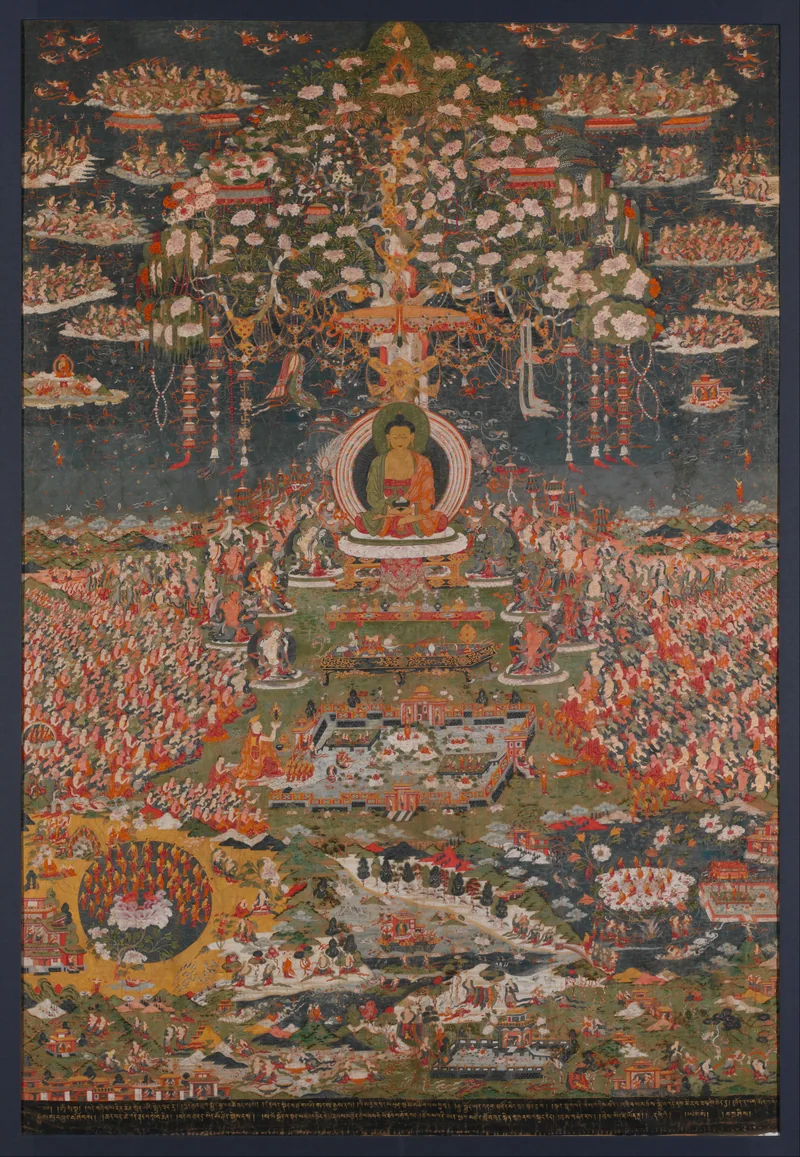
The sixteenth-century painting shown here brings four mandalas of the Guhyasamaja cycle onto one cloth. Palace walls, gates, concentric enclosures and many small figures organise a dense sacred space. Its five-family imagery includes Guhyasamaja, a form of Akshobhya, alongside Vairocana, Ratnasambhava, Amitabha and Amoghasiddhi. Four visible mandalas and five Buddha families describe different aspects of this painting.
Five Buddhas and other familiar groups
The Five Dhyani Buddhas are not simply five forms of Shakyamuni, and Medicine Buddha is not one of the five names in this usual grouping. Akshobhya and Medicine Buddha can both be blue, but their attributes and settings differ. A jewel, a vajra, a medicine bowl or fruit can clarify an image more effectively than colour alone. The comparison of Shakyamuni, Amitabha and Medicine Buddha addresses that separate identification question.
Seeing the relationships
Once the names become familiar, the group begins to look less like a list. A curved crown joins five panels; a large blue Buddha suggests a wider painted ensemble; a mandala gives figures their places within a palace. Colour, hands and repeated forms work together. Those relationships make the five an especially rewarding subject to look at closely.
Questions and answers
Who are the Five Dhyani Buddhas?
They are usually Vairocana, Akshobhya, Ratnasambhava, Amitabha and Amoghasiddhi. The same grouping is often called the Five Wisdom Buddhas or Five Tathagatas.
What are the five family symbols?
In a familiar grouping, the Buddha family uses a wheel, the vajra family a vajra, the jewel family a jewel, the lotus family a lotus and the action family a crossed vajra. Some presentations use a sword for the action family.
Does Vairocana always occupy the centre?
He occupies the centre in a familiar fivefold arrangement, but particular mandalas can centre another figure. Guhyasamaja-Akshobhyavajra provides a documented example, with Vairocana in the east.