Discover / Subjects & Meaning
Amoghasiddhi Buddha: Meaning, Symbols and the Green Buddha
Understand Amoghasiddhi, the green Buddha of the north, through his name, fearlessness gesture, crossed vajra, relationship with Tara and two historical works.
In this story
Amoghasiddhi is one of the Five Wisdom Buddhas, associated with the north, green colour and all-accomplishing wisdom. A raised palm is a familiar sign, but paintings and sculptures reveal more than one way to represent him.
Who is Amoghasiddhi?
The name Amoghasiddhi is usually translated as “unfailing accomplishment” or “unobstructed accomplishment.” Amogha carries the sense of not being in vain; siddhi refers to accomplishment. His Chinese name, 不空成就佛, expresses the same connection. In Tibetan he is Dön yö Drub pa, written don yod grub pa in Wylie transliteration.
You may also encounter the spelling Amogasiddhi. It refers to the same Buddha rather than a separate figure. Within the Five Buddha families, Amoghasiddhi belongs to the Karma family, associated with enlightened activity. This is a different setting from an account of the historical life of Shakyamuni.
What does all-accomplishing wisdom mean?
Amoghasiddhi’s wisdom is concerned with activity: wisdom expressed in what is done for the benefit of beings. It is commonly described as the transformation of jealousy or envy into all-accomplishing wisdom. The movement is from anxious comparison with others toward an activity no longer driven by that comparison.
“Accomplishment” here belongs to a Buddhist account of awakening. It gives the Buddha’s calm presence and fearlessness gesture their religious meaning; it is not a guarantee that an image will make a project succeed. Reading the name in this context brings together wisdom, compassion and action rather than separating success from its purpose.
The green body and the raised palm
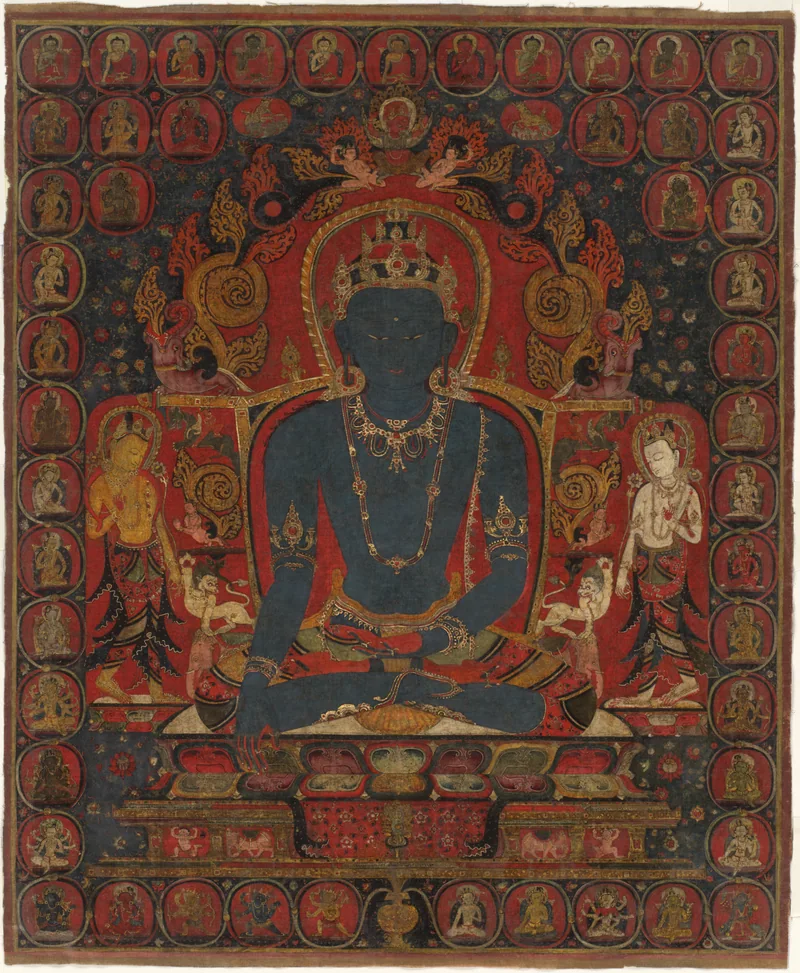
A familiar painted form is green, seated on a lotus, with the right hand raised and the palm turned outward. This is abhayamudra, the gesture of fearlessness or reassurance. The left hand often rests in the lap. The quiet face and open palm make a striking contrast with the richly patterned clothes and surrounding figures.
Neither green colour nor a raised palm identifies Amoghasiddhi on its own. Other Buddhist figures share these features, while some images of Amoghasiddhi use different gestures or attributes. He can appear in monastic robes or in a peaceful crowned form with jewellery. The crowned appearance does not make him a different deity.
A thirteenth-century Amoghasiddhi painting
The opening painting was made in Central Tibet around 1200–1250. Its green Buddha wears a crown and jewellery above red garments. The right hand opens before the chest, and the other hand rests near the lap. Fine lines in the clothing and the surrounding compartments reward a closer view.
Eight bodhisattvas surround the central Buddha, and Tara figures occupy the lower part of the work. Those smaller images turn a single seated figure into a larger religious arrangement. Looking from the central palm to the companions also makes clear why a cropped face or a colour label tells only part of the story.
A metal image with a different gesture
This silver and bronze Amoghasiddhi was made in Western Tibet in the late tenth or early eleventh century. Copper inlay and traces of gold foil add to its metal surfaces. At just over twenty centimetres high, it brings the same Buddha into a very different material and scale from the painted cloth.
The hands are held before the body rather than displaying the painting’s raised open palm. A crossed vajra appears at the front, while Garuda kneels below the architectural throne support. The relationship between figure, emblem and throne provides the useful clues here. A rule that every Amoghasiddhi must be painted green or show one particular gesture would miss this object.
The crossed vajra
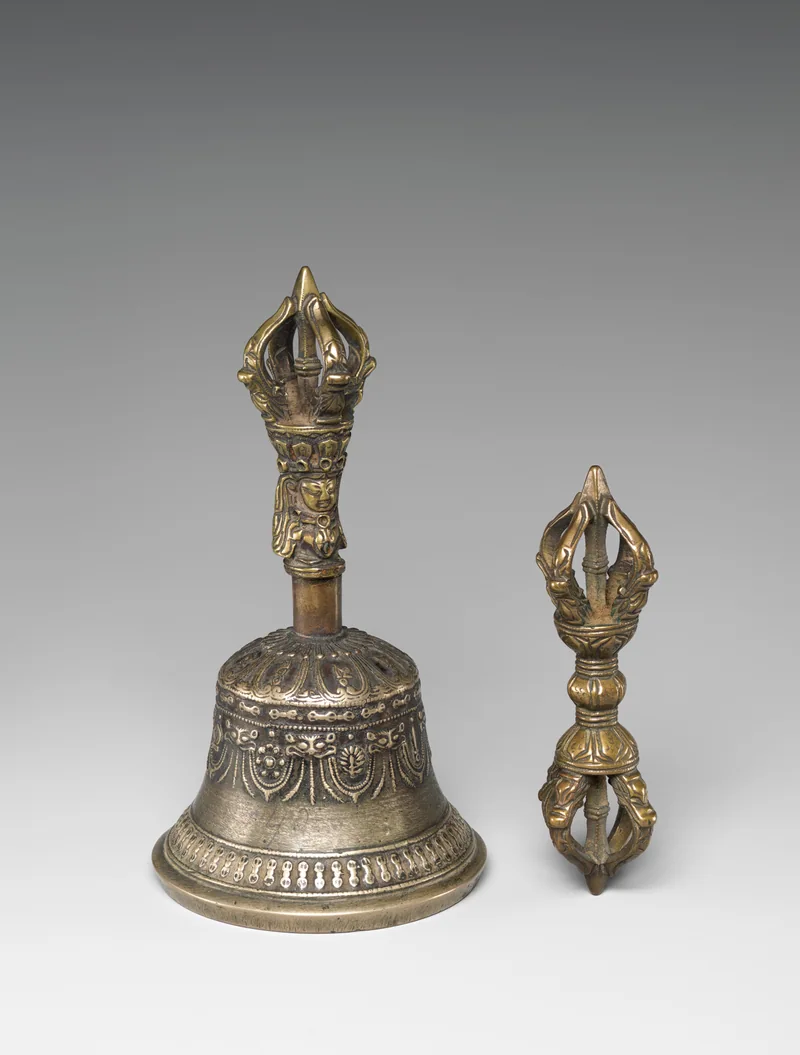
The crossed vajra, or viśvavajra, is an emblem associated with Amoghasiddhi’s Karma family. Two vajra forms cross at the centre, extending in four directions. It can be represented as a held attribute, an emblem in front of a figure, or a motif within a larger design.
The shape also occurs beyond images of Amoghasiddhi, so it is useful in combination with other features. In the metal sculpture, its position beside the hands helps identify the figure. On another object, the same motif may serve a broader ritual or decorative purpose. The vajra and dorje guide follows that wider use.
The northern Buddha and Tara
In a common arrangement of the Five Wisdom Buddhas, Amoghasiddhi is associated with the north. This is a position within a religious system, not an instruction to read every painting as a fixed map. Sets, mandalas and individual portraits can organize their figures differently.
Tara is associated with Amoghasiddhi as his wisdom counterpart in common five-family accounts, and Green Tara shares the emphasis on compassionate activity. They are distinct figures. The Tara images below the Buddha in the opening painting show one way their imagery can meet, without suggesting that every Green Tara painting must include Amoghasiddhi.
His name in the mantra
A commonly written mantra is Om Amoghasiddhi Ah Hum, more fully transliterated oṃ amoghasiddhi āḥ hūṃ. The syllable āḥ also appears as his seed syllable. Spellings vary as Sanskrit sounds are represented in Tibetan and Roman letters, so a short English transcription does not show every detail of the written form.
The name, the open palm and the crossed vajra all return to a theme of awakened activity. The two works give that theme different forms: a green figure within a painted assembly, and a small metal Buddha above an elaborate throne. Their differences make the shared identity more interesting to look at.
Questions and answers
Is Amoghasiddhi one of the Five Wisdom Buddhas?
Yes. In a common five-family system he belongs to the Karma family, associated with the north, green colour and all-accomplishing wisdom.
What does Amoghasiddhi mean?
The name is commonly translated as unfailing or unobstructed accomplishment. It concerns awakened activity in Buddhist interpretation, rather than a promise of success from owning an image.
Does he always show the fearlessness gesture?
No. A raised right palm is familiar, but other forms use different gestures or attributes. The metal example here has hands before the body and a crossed-vajra emblem.
Are Amoghasiddhi and Green Tara the same?
They are distinct figures. Tara is associated with him as a wisdom counterpart in common five-family accounts, and their imagery shares an emphasis on compassionate activity.
Is Amogasiddhi a different Buddha?
No. Amogasiddhi is a spelling variant encountered for Amoghasiddhi; it does not identify a separate deity.