Discover / Subjects & Meaning
Samantabhadra Meaning: The White Elephant, Great Vows and Primordial Buddha
What does Samantabhadra mean? Explore Puxian, the six-tusked white elephant and Ten Great Vows, and distinguish the bodhisattva from primordial Buddha Kuntuzangpo.
In this story
Samantabhadra is often translated as “Universal Goodness” or “Universal Worthy”. The bodhisattva represents awakened conduct: carrying aspiration into practice. His familiar white elephant appears in East Asian Buddhist paintings, often beside Shakyamuni and Manjushri. In Tibetan Buddhism, the name can also refer to Kuntuzangpo, the primordial Buddha. These are distinct subjects. Their shared name makes more sense when we follow the images, from an elephant-mounted bodhisattva to a blue Buddha with Samantabhadri.
Who is Samantabhadra?
The bodhisattva is called Puxian in Chinese and Fugen in Japanese. In Mahayana Buddhism he is associated with vows, beneficial activity and dedication. Where Manjushri especially embodies wisdom, Samantabhadra brings attention to what follows from understanding: the way a person acts, learns and continues to benefit others.
The names cross languages, but their setting still matters. The Mahayana bodhisattva and the primordial Buddha of Nyingma and Dzogchen teachings are not interchangeable. A Tibetan work can depict either subject; its region alone does not settle the question.
Why the white elephant has six tusks
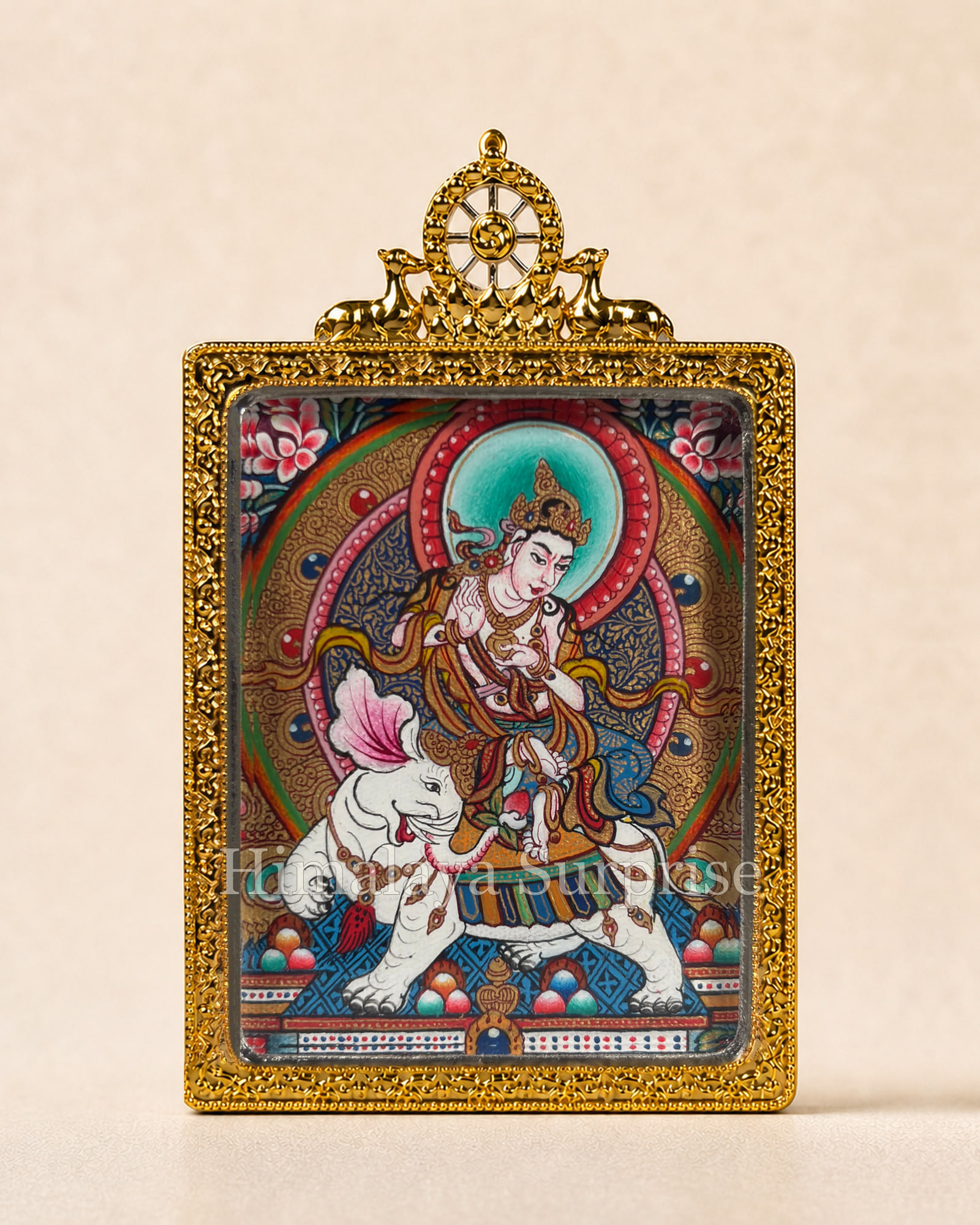
The final chapter of the Lotus Sutra describes Samantabhadra arriving on a white elephant with six tusks. This textual image became a familiar subject in East Asian Buddhist art. In paintings, the elephant can stand on lotus flowers and carry a lotus throne, lifting the seated bodhisattva above its broad back.
The mount gives the composition weight and movement. A softly bending trunk, rounded body and measured stance contrast with the upright, adorned figure above. A six-tusked elephant is a strong clue for this form of Samantabhadra, while other Buddhist images show the bodhisattva without a mount.
The Ten Great Vows
Samantabhadra’s vows give concrete form to the idea of universal goodness. A familiar Mahayana presentation gathers ten aspirations: paying homage to the buddhas; praising them; making offerings; acknowledging and purifying harmful actions; rejoicing in others’ goodness; requesting the teaching of Dharma; asking the buddhas to remain; learning from them; responding to living beings; and dedicating merit to all.
The sequence combines devotion with learning and conduct. Rejoicing recognises goodness beyond oneself; dedication extends the purpose of an action beyond personal benefit. Samantabhadra’s association with practice therefore has a wider meaning than willpower or a private wish.
The Prayer for Completely Good Conduct, associated with the closing part of the Avatamsaka Sutra, is another important expression of these aspirations. The vows and prayer help explain why Samantabhadra appears with a teaching Buddha: the image links receiving a teaching with carrying it into life.
A lotus carrying a sutra
A twelfth-century Chinese silk painting in the Cleveland Museum of Art makes the subject tangible. Samantabhadra sits above a white elephant, wearing red and green robes and holding a lotus whose blossom supports a sutra. Small lotus flowers beneath the elephant carry the idea of a sacred support through the whole scene.
An attendant with a staff stands below the much larger bodhisattva. The contrast in scale draws the eye upward, while the halo gathers attention around the calm face. The museum considers the painting probably the left panel of a triptych. It survives as one work, with signs of a wider original arrangement.
Samantabhadra beside Shakyamuni and Manjushri
In another Cleveland painting, dated to around 900, Shakyamuni occupies the centre of a three-figure assembly. From the viewer’s position, Samantabhadra and his elephant appear on the left; Manjushri and his lion are on the right. The animals make the two companions easy to distinguish within this particular composition.
The three figures share the pictorial space while keeping their own seats, haloes and proportions. Wisdom and conduct are brought into the setting of the Buddha’s teaching. Our Manjushri article explores the other bodhisattva’s sword, book and lion imagery.
Kuntuzangpo: primordial Buddha Samantabhadra
Kuntuzangpo is a Tibetan name meaning “all good”, also rendered Samantabhadra in English. In Nyingma and Dzogchen teaching, primordial Buddha refers to original awakening or awareness, rather than a historical teacher’s life. The familiar image has a blue, unclothed body and can appear in union with Samantabhadri, usually shown white or pale.
A seventeenth-century Tibetan painting in the Rubin Museum shows this contrast clearly: blue Samantabhadra is embraced by pale Samantabhadri, above a lotus and snow-lion throne. The couple belongs to a larger assembly that includes Padmasambhava and Vajrasattva. Its visual language is quite different from the elephant-mounted, ornamented bodhisattva.
A bodhisattva in a Tibetan initiation card
A small painting in The Metropolitan Museum of Art adds another setting. The museum titles it Initiation Card: Bodhisattva Samantabhadhra. Made in Tibet in the early fifteenth century, it measures about 16 by 14.5 centimetres and uses opaque watercolour on paper. This is a bodhisattva image in a Tibetan ritual set.
The red central figure appears with a pale-green companion, both framed by an arch of colour. The small format concentrates their bodies and ornaments into a close composition. It looks markedly different from the expansive elephant scenes above.
The cards could be arranged to create a mandala during an initiation ceremony. Each small figure was therefore part of a larger visual organisation. Here the bodhisattva title and the set’s function help explain the object; “Tibetan Samantabhadra” need not mean the blue primordial Buddha.
Samantabhadra in miniature painting
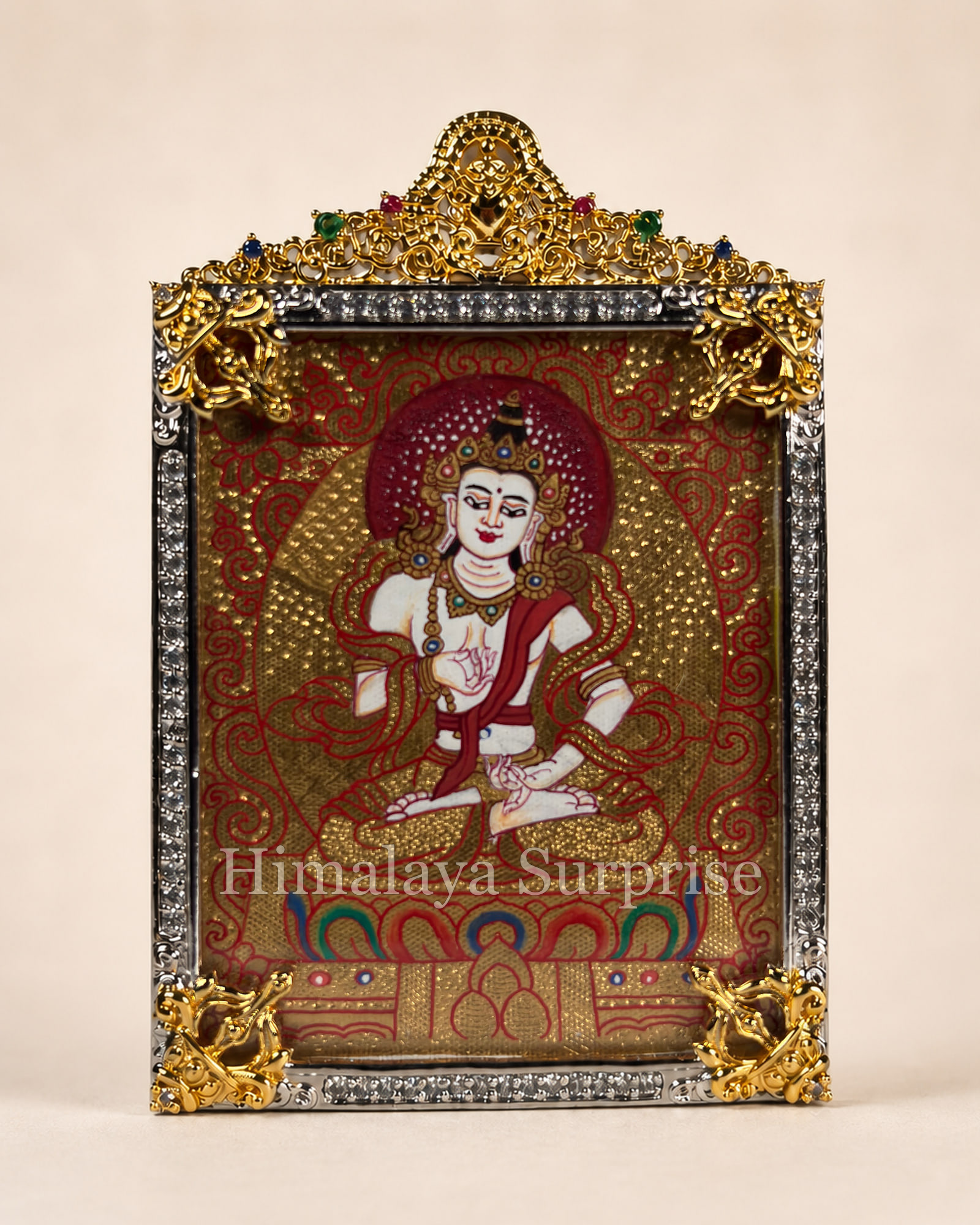
The white-elephant Samantabhadra shown at the beginning brings figure and mount into a painted area of 4 × 5 centimetres. Our gold-ground Samantabhadra takes a different approach, concentrating on the peaceful seated bodhisattva without an elephant. The same subject gives painters room for different compositions.
Questions and answers
What does Samantabhadra mean?
The name is commonly translated as “Universal Goodness” or “Universal Worthy”. It names the Mahayana bodhisattva associated with conduct and vows, and also the distinct primordial Buddha Kuntuzangpo in Tibetan Buddhism.
Why does Samantabhadra ride an elephant?
The Lotus Sutra describes Samantabhadra arriving on a six-tusked white elephant. This became a familiar image of the bodhisattva in East Asian Buddhist art. Some other forms have no mount.
Are Samantabhadra and Manjushri the same?
They are distinct bodhisattvas. Manjushri especially embodies wisdom; Samantabhadra is associated with conduct and vows. They often appear together beside Shakyamuni.
How does Kuntuzangpo look different?
The familiar primordial-Buddha form is blue and unclothed, sometimes with white or pale Samantabhadri. The elephant-mounted bodhisattva is an adorned figure in a different Buddhist setting.