Discover / Subjects & Meaning
Vajra Meaning: The Dorje, Its Forms and Buddhist Art
What does a vajra mean, and is it the same as a dorje? Explore its prongs, the bell pairing and crossed forms through real ritual objects and a Tibetan thangka.
In this story
Vajra is a Sanskrit word associated with the thunderbolt and diamond; dorje is its Tibetan name. In Buddhist art it commonly describes a short ritual implement with a central grip and pronged ends. The thunderbolt suggests irresistible force, while the diamond evokes firmness and indestructibility. These ideas enter Buddhist teaching as images of awakened understanding. A dorje may be held in a hand, paired with a bell or drawn as an emblem; its form and setting help explain what it means.
Vajra and dorje: two names for a familiar symbol
In a Tibetan Buddhist context, vajra and dorje usually refer to the same implement. The English words diamond and thunderbolt highlight different aspects of its symbolism. A bronze dorje need not contain a diamond, and the name does not describe the material from which every example is made.
Vajra also appears in larger religious terms. Vajrayana, often translated as the Vajra or Diamond Vehicle, names a Buddhist tradition; Vajrasattva and Vajrapani name particular figures. Recognising the shared word is useful, but the tradition, the deity and the object are different subjects.
Why a thunderbolt becomes a Buddhist symbol
In ancient Indian religious accounts, the vajra is the thunderbolt weapon of Indra, the god associated with storms and rain. Buddhist uses give it a further context: firmness, the force of awakened insight and the capacity to overcome ignorance. Mythic accounts of a divine weapon and surviving bronze ritual objects belong to different kinds of evidence.
This helps explain why English descriptions alternate between diamond and thunderbolt. One emphasises a quality that cannot be broken; the other an active force. In a painting these meanings become visible through a small, recognisable object rather than an illustration of a literal storm.
How a vajra is put together
A common Himalayan vajra has a central sphere or grip, a lotus-like base on either side and matching clusters of prongs. In a five-pronged end, one prong runs along the axis while four outer prongs curve around it. The five include that central prong; they do not mean five separate spikes on the outside.
The nineteenth-century Tibetan bell and dorje above show how sculpture gives this structure depth. Open spaces separate the curved prongs; small makara, or mythical aquatic-creature, heads appear at their bases. The bell handle repeats the pronged form, creating a visual relationship between two objects of very different shapes.
Why the vajra is paired with a bell
In a familiar Tibetan ritual convention, the vajra is held in the right hand and the bell in the left. Their pairing expresses method and wisdom: effective action and understanding belong together. The object is therefore more informative beside its partner than it would be as an isolated decorative mark.
A bell may have a vajra-shaped handle even when no separate dorje is visible in the photograph. This fourteenth-century Korean bell is one example. Its four outer prongs turn toward a central prong, while the bell body carries small figures in vertical panels. The photograph offers a side view, so some prongs lie behind others.
Five prongs, nine prongs and other forms
Five-pronged and nine-pronged sets are common in Himalayan Buddhist ritual art. A five-pronged form is often discussed through the five Buddha families and five wisdoms. Nine-pronged forms also occur in Nyingma contexts. Their explanations belong to particular teachings and ritual cycles; a number alone does not supply the whole meaning.
The range extends beyond those two types. Three-pronged vajra forms appear, for example, on Japanese sacred sword hilts. Regions and periods also differ in their lotus petals, makara heads and metalwork. A stylised painted vajra may show fewer separate lines than a sculpted one, especially when its ends are turned sideways. Our five Buddha families guide follows one important set of symbolic connections.
What is a double or crossed vajra?
A crossed vajra, often called a double vajra or vishvavajra, joins two axes at right angles. It gives the emblem four outward directions. This differs from the prong count at one end of a straight vajra: four arms in a cross and five prongs at an end describe different features.
On this mid-sixteenth-century Chinese cloisonné box, two crossed vajras occupy the centre of the lid. Their dark outline stands against blue enamel and flower scrolls. The motif places the container in an Esoteric Buddhist setting; the box probably held incense. Here the vajra is an ornament on a ritual object rather than something held by a deity.
A small vajra can change the reading of a thangka
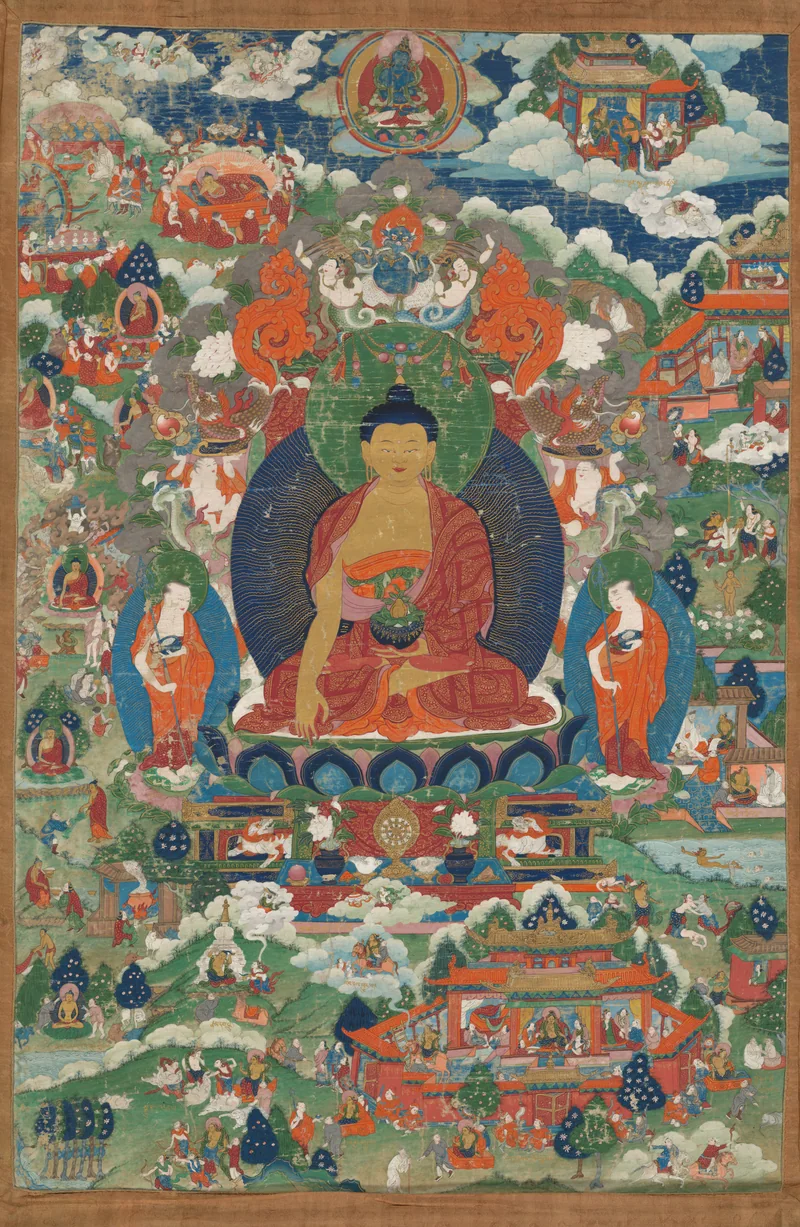
In this Central Tibetan painting of about 1150–1200, a tiny vajra rests above the central figure’s joined hands. The gesture in which one hand encloses the other’s index finger identifies the Buddha as Vairochana. The golden body and tiny six-pronged vajra suggest his appearance as Vajrasattva.
The detail matters because it is small but specific. It gains meaning beside the hand gesture, crown and surrounding figures. The held object and the way a figure holds it are two parts of the same image.
Vajrasattva, Vajrapani and other appearances
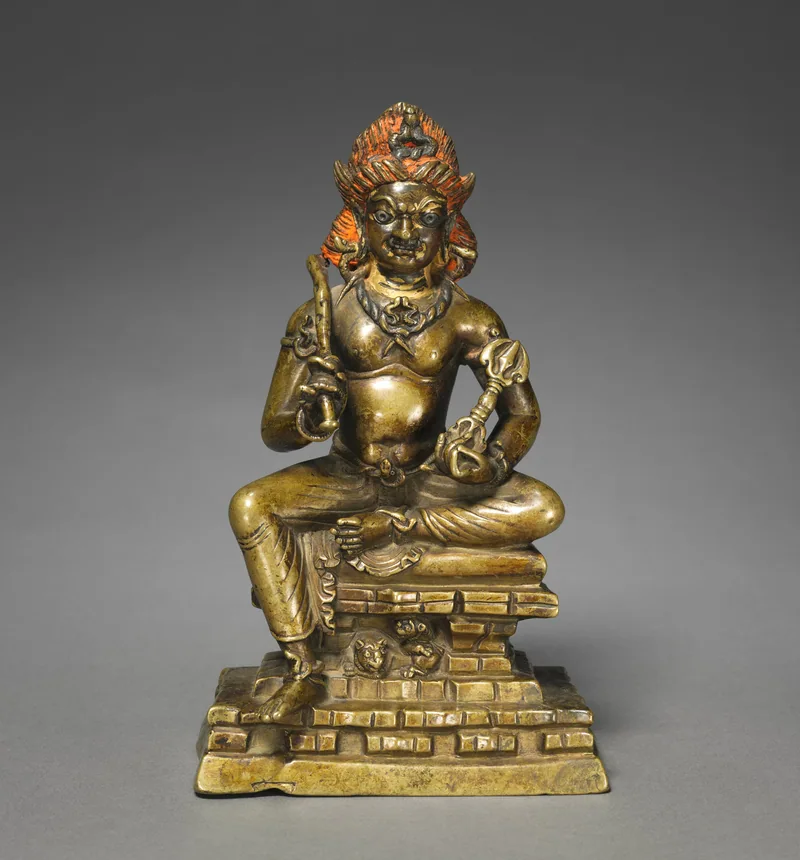
Vajrasattva is often shown with a vajra near the chest and a bell near the hip. Vajrapani, whose name means Vajra-in-Hand, can hold or raise the implement in different forms. In the five Buddha families, a vajra is associated with Akshobhya, while a crossed vajra commonly serves as Amoghasiddhi’s emblem. These uses connect a shared symbol with different figures.
A vajra can also top a Nepalese ritual crown or appear within a mandala. Its position tells us whether it is functioning as a held attribute, an emblem or part of a larger sacred arrangement. The guide to reading a thangka explores how hands and attributes work together.
Following the shape
The curved prongs of a bronze dorje, the crossed axes on a box and the tiny attribute above a painted hand share a recognisable form. Each offers a different way of seeing it. Once familiar, the small symbol becomes easier to notice among the many details of Buddhist art.
Questions and answers
Are a vajra and a dorje the same thing?
In Tibetan Buddhist usage, they usually name the same ritual implement: vajra is Sanskrit and dorje is Tibetan. Both terms can also enter deity names and other religious expressions.
Does a vajra mean diamond or thunderbolt?
English accounts commonly use both. Diamond evokes firmness and indestructibility; thunderbolt connects the word with Indra and powerful action. Neither term alone describes every Buddhist use or the metal of an actual object.
What is the difference between a vajra and a double vajra?
A familiar straight vajra has one axis with pronged ends. A double or crossed vajra has two intersecting axes, creating four outward arms. The number of arms differs from the number of prongs at each end.