Discover / Subjects & Meaning
Endless knot meaning: wisdom, compassion and a line without an end
Understand the Tibetan endless knot, its place among the eight auspicious symbols and its connection with karma. Read the pattern through a diagram and documented historical objects.
In this story
The endless knot, also called the eternal knot, is one of the eight auspicious symbols in Tibetan Buddhism. Its interlaced line has no visible beginning or end. It is commonly understood as expressing the Buddha’s boundless wisdom and compassion, and the way lives and conditions depend on one another. Following the line is a good place to begin; looking at the object that carries it tells us more.
Follow the line through the crossings
In this common drawing, a broad red band turns through angular loops. At each crossing, one part passes over another, then disappears beneath it elsewhere. The small spaces between the turns help the eye separate the routes. Choose a corner and follow the band slowly: the design keeps returning you to its interwoven structure, rather than presenting two loose ends.
An actual painted, woven or metal version may round the corners, change the number of turns or add a ribbon. Look for the interlaced structure before relying on a particular colour or outline. A photograph with the crossings blurred can make the motif much harder to recognise. In Tibetan, the symbol is called palbeu; endless knot and eternal knot are English names used for the same familiar emblem.
Wisdom and compassion, held together
The Tibetan Nuns Project explains the unending design through the Buddha’s boundless wisdom and compassion. The interweaving also offers an image for bringing wisdom and method together. These are related readings of a symbol, rather than a code in which every corner represents one fixed doctrine. A community, text or individual work may emphasise a particular reading.
Interdependence is another important interpretation. One segment belongs to the same design as the parts that cross it, just as experiences arise through causes and conditions. The metaphor encourages attention to relationships and consequences. It does not establish a scientific claim that an ornament changes the energy of a room, nor require us to treat Buddhist philosophy as a general promise that everything is always harmonious.
Does the endless knot represent karma?
It can be read in relation to cause and effect, and to samsara, the cycle of birth, death and rebirth. The design’s continuity gives these ideas a visible form. But karma has a more specific meaning than simply “everything is connected.” In the Buddhist discourse AN 6.63, intention is central to action through body, speech and mind. The knot can remind a viewer to consider what an action sets in motion.
This reading leaves room for choices and practice. An unbroken pattern does not mean that a person has an unchangeable fate, or that suffering must continue forever. The same Buddhist tradition that discusses samsara also discusses liberation. A pendant or image may carry a meaningful reminder; its shape alone cannot tell someone their future or erase the consequences of an action.
One symbol within a group of eight
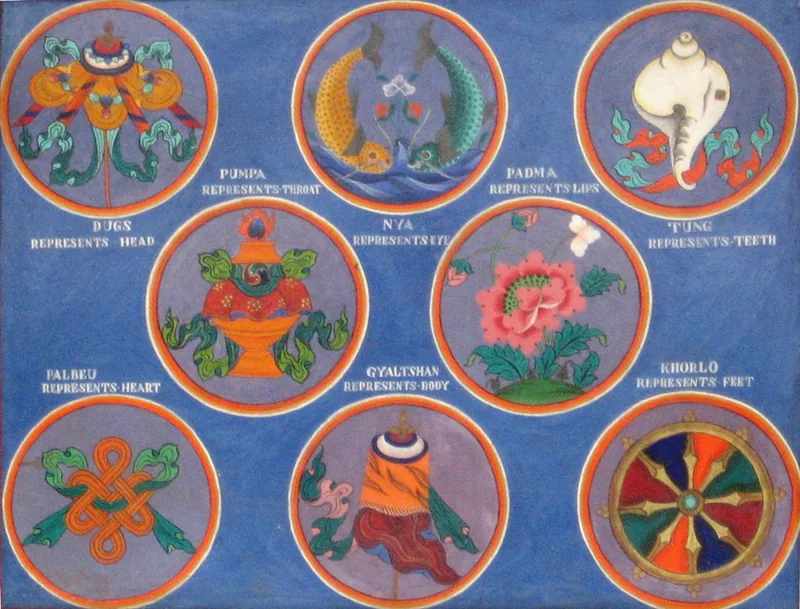
The knot often appears with the other auspicious symbols. A familiar Tibetan group includes the parasol, pair of golden fish, treasure vase, lotus, conch, victory banner and Dharma wheel. The Tibetan Nuns Project describes the group as offerings to Shakyamuni at his awakening. Their association matters: several neighbouring motifs can make the religious context clearer than an isolated knot.
On the cloisonné disc above, the symbols sit among flowers against a turquoise ground. The object is a mandala base, made in China in the early 1400s and used in Tibetan Buddhist ritual. It supported a three-dimensional mandala with miniature buildings, in a practice known as Offering the Universe. Here, auspicious imagery appears on a ritual object; it is not a painted thangka, and its pattern does not make it the same thing as a deity mandala.
What does a knot tell us about a thangka?
The symbol travels across materials: ceremonial scarves, textiles, jewellery, architectural details and painted surfaces can all carry it. The Tibetan Nuns Project illustrates this range with handicrafts and actual balcony designs at a nunnery. These examples show how a religious emblem can be encountered in daily surroundings, without turning every occurrence into the same ritual prescription.
In a thangka, first establish where the motif belongs. Is it painted within the image, part of the textile mounting, or visible on a separately photographed frame? Then return to the main figure, surrounding symbols and work record. A knot can contribute an auspicious association, but cannot identify the deity or painting school by itself. Not every thangka needs to include it. Our guide to reading a thangka continues this movement between detail and complete composition.
Similar lines, different histories
This Egyptian linen fragment, dating to the 1200s–1300s, includes interlocking motifs between printed medallions. The textile uses block-printing and carries the abbreviated Arabic inscription “the sultan.” Looking beside the Buddhist knot reveals a useful limit: the presence of intertwined lines cannot, by itself, make this textile a Buddhist object or give it a Tibetan interpretation.
Chinese knotting, Celtic interlace and other traditions also invite comparison, but a visual resemblance is only the beginning of an enquiry. Ask about place, date, material, inscription and use before asserting a shared origin. Likewise, names associated with Indic auspicious marks should be checked in their own religious context. For choosing art, a well-documented object tells you more than a broad claim that all knots express one universal meaning.
Choosing an image for its detail and meaning
If a knot motif is part of what attracts you to a thangka, ask for both a complete photograph and a close view of the relevant area. Clear crossings, consistent spacing and deliberate changes in line make the drawing easier to follow. At small scale, a tightly crowded pattern may read very differently from its enlarged photograph. Compare the actual painted dimensions, rather than the size of an image on your screen.
A gift can express a wish for wisdom, compassion or an enduring connection. The knot brings these associations into a small, memorable form.
Questions and answers
Are endless knot and eternal knot the same symbol?
In the familiar Tibetan Buddhist context, yes. Both English names refer to the interlaced auspicious emblem called palbeu in Tibetan. Individual artistic versions can vary.
Does the endless knot bring good luck?
It is an auspicious symbol and can carry a wish or reminder of wisdom and compassion. That cultural meaning is different from a guaranteed outcome produced by owning an object.
What does an endless knot tattoo mean?
A wearer may intend continuity or connection, while the motif also has a Tibetan Buddhist history. Explain the personal intention and the cultural context separately; neither gives every version one fixed meaning.
Is the knot present in every thangka?
No. A thangka’s subject and composition determine its imagery. When a knot is present, check whether it belongs to the painting, mounting or frame, and read it with the rest of the work.