Discover / Subjects & Meaning
The eight auspicious symbols: a guide to their shapes and meanings
Recognise the parasol, fish, vase, lotus, conch, knot, banner and Dharma wheel. Compare a painted group with historical objects, and learn how to read the signs in Tibetan Buddhist art.
In this story
The eight auspicious symbols in Tibetan Buddhism are the parasol, pair of golden fish, treasure vase, lotus, right-turning conch, endless knot, victory banner and Dharma wheel. The group is called Ashtamangala in Sanskrit and tashi takgyé in Tibetan. Each sign has a recognisable shape and a range of religious associations. Together, they form a vocabulary that artists use on paintings, textiles, architecture and everyday objects.
Begin with the painted group
The photograph above shows a display at the Hall of Fame in Leh. Read its circles from left to right: the top row contains the parasol, two fish and conch; the middle has the vase and lotus; the bottom has the knot, banner and wheel. This gives us a specific arrangement to follow while learning the forms. The written labels around the circles add bodily associations to this particular display.
Religious explanations can differ in emphasis. FPMT publishes a 2014 explanation dictated by Lama Zopa Rinpoche, with its teacher, translator and setting identified. It discusses the signs through Buddhist teaching and practice. A useful way into the subject is to recognise each form first, then distinguish the explanation of a named tradition from the details of an individual work.
The parasol: a canopy and its shade
Look at the upper-left circle. A broad canopy sits over a narrow shaft, with hanging ornament and ribbons around it. The canopy is the most useful clue: it spreads sideways over the space beneath. Even when the artist adds abundant curls and decoration, the umbrella-like structure remains legible.
The shade offers a natural image of shelter. In Tibetan Buddhist explanations, the parasol is associated with protection from suffering and obstacles. Compare it with the victory banner below: both can have a pole and fringe, but the banner usually has a more vertical, layered or cylindrical body. Read that overall construction before using colour to name the sign.
The golden fish: two bodies in motion
In the top-centre circle, two fish curve towards one another. Their heads, tapering bodies, tails and fins distinguish them from a pair of decorative leaves. Their colours differ in this painting; the familiar name “golden fish” does not require every painted version to use two identical gold silhouettes.
A fish moving freely in water becomes an image of freedom and fearlessness. FPMT relates this movement to freedom from the ocean of suffering; Rigpa Wiki also includes happiness and liberation among its associations. When only a small part survives on an old object, finding the second fish helps establish whether you are looking at the paired emblem.
The treasure vase: a full, rounded vessel
The middle-left circle contains a vessel with a rounded body, narrow neck and decorated top. Ribbons spread out from its sides. Follow the shoulders and base of the container: a jewel-shaped finial by itself can be mistaken for the whole symbol, especially in a cropped photograph.
Traditional readings connect the vase with inexhaustible abundance. That abundance can encompass spiritual qualities and the richness of the teachings, as well as wishes for longevity and prosperity. An image of a treasure vase is different from identifying a particular ritual vessel: the latter also needs information about its contents, construction and use.
The lotus: a flower rising above its roots
The large pink bloom in the middle-right circle has layered petals, a stem and leaves. A complete flower is especially easy to recognise here. Elsewhere, an artist may compress the petals into a small rosette or place them beneath a figure as a lotus seat. The surrounding image helps explain which role the flower plays.
Purity and awakening are central associations: the flower emerges from muddy water, while the blossom opens above it. The eight-symbol group uses that same visual vocabulary, but a lotus held by Tara or supporting a Buddha belongs to a larger iconographic setting. Our guide to the lotus in Buddhist art compares those uses in complete paintings.
The conch: a spiral shell and a carrying sound
In the top-right circle, the white shell has a pointed, spiralling top and a broad opening lower down. Its shape is more organic than the treasure vase beside it. The familiar Tibetan emblem is a right-turning conch. Establishing the direction on a highly stylised or mirrored photograph can require a clearer view of the shell itself.
The sound of the conch is associated with the spreading of the Dharma, reaching listeners and awakening attention. This joins an actual quality of a shell trumpet to a religious interpretation. A decorative picture of the conch and a shell prepared for use as an instrument may look related, while remaining different kinds of objects.
The endless knot: follow the crossings
The lower-left circle shows an orange interlaced band, framed by green ornament. Look for the alternation of over and under at the crossings, rather than a flower centre or loose ends. Compared with a sharply angular drawing, this version has soft loops and rounded turns. The recognisable structure survives those artistic choices.
The interweaving is commonly associated with interdependence and the connection of wisdom and compassion. FPMT’s explanation also discusses wisdom and method together. Our endless knot guide follows the shape more closely and considers how karma differs from an idea of fixed destiny.
The Dharma wheel: hub, spokes and rim
The lower-right circle contains a hub, radial spokes and an enclosing rim. Count the spokes in this example: eight extend from the centre. The wheel is a familiar symbol of the Buddha’s teaching, and an eight-spoked form is commonly associated with the Noble Eightfold Path. Its circular structure makes it distinct from a jewel or flower, even when colour and ornament are elaborate.
The painted wheel is also different from the Wheel of Life, a much larger diagram containing realms, figures and a cycle of existence. When identifying a detail in a thangka, look at what actually surrounds the circular form. A complete composition usually supplies better clues than the word “wheel” alone.
Does the group have one fixed order?
The Leh display arranges the signs in three rows. The FPMT article lists them in a different sequence and specifically notes that Andy Weber’s accompanying illustration puts the banner first and the umbrella seventh. Even the illustration and written list on one teaching page can use different placements. It helps to separate the identity of the eight members from the order chosen for a composition.
This guide follows a familiar Tibetan Buddhist set. Ashtamangala is also used in other religious and regional contexts, where a list or interpretation can differ. If you need the order required by a particular ritual, work from that tradition’s instructions. If you are studying an artwork, start with its actual arrangement, title and object record.
A vertical sequence on a leather quiver
This long, worn object held arrows and hung from an archer’s belt. The object is Tibetan or Mongolian, dating to the fourteenth–sixteenth century. Leather, shellac and pigment form a surface decorated down the front with the eight signs. The remaining dark motifs can be difficult to separate, which makes the complete photograph and the object description valuable together.
The example extends the story beyond temple painting. A narrow functional object gives the set a vertical rhythm, while the Leh display gives it separate round frames. In his Met essay on Tibetan arms and armour, Donald J. La Rocca explains that the signs can occur individually or together, as prominent designs or small accents, on objects including paintings. The support changes how an artist organises the forms.
A circular arrangement in cloisonné
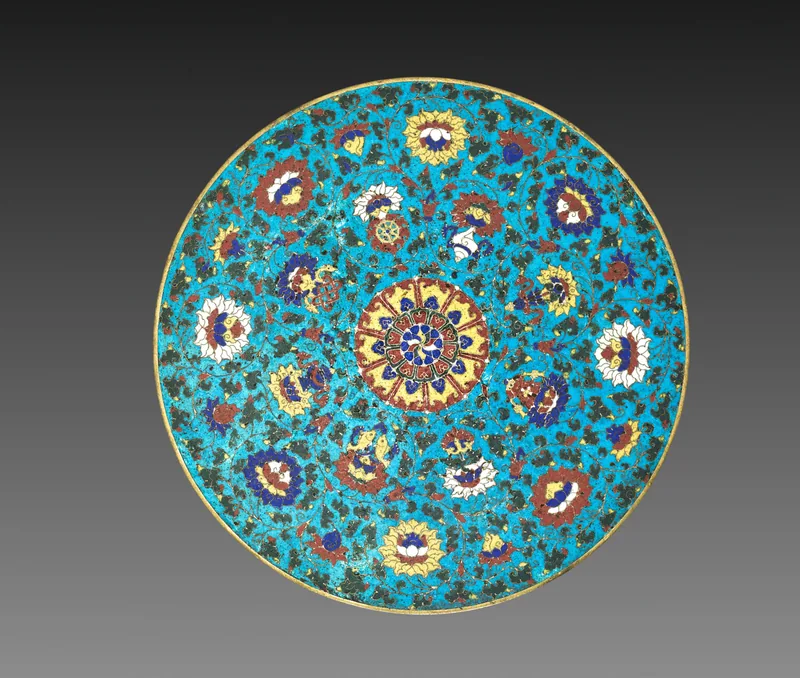
This Chinese cloisonné disc, made in the early 1400s, is a base for a three-dimensional mandala used in Tibetan Buddhist ritual. The turquoise ground is filled with flowers; the auspicious emblems appear within that ornamental field. The group is called the Eight Buddhist Treasures and includes “canopy” in the list. Familiar forms can therefore have slightly different names.
Metal outlines and coloured enamel produce a different kind of line from the painted Leh group or the worn leather surface. Compare the complete objects before expecting every curl or petal to match. Here, the object serves a ritual purpose; the floral disc is not itself a thangka painting.
Reading the signs within a thangka
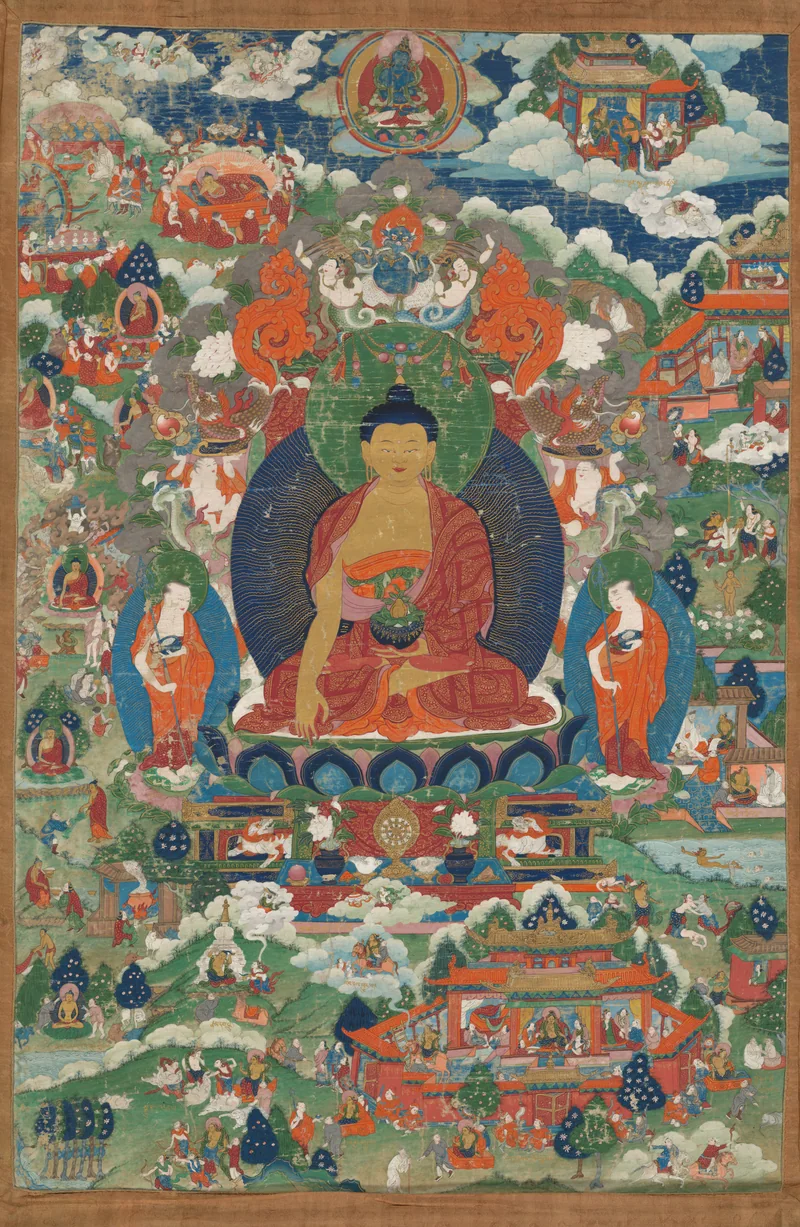
In a painting, first locate the sign: within an offering arrangement, beside a throne, on an architectural surface, or on the textile mounting around the painted image. A lotus seat and a lotus among the eight signs share a form while doing different jobs. A vajra, bell or flaming jewel may also occur nearby; they belong to other parts of Buddhist visual language. Identify each shape rather than filling an assumed eight-place checklist.
For a closer look at how figures and smaller symbols share a painting, see our guide to reading a thangka.
Questions and answers
What are the eight auspicious symbols?
The familiar Tibetan Buddhist set comprises the parasol, pair of golden fish, treasure vase, lotus, right-turning conch, endless knot, victory banner and Dharma wheel. Ashtamangala and tashi takgyé are names used for the group.
How can I distinguish the parasol from the victory banner?
Compare their construction. The parasol has a broad umbrella-like canopy; the banner usually has a more vertical, layered or cylindrical body. Both may have a shaft, finial and fringe.
Are the eight symbols the same as the Noble Eightfold Path?
They are different sets. The Noble Eightfold Path is a teaching about practice; the auspicious symbols are visual emblems. An eight-spoked Dharma wheel, one member of the symbol group, is commonly associated with that path.
Must a thangka contain all eight?
No. An artist may include a group, an individual sign or none of them, depending on the subject and composition. Read the main figure and the complete work, then consider the symbols that are actually present.