Discover / Subjects & Meaning
Shakyamuni Buddha: his life, meaning and the earth-touching hand
Who is Shakyamuni Buddha? Understand his names, life and teachings, then read the earth-touching gesture, narrative thangkas and historical works with different poses.
In this story
Shakyamuni is the historical Buddha, also known as Gautama Buddha, whose teachings gave rise to Buddhism. In a familiar Tibetan image, he sits in monastic robes with his right hand reaching down over the knee. That small movement recalls his awakening beneath the Bodhi tree. Around him, a thangka may unfold a whole life of searching, teaching and departure.
Shakyamuni, Gautama and Siddhartha
Shakyamuni means “sage of the Shakyas,” the community into which Buddhist accounts place his birth. Gautama, or Gotama in Pali, is another name used for this same teacher; Siddhartha is his familiar given name in the traditional biography. Buddha is a title meaning an awakened one. These names should not turn a single person into several different figures.
Calling him the historical Buddha distinguishes him from figures such as Amitabha and Medicine Buddha in Buddhist cosmology. It does not mean that every tradition describes him only in human terms. His life and awakened qualities are understood through different scriptures and schools. A painting can express devotion as well as remember a teacher.
The journey that gives the image its meaning
The traditional story begins at Lumbini, in present-day Nepal. Raised in princely surroundings, Siddhartha encounters an old person, a sick person, a dead body and a renunciant. The four sights make suffering and the possibility of a different life impossible to ignore. He leaves his household, studies with teachers and undertakes severe austerities, before recognising that bodily deprivation has not brought the freedom he seeks.
His awakening is associated with Bodh Gaya in India; teaching follows at the Deer Park at Sarnath, and his passing into parinirvana at Kushinagar. These places anchor the remembered life without requiring us to treat every miracle or precise age as a modern historical record. Dates and traditional chronologies differ. The distinction matters when a sacred biography becomes the subject of an artwork.
What did Shakyamuni teach?
The Four Noble Truths connect suffering, its origin in craving, its cessation and the path leading to that cessation. The teaching asks for more than assent: suffering is to be understood, craving abandoned, cessation experienced and the path cultivated. In SN 56.11, the discourse on setting the wheel of Dharma in motion, these are related tasks within a single practice.
The Noble Eightfold Path brings together right view, intention, speech, action, livelihood, effort, mindfulness and concentration. The Middle Way here avoids both sensual indulgence and self-torment. When an image represents awakening, this larger teaching helps explain its significance. A calm expression can invite attention, but owning the image is not the same as undertaking the practice.
Why does the right hand touch the earth?
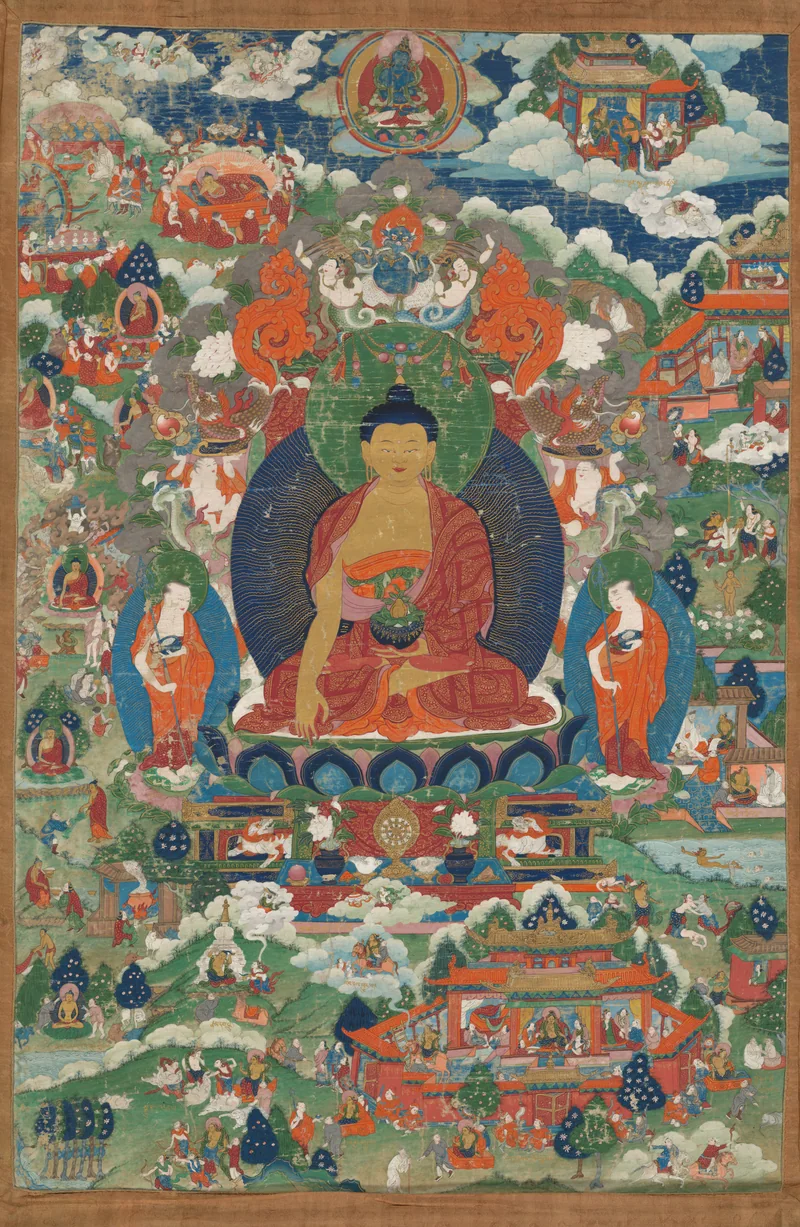
In the earth-touching gesture, bhumisparsha mudra, the figure’s right hand descends over the knee. For someone facing the painting, this is the hand on the left side of the image. The gesture recalls the awakening story: challenged by Mara, the Buddha calls the earth to witness. The hand gives a dramatic event a remarkably restrained visual form.
Look at the other hand as well. In the painting above, it rests in the lap around a bowl, while the downward fingers remain readable beside the knee. Follow the robe, seat and surrounding figures before stopping at the hand. Our guide to Mara in Buddhist art explores the challenge and its visual forms more fully.
A whole life around a seated Buddha
The Tibetan painting above, dating around 1700, places a large Buddha between two smaller monks. Episodes spread through the landscape around them. Differences in scale guide the eye: the central figure establishes the devotional focus, while smaller figures and buildings invite a slower exploration.
A life-story painting need not read like a strip of panels from left to right. Identify the central figure first, then examine groups of figures, gestures and settings. Tibetan devotional literature often organises the life through the Twelve Deeds, as in the praise attributed to Nagarjuna preserved by Lotsawa House. That framework helps explain why birth, renunciation, awakening, teaching and parinirvana can share one surface. Individual scenes still require the painting’s own documentation; a framework cannot identify every small figure for us.
The Buddha can also raise his hand
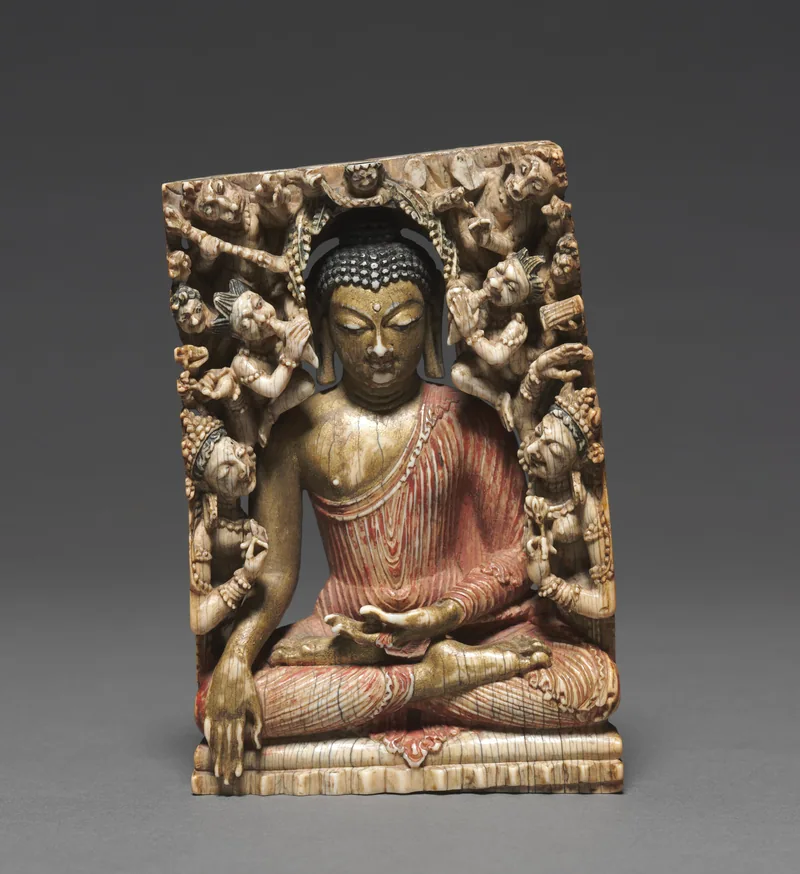
This early sandstone figure from Mathura raises its right palm outward. It dates to around 120 CE and shows Shakyamuni seated beneath the Bodhi tree. The coiled hair, elongated ears, remnants of the tree and lions on the base belong to its particular sculptural language. Its damaged edges are part of the surviving object.
Placed beside a later Tibetan thangka, it makes the limits of a single pose clear. Shakyamuni is represented in different moments and artistic traditions, including standing, teaching and reclining images. The earth-touching hand is a strong clue in an awakening image, rather than a requirement that every image of this Buddha must satisfy.
When even a museum keeps two possibilities
The title of this Tibetan gilt-copper sculpture is “Buddha Shakyamuni or Akshobhya, the Buddha of the East.” Its right hand makes an earth-touching gesture, shared by both figures. The unusual position of the other hand, with thumb and middle finger together, supports Akshobhya. The title retains the uncertainty.
For a viewer, the lesson is practical: inspect both hands and ask what supports the name. A bowl or gold-coloured body alone may be shared across figures. With Medicine Buddha, blue colour and the documented medicinal attributes provide a different combination; with Amitabha, the hands and wider Pure Land composition may matter. A close photograph, inscription and reliable object record can be more useful than a confident label attached to a thumbnail.
Looking at a Shakyamuni thangka for your space
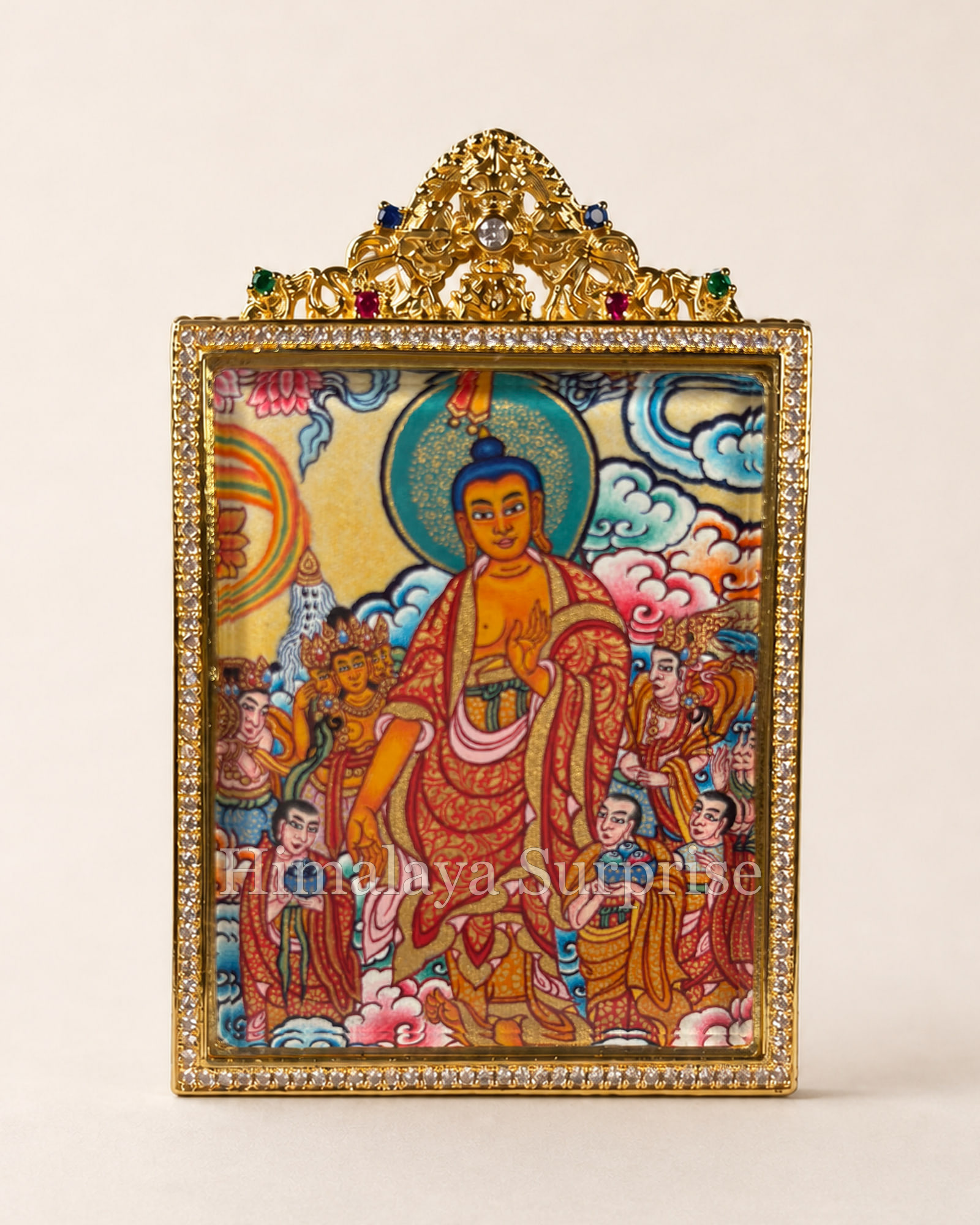
Start with the complete painted area. A single-figure thangka offers a different experience from a narrative painting: one concentrates on the Buddha’s presence, while the other asks you to spend time with smaller scenes. Then request a detail of the hands, face and robe. At miniature scale, a clear finger or continuous robe line matters more than a photograph that simply makes the gold look bright.
For more ways to compare paintings, our guide to buying a thangka online continues the discussion.
Questions and answers
Are Gautama Buddha and Shakyamuni the same?
Yes. These names refer to the historical Buddha in different naming conventions. Shakyamuni means sage of the Shakyas; Buddha is the title of an awakened one.
Is every earth-touching Buddha Shakyamuni?
No. Akshobhya can share this gesture. Look at both hands, the complete composition and the work’s documentation; the Met sculpture discussed here shows why a single sign can leave the identification open.
What does Shakyamuni represent in a thangka?
He represents the awakened teacher and his teachings. A particular work may emphasise awakening, teaching or the narrative of his life, so the gesture and surrounding scenes help explain its focus.