Discover / Subjects & Meaning
Buddha and Mara: Reading the Story in Buddhist Art
Who is Mara, and how did the Buddha overcome him? Follow the story through an ivory shrine, an earth-touching Buddha and a Japanese painting, then look for the scene in a thangka.
In this story
The story of Buddha and Mara centres on a challenge to awakening. Siddhartha Gautama remains in meditation while Mara tries to turn him from his purpose. In Buddhist art, that encounter can become a crowded scene of attack and temptation, or be recalled through one quiet gesture: the Buddha touching the earth. The two images are related, but they do not contain the same amount of story.
What happens beneath the Bodhi tree
In a familiar account, Siddhartha sits beneath the tree that will become known as the Bodhi tree, resolved to reach awakening. Mara challenges him with threatening forces and temptation, and disputes his right to occupy the seat. The Buddha-to-be answers by reaching his right hand toward the ground, calling the earth to witness the merit accumulated through his path. His steadiness, rather than military strength, is the centre of the episode.
Versions vary in their sequence and detail. An army, Mara’s daughters, weapons changing into flowers and an earth goddess can appear in later narratives and visual traditions. A short retelling should not imply that every Buddhist text gives precisely the same account. Nor do encounters with Mara stop at this one night: Buddhist teaching also describes later attempts to obstruct the Buddha and his followers.
A named challenger, and a wider idea of obstruction
Māra can be a personified tempter within Buddhist cosmology, as well as a name for what obstructs liberation. Calling him a “demon” conveys something of his role in the story, but translating him directly into the devil of another religion can conceal important differences. An artist can give this obstruction a face, a body and an army; a teacher can discuss it through craving, fear or other experiences.
One Buddhist classification describes four maras: death; disturbing emotions; the conditioned aggregates of experience; and the celestial Mara, often called the “son of the gods” (devaputra-mara). These are categories of obstruction, not a rule that a painting must contain four demons. The classification and the individual character belong to different levels of explanation.
A small ivory shrine, with pressure on every side
The object above is only 13 centimetres high. Made in eighth-century Kashmir, it is ivory with gold and polychrome, not a painting or a thangka. It is titled Temptation of Buddha by the Evil Forces of Mara and functions as a small shrine for personal meditation.
The Buddha’s seated body occupies the centre, while figures press close around his head and shoulders. The scene shows demons trying to frighten him and female figures trying to tempt him. It does not identify every woman as one of a fixed group of three daughters. The surviving gold and red colour make his calm body stand out against the crowded carving.
A useful way to look is to follow the contrast: the still central body against the restless figures around it. That relationship carries the story even in a very small object. In a narrative thangka, a painter has a much larger surface on which to distribute those pressures, witnesses and responses.
Touching the earth can recall a whole event
In the ninth-century clay sealing shown here, the Buddha sits within a representation of the Mahabodhi Temple at Bodhgaya. The earth-touching gesture is known as bhumisparsha mudra. This hand position calls on the earth goddess to witness his accumulated merit. The temple setting locates that remembrance at the place of awakening.
The sculpture does not need to reproduce an attacking army to recall the event. This is the value of an established gesture: a concentrated image can stand for a much fuller narrative. Yet it would be misleading to describe the sealing as if it visibly showed all of Mara’s forces.
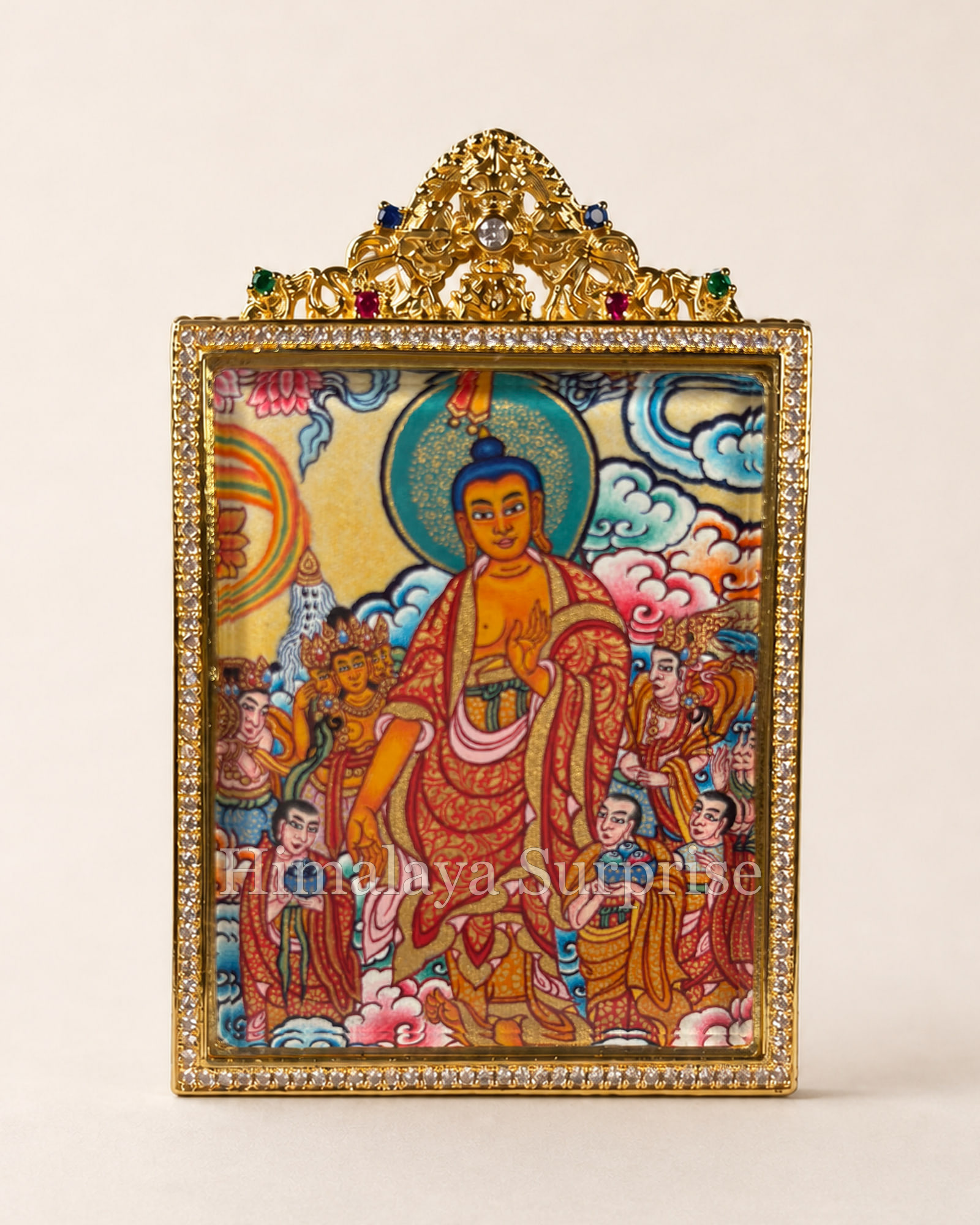
The same distinction matters in a thangka. A right hand extending over the knee supports an earth-touching reading; it does not by itself prove that the whole painting narrates the defeat of Mara. Look at the robe, seat, setting, surrounding figures and catalogue description together. Our Shakyamuni guide considers the general Buddha image; here the question is how a specific event becomes visible.
A Japanese painter changes the visual language
Kawanabe Kyōsai’s Shakyamuni Subjugating Demons, made around 1888, offers a different encounter. A dragon rises beside flames; the Buddha sits within a cave-like setting. The Met notes that the artist changed the traditional gestures. The work was originally an album leaf and was later mounted as a hanging scroll, painted in ink and colour on silk.
The title identifies the subject, while the image shows how freely a particular artist can reshape its appearance. If we required an earth-touching hand, the usual army and a Bodhi tree in every work, we would miss this documented example. Its dragon and cave are features of this Japanese interpretation, not a checklist to impose on Tibetan thangkas.
Read the scene across the whole thangka
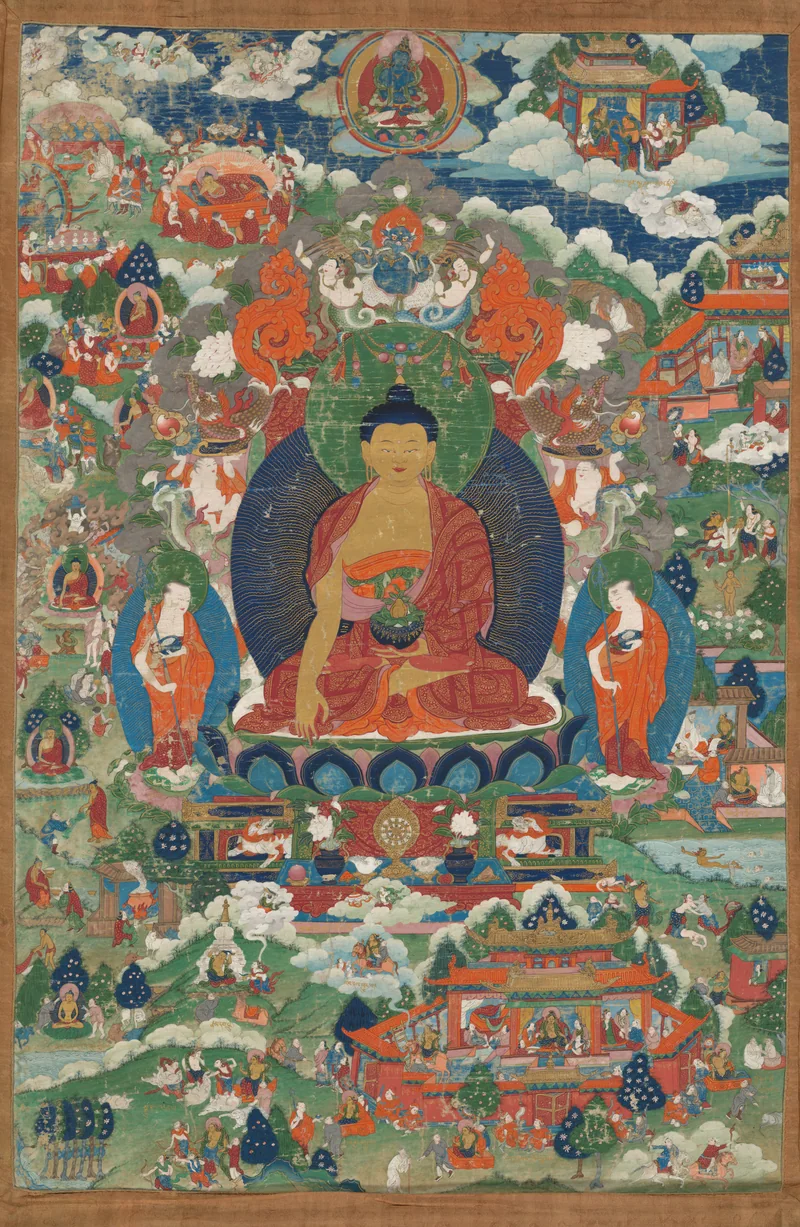
A Tibetan or Mongolian thangka can place the calm Buddha at the centre and surround him with the events that establish the scene. The Rubin Museum’s nineteenth-century Buddha Shakyamuni Defeating Mara, attributed to eastern Tibet or Mongolia, connects the attacking army, temptation and earth-touching gesture within the painting. It is an example of the fuller narrative, rather than simply a Buddha with one hand lowered.
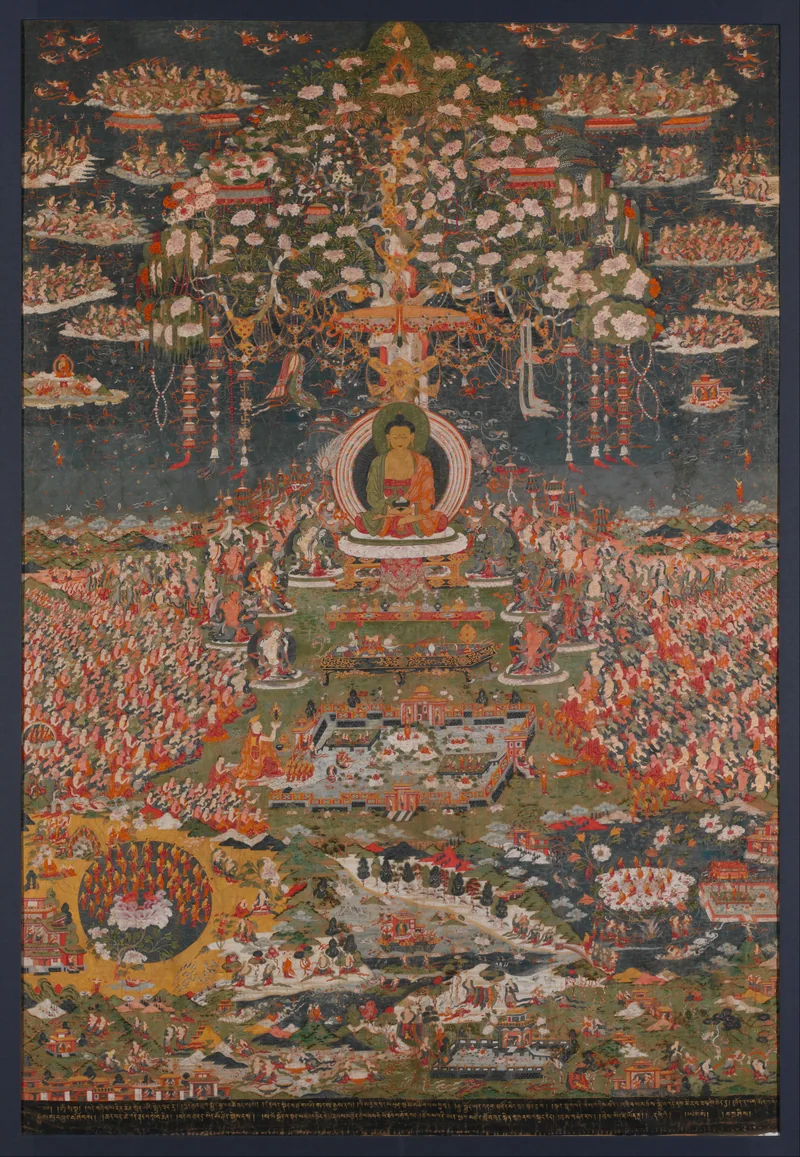
In another work, the episode may be one small part of a life-of-the-Buddha painting. Begin with the central Buddha, then follow the neighbouring groups: what moves toward him, what retreats, and which figures connect one episode to the next? The arrangement need not follow the order in which we read a page. A photograph of the entire painting is more informative here than a close crop of the face.
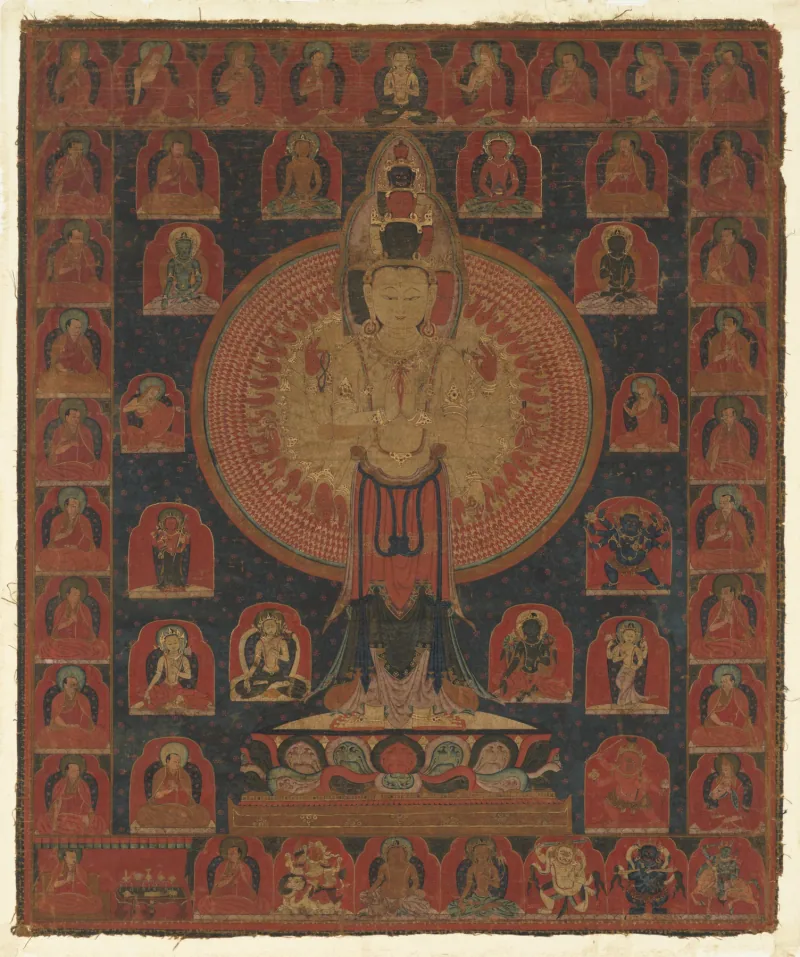
Fierce expressions alone are insufficient. Buddhist art also contains wrathful protective and meditational figures with quite different roles. An elephant, a woman or a threatening face should not be named as Mara solely because it looks dramatic. Compare its position and attributes with the particular work’s record.
The story can also become a teaching about suffering
Modern teachers sometimes turn the encounter inward. In a talk given in 1996, Thich Nhat Hanh tells a playful story of the Buddha welcoming Mara and asking Ananda to make tea. He uses their meeting to explore caring for difficult emotions rather than simply rejecting them. This is a teaching context, not a description of the ivory shrine or a universal account of every Mara image.
Such readings can enrich a response to the art. They should sit alongside the work’s region, date, material and visible composition. A painting may participate in devotion or meditation, but buying it does not guarantee victory over anxiety, obstacles or illness. Its artistic interest begins with what the maker has actually placed before us.
Questions and answers
How did the Buddha defeat Mara?
In a familiar enlightenment narrative, he remains unmoved by threats and temptation and calls the earth to witness his merit. Different texts and artworks emphasise different parts of that account; the victory is not usually represented as a fight won with a weapon.
Are Mara’s daughters always shown in the scene?
No. Some narratives include the daughters, and some works show female figures attempting to tempt the Buddha. Other images concentrate on the army, earth-touching gesture or another part of the event. Identify the figures from the particular work, rather than requiring a fixed cast.
Is every earth-touching Buddha a complete Mara scene?
The gesture recalls awakening and the earth as witness, but a single Buddha image may omit the surrounding narrative. A complete Mara-scene attribution needs the composition, object title and supporting record as well as the hand position.