Discover / Subjects & Meaning
Jambhala Meaning: Yellow Jambhala, the Mongoose and Generosity
Understand Jambhala and Dzambhala through Yellow Jambhala’s fruit and mongoose, early South Asian bronzes, and the different traditions behind five coloured forms.
In this story
Jambhala, also written Dzambhala or Jambala, is a Buddhist deity of wealth. Yellow Jambhala is especially familiar in Tibetan art: a rounded, richly adorned figure holding a fruit and a jewel-releasing mongoose. The treasures express wishes for abundance and the ability to give. His image has a long history across South Asia and the Himalayas, with forms that range from regal and relaxed to fierce.
Jambhala, Dzambhala and the wealth-deity tradition
The different English spellings are transliterations of the same name. “Yellow Jambhala” narrows the subject to a particular form, while Jambhala on its own covers a wider range of images. A broad name can therefore connect works with quite different colours, postures and accompanying figures.
Jambhala’s ancestry is linked to yakshas, the nature spirits of early northern Indian religion. He is also understood as the Buddhist counterpart of Kubera, the Hindu god of riches. That shared history helps explain the generous body, royal ornaments and treasure imagery that travel with the subject.
Two small bronzes from Nepal and Sri Lanka
The tenth-century Nepalese bronze above is only 13.3 centimetres high. Its broad torso, crown and extended leg give the seated figure an unhurried presence. The left hand holds a jewel-emitting mongoose. Dark patina and green surface tones now shape our impression of the work, alongside the sculpted jewellery and rounded forms.
A second Jambhala in the same collection comes from Anuradhapura in Sri Lanka and dates to the ninth or tenth century. At 9.3 centimetres high, it is smaller still. The full belly, smiling face and arrangement of bent and extended legs make the compact copper-alloy figure remarkably expressive. These early works show how far the subject reaches beyond modern Tibetan paintings.
The fruit, mongoose and royal appearance
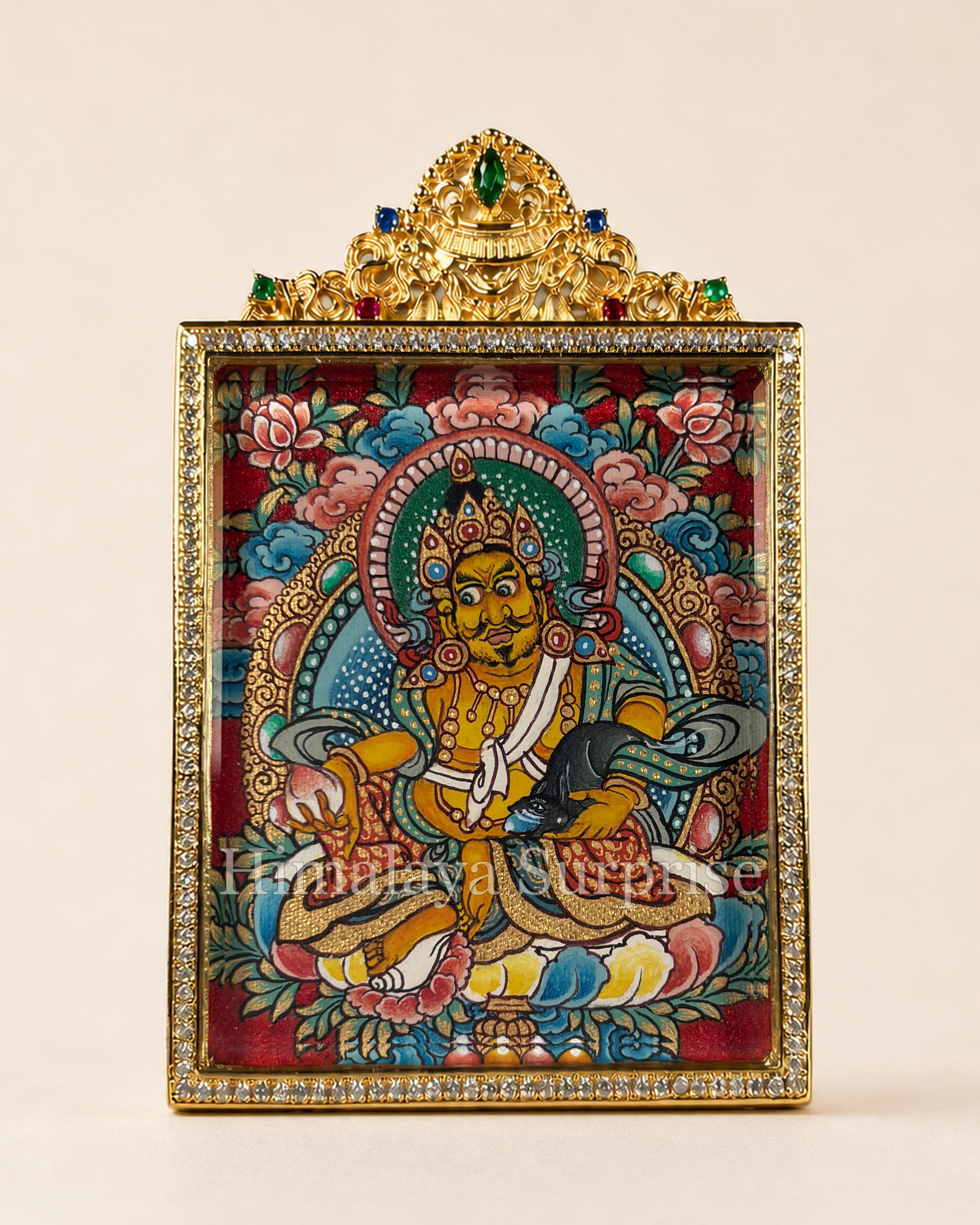
Yellow Jambhala’s familiar two-armed form pairs a yellow body with a crown and abundant jewellery. Himalayan Art Resources reproduces a description by the sixteenth-century author Konchog Lhundrub: the right hand carries a bijapuraka fruit, the left a mongoose releasing jewels, and the feet press upon a conch and lotus treasure. It gives a precise literary anchor for the familiar image.
The fruit is often described in English as citron-like. Its rounded shape balances the elongated animal in the other hand. Together with the full body and comfortable seat, the pair gives abundance a tangible form. Individual traditions develop the image further, changing its posture, companions or surrounding sacred figures.
Yellow Jambhala in a miniature painting
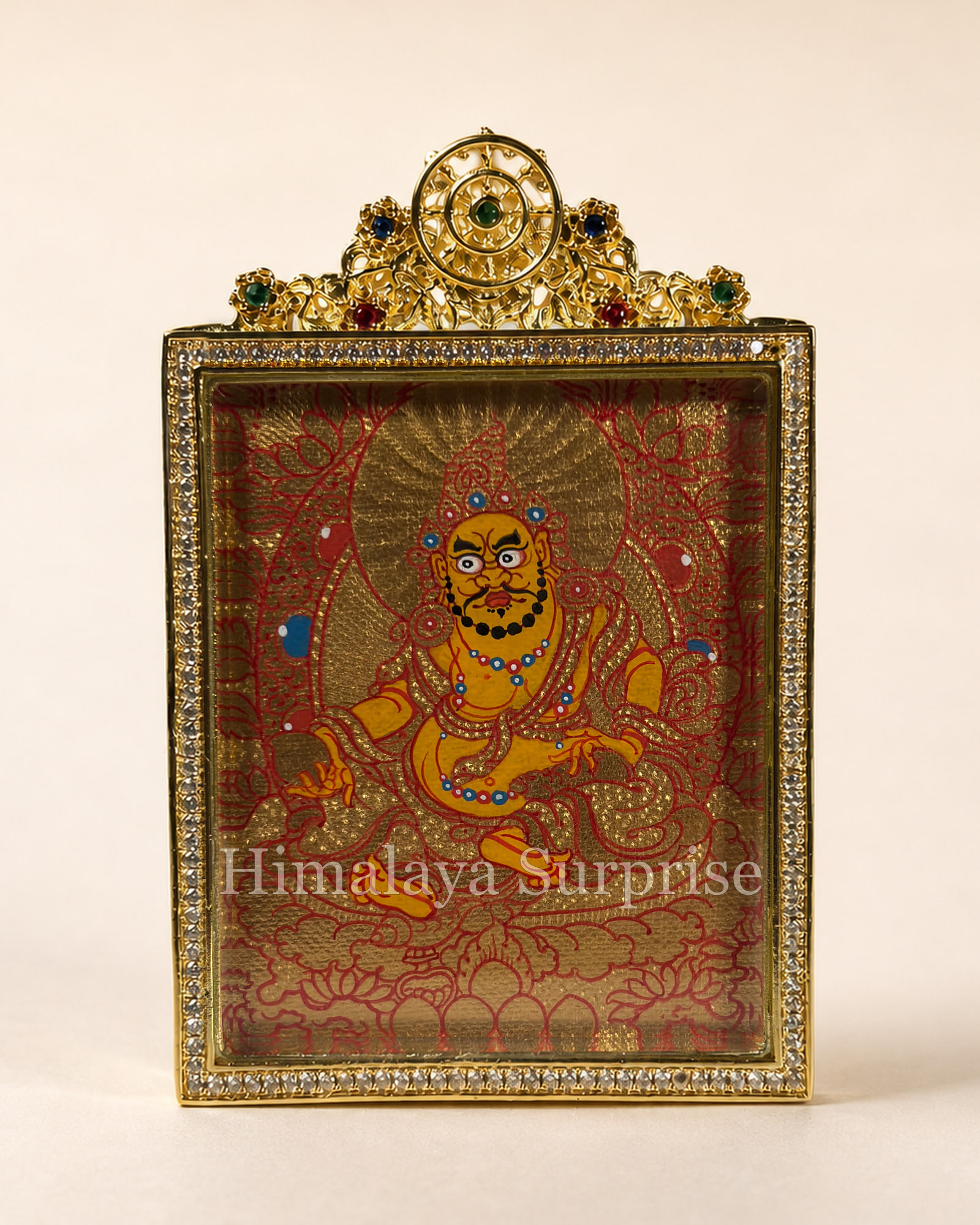
In the polychrome miniature shown here, a bright yellow body stands out against green, red and blue surroundings. The crown leads into a circular halo, while flowers spread through the corners. The dark mongoose is held at the figure’s left side; the rounded fruit is visible at the right. The painting preserves these familiar attributes within a painted area of just four by five centimetres.
The close view makes the work’s line drawing especially clear: eyebrows, jewellery, fingers and folds each have their own contour. Its lively colour gives this Yellow Jambhala a different presence from the dark surfaces of the early bronzes. Both approaches retain the broad body and intimate pairing of hands and attributes.
Why a mongoose releases jewels
The small animal makes the wealth symbolism memorable. The motif draws on the mongoose’s relationship with the snake: the snake represents greed, while its natural enemy suggests overcoming that attachment. Jewels emerging from the animal’s mouth give this interpretation a vivid, almost surprising visual form.
In the museum’s reading, abundance and giving belong together. Wealth supplies the resources with which a person can sustain life and help others. This is the traditional meaning carried by the imagery, rather than a prediction about a painting’s owner. The mongoose is also shared by other wealth-related figures, so its story extends beyond one deity.
A conch seat and a sculpture made from clay
A seventeenth-century Yellow Jambhala in the Rubin Museum sits on a conch shell, a symbol of plenty. The museum associates this form particularly with Kham in southeastern Tibet. The seat becomes an active part of the subject: abundance appears underneath the body as well as in the hand-held treasures.
The sculpture is made from unfired clay with pigments. Its inner form was built gradually from clay strips, with finer material used for surface detail and separately moulded elements attached later. This offers another way to picture Jambhala: a large, painted clay figure whose construction differs greatly from the little bronzes, even while the treasures remain familiar.
What do the five colours of Jambhala mean?
Yellow, white, black, red and green are useful starting names. Yellow and green forms have a royal appearance, white and black forms are wrathful, and red forms are partly peaceful and partly wrathful. The colours lead into distinct appearances and traditions, rather than a simple list of five interchangeable portraits.
These forms are distinct from modern paintings that gather five different Jambhalas into one composition. Such groupings are popular, but their figures can come from different textual traditions. “Five-deity Jambhala” can mean something else again: Atisha’s White Jambhala with four accompanying dakinis. The name of the grouping therefore has its own history, beyond the colours.
Questions and answers
What does Jambhala represent?
Jambhala is a Buddhist wealth deity. His treasures express abundance and the resources that make generosity possible; these are devotional and symbolic meanings.
Are Jambhala and Dzambhala the same name?
Yes. Dzambhala and Jambala are common alternative transliterations. Yellow Jambhala names a particular form within the wider subject.
What does Yellow Jambhala hold?
A familiar two-armed form holds a citron-like fruit in the right hand and a jewel-releasing mongoose in the left. A conch-and-lotus seat appears in documented examples.
Are the five Jambhalas one fixed group?
Not in every context. Five colours describe different forms, while five-deity compositions can follow other arrangements. Atisha’s White Jambhala with four dakinis is one example.