Discover / Subjects & meanings
Dzi Bead Types and Meanings: Eyes, Bands and Lotus Patterns
Explore the common meanings of one-eye, two-eye, three-eye and nine-eye Dzi, how to count a complete pattern, and why material and age are separate questions.
In this story
An eye is a ring-like motif, not every line surrounding it. One-eye, two-eye, three-eye and nine-eye Dzi are familiar names, but they are only part of a much larger world of bands, angular designs and flower patterns. Reading that world becomes easier when the visible design and its cultural meaning are considered together.
What counts as a Dzi bead type?
Online and commercial Dzi guides often group beads by eye count or by a distinctive motif: one eye, nine eyes, tiger tooth, lotus, stripes and so on. Eye counts describe repeated circular or oval centres; the other names describe the arrangement of lines and shapes. A bead may combine an eye with a band or a flower, so these groups can overlap.
Other terms describe material, treatment or history. Agate is a material name; etched or coloured refers to how a pattern or colour was formed. New, vintage and ancient may be descriptions or market labels about age. A nine-eye design by itself does not tell you whether the bead is ancient, or how its colours were made.
How to count the eyes on a Dzi bead
Look for complete centres before counting outlines. A central oval surrounded by three nested rings may still be one eye. Two separate centres, each with its own surrounding outline, are a different arrangement. Bands running around the ends of a bead are not normally counted as additional eyes.
Then follow the design around the whole bead. A cylindrical surface hides part of its pattern in a front photograph. Figure 1 in a 2020 scientific study shows a single sample with one eye on one side and two on the opposite side; the researchers describe that specimen as a three-eye Dzi. It is a clear example of why turning the bead, or comparing front and back photographs, matters.
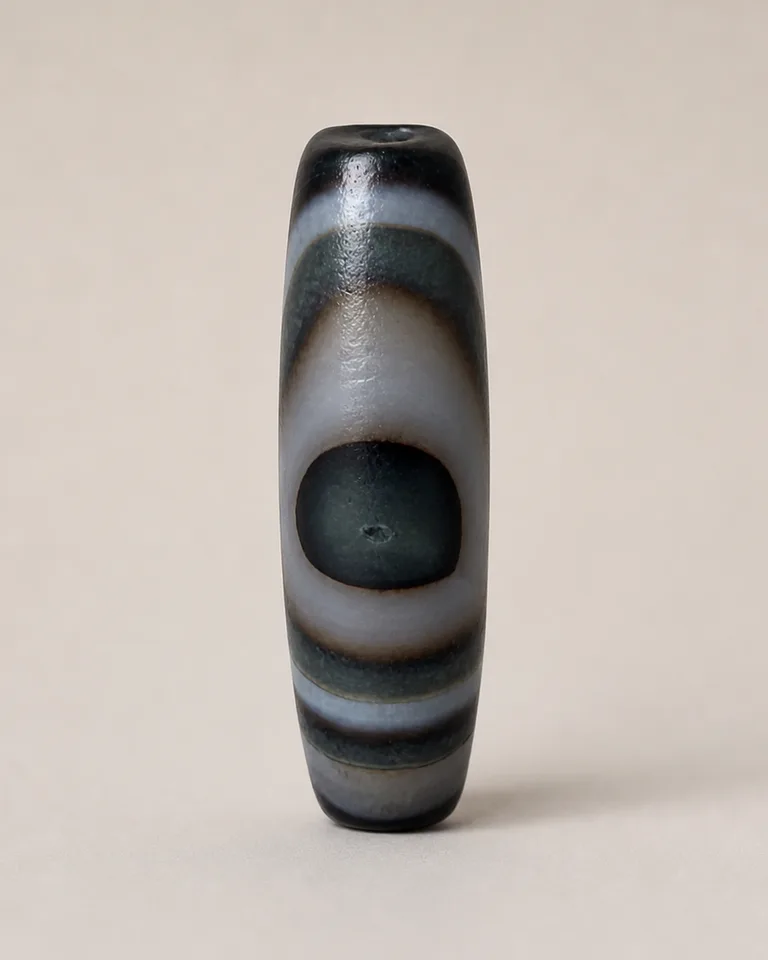
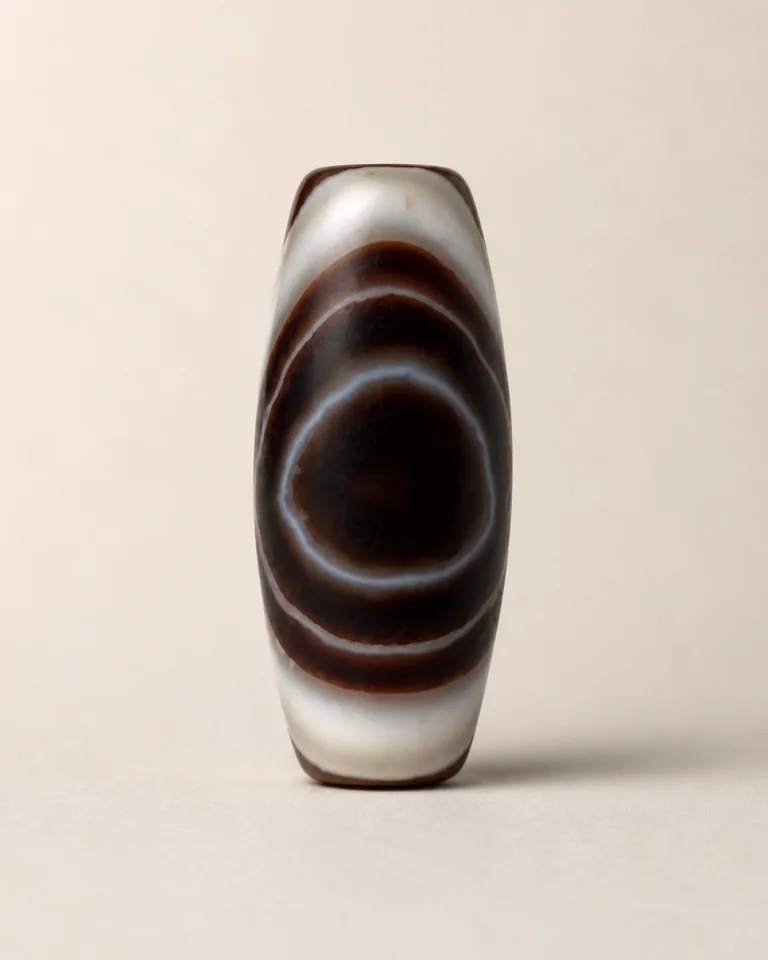
Natural banded agate can also form striking eye-like ovals. The dark banded-agate example in this article shows a single focal centre surrounded by fine nested bands. It illustrates the difference between a centre and its outlines; it is not an example of an artificially patterned one-eye Dzi. The resemblance is visual, while the formation of the pattern is a separate question.
Common meanings of one-eye Dzi
One-eye Dzi is commonly associated in contemporary guides with focus, clarity and insight. Visually, a single eye gives the composition an obvious centre: the surrounding bands lead attention toward one place. This makes it an appealing symbol for a personal intention, a new direction or a wish to see something more clearly.
These are associations attached to the motif, rather than a single official Buddhist definition. Some sellers add promises about intelligence, examination success or good fortune. The symbolism can be meaningful without turning those promises into a guaranteed effect.
Common meanings of two-eye Dzi
Two-eye Dzi is often linked with partnership, harmony and the balance of complementary qualities. Contemporary sellers frequently present it as a relationship or marriage symbol. The paired centres make that reading easy to understand: two distinct elements belong to one overall design.
A wish for companionship need not be limited to a couple. Friendship, cooperation and a balanced way of living are other ways people read the same motif. Yin and yang also appear in some modern explanations, but that vocabulary should not be mistaken for the only meaning of a Tibetan bead.
Common meanings of three-eye Dzi
Three-eye Dzi has several recurring interpretations. Many commercial guides connect it with Fu, Lu and Shou: happiness or good fortune, prosperity or status, and longevity. Others explain the three eyes through the Buddhist Three Jewels—Buddha, Dharma and Sangha—or use a simpler wish for health, happiness and abundance.
These interpretations draw on different cultural vocabularies. They are worth distinguishing rather than blending into a claim that three eyes have always meant exactly the same thing. The common thread is a wish for a fuller life; the precise wording depends on who is describing the bead.
Common meanings of nine-eye Dzi
Nine-eye Dzi is widely presented in modern guides as a comprehensive auspicious symbol. Prosperity, protection, reputation, opportunity and a sense of completeness recur in the explanations, although the lists do not agree item for item. Its attraction is the breadth of the wish, rather than one narrowly defined quality.
Nine eyes also create a dense visual rhythm as the motifs repeat around the bead. The exact arrangement varies, and all nine may not appear in one photograph. A high eye count is not, by itself, proof of rarity, antiquity or greater value. Those questions depend on the particular object, while the pattern remains something you can appreciate directly.
Bands, tiger tooth and geometric patterns
Striped and banded designs use lines that circle or cross the bead. Their character comes from width, spacing and contrast: a few broad bands feel different from many fine parallel lines. In natural banded agate, layers can sweep into an oval, open into an arc or gather around a dark centre, as in the photograph here.
Tiger-tooth Dzi generally refers to a repeated angular or zigzag motif. Some designs look like rows of pointed teeth; others are closer to nested chevrons. Strength and protection are common contemporary associations. Mountain, diamond, square and wave names describe other families of geometry, but the naming conventions differ between guides. The actual line pattern is often a clearer starting point than the name alone.
Lotus Dzi: motif and meaning
The label “lotus Dzi” usually points to a flower-like motif rather than a particular eye count. Some examples show open petals; others resemble a compact bud, and lotus designs may appear alongside eyes or bands. If two beads both carry the lotus name, their compositions can still look quite different.
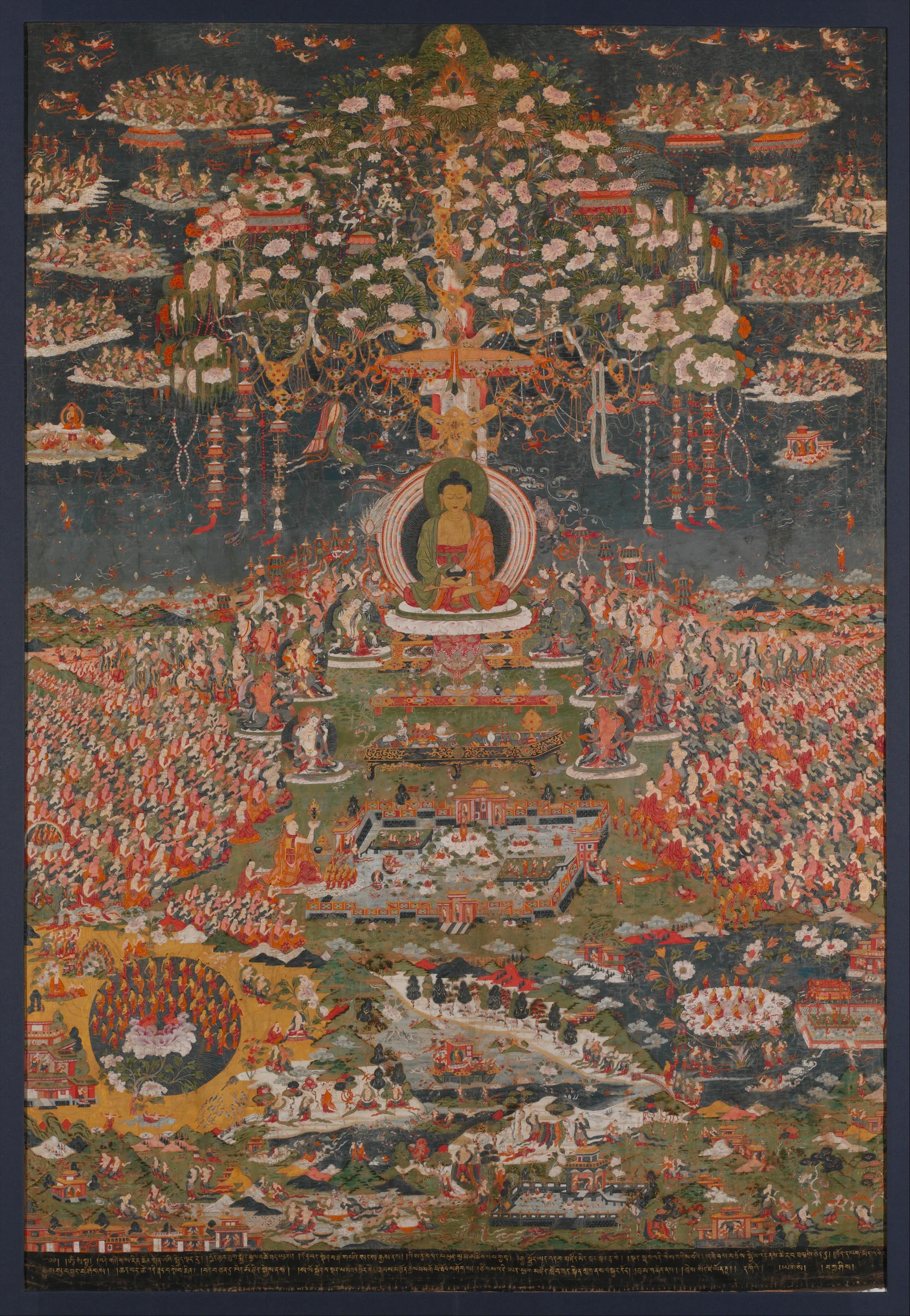
In Buddhist art, a lotus rising from water is associated with purity and awakening. On a bead, contemporary explanations often extend this to renewal, growth or beginning again through difficulty. The flower offers a cultural connection; it does not require a promise that wearing the bead will change a person’s circumstances.
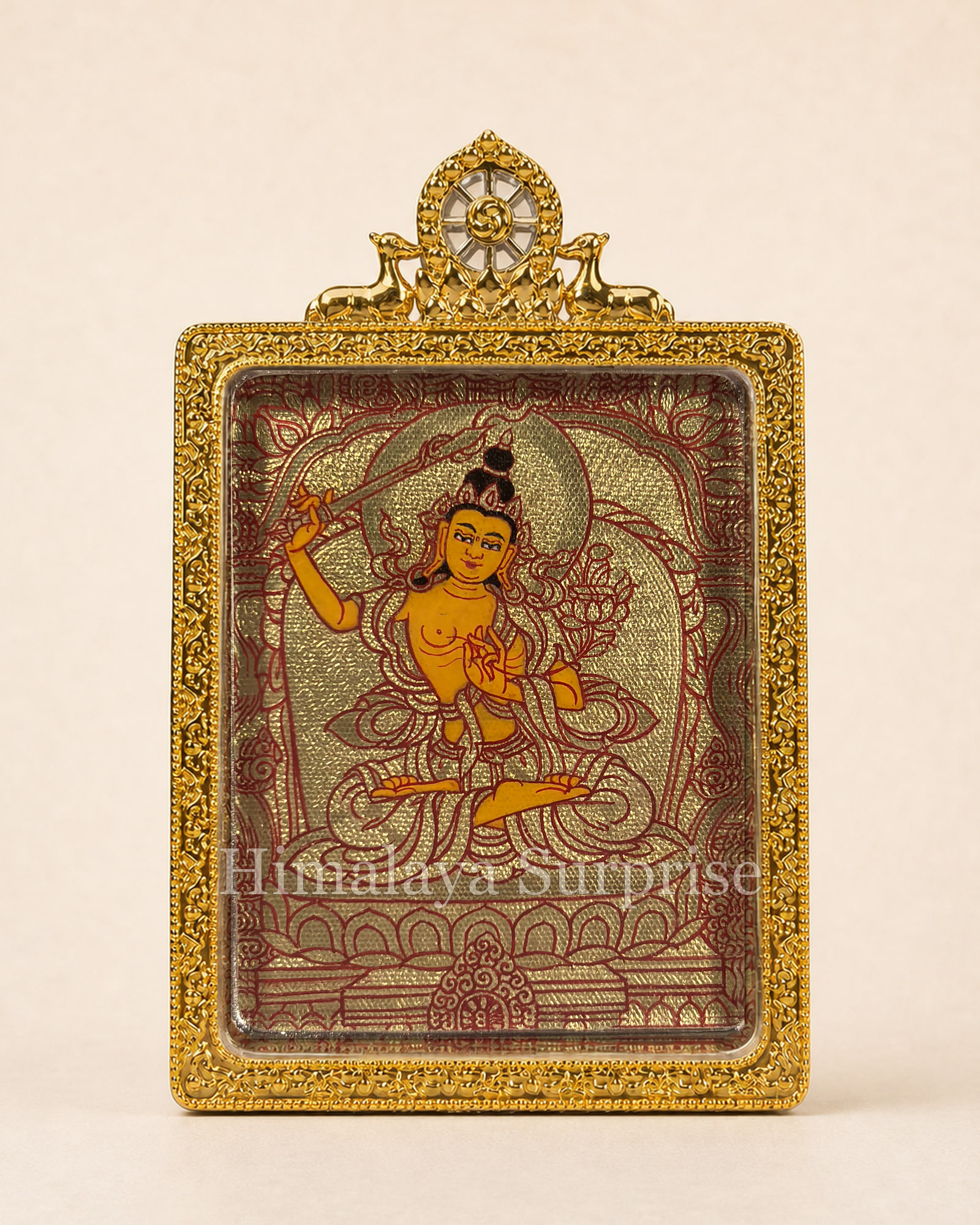
The same flower plays more specific roles in a painting: it may form a throne, be held in a hand or support a book. Our guide to the lotus in Buddhist art follows those settings and the differences between them.
Natural bands and deliberately patterned surfaces
Agate is a form of chalcedony, a fine-grained quartz material. Its bands can produce layered colours and eye-like shapes. Many patterned Dzi beads are also described as agate, but the pattern can involve additional treatments rather than the stone’s original layers. Such treatments can extend below the outer surface. Similar-looking motifs therefore need not have formed in the same way.
A 2020 synchrotron study examined one three-eye Dzi bead bought in a jewellery shop. It identified a quartz body, patterns extending below the surface and copper-related traces, and proposed a possible treatment process. This is useful evidence about how one patterned bead was made. It does not establish the method, date or origin of every bead called Dzi.
The photographs in this article show pieces listed in our collection as banded agate. Their natural-looking layers are a useful visual comparison with the strong light-and-dark motifs described in many Dzi guides. Neither an eye count nor a front photograph alone is a dating test.
Let the pattern be the starting point
A single focal eye, a repeated sequence, a sharp zigzag and a quiet band each offer a different way to look at a bead. Meaning can add a personal connection, while colour, proportion and scale shape its presence when worn. A design does not have to carry the largest number of eyes to be the one you prefer.
For the practical next step, our Dzi selection guide looks at shape, dimensions and wear. Here, it is enough to begin with a motif you enjoy and understand the wish or story you choose to associate with it.
Questions and answers
What are the main types of Dzi beads?
Eye counts are the most familiar naming system, but they are only one layer. Bands, chevrons, arcs, geometric forms, lotus motifs, material and history can all describe the same bead from different angles. A descriptive combination is often more useful than a single universal type label.
How do I count the eyes on a Dzi bead?
Follow each complete ring-like centre around the three-dimensional bead, checking the sides, ends and drilled opening. Several nested outlines can belong to one eye. If the available photograph hides part of the route, describe what is visible instead of forcing a number.
Is a lotus Dzi one fixed design?
The label usually refers to a flower-like motif or a combination of petals with other marks. Petal shape, placement and the guide using the term can vary. Start by describing the visible flower, then read its Buddhist association in context.
Does an eye count tell me the material or age?
No. Eye count names a visible design. Material and age are separate questions, and modern beads can carry the same pattern names as older ones.
Why do different Dzi guides give different meanings?
The names travel across communities, languages and modern markets. One guide may emphasise a broad aspiration, while another uses a more specific phrase. Presenting these as common associations, with their context visible, is more faithful than treating one list as the only meaning.