Discover / Subjects & Meaning
Tsongkhapa Thangka: Yellow Hat and Life-Story Scenes
A visual guide to the central figure, nearby forms and surrounding space.
In this story
Look at a Tsongkhapa thangka in two passes: first find the seated teacher, then follow the details that pull the eye outward. The same subject can appear in a compact portrait or a field crowded with scenes, so the surrounding space matters as much as the face.
Who is Tsongkhapa?
Tsongkhapa (1357–1419) founded the Gelug school of Tibetan Buddhism and established Ganden Monastery.
The central figure is the anchor. Before chasing small panels, note where the face, hands and seat sit, and how much open space surrounds them.
The yellow Pandita hat
A yellow Pandita hat and monastic robes are common Tsongkhapa clues. Use them to locate the subject before reading the surrounding field.
Read the hat with the body and hands. In a crowded painting it is the first visual landmark; in a quiet portrait it keeps the subject steady while you inspect the field.
What do the sword and book show?
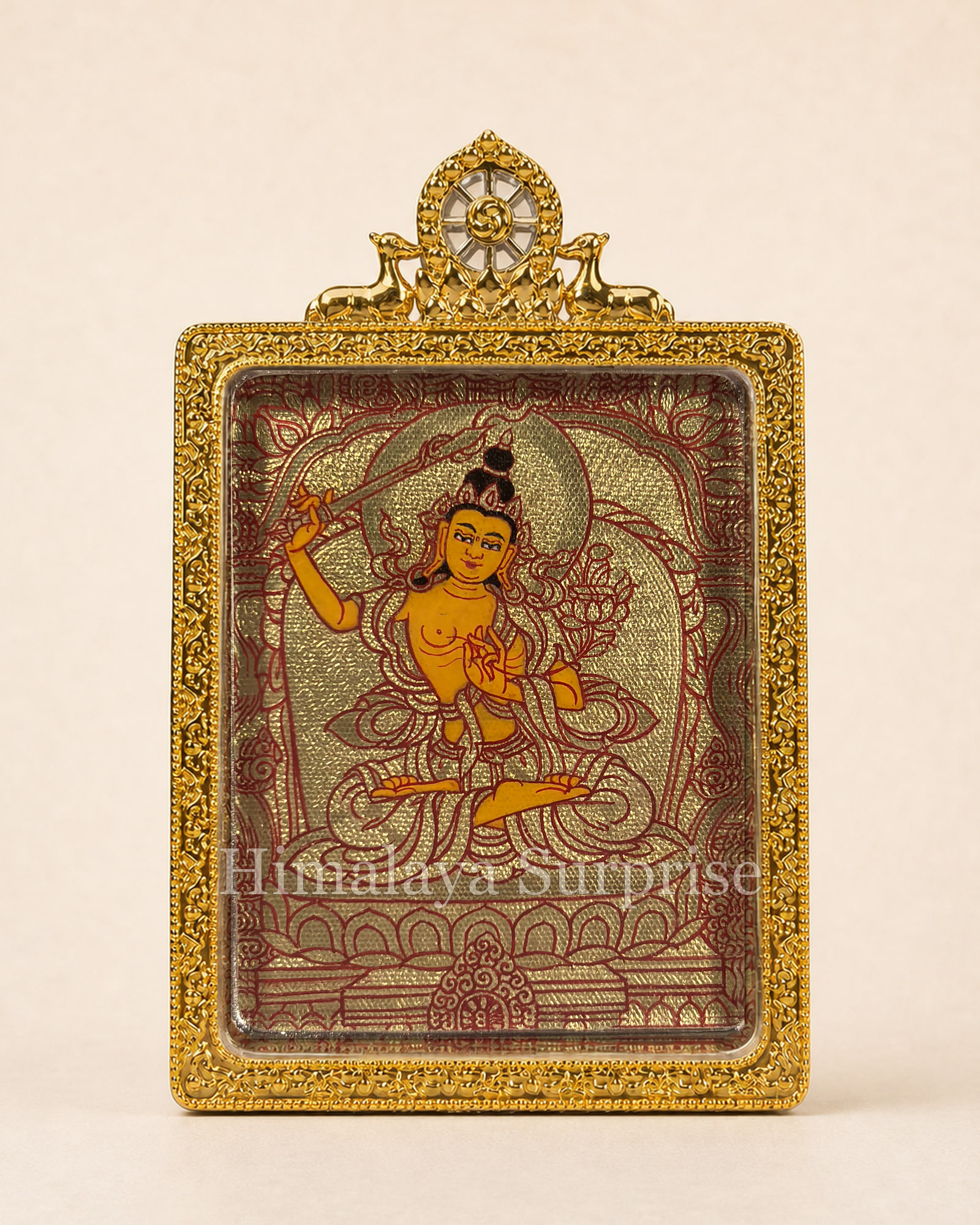
When present, a sword and book on lotus blossoms link him with Manjushri, the bodhisattva of wisdom.
The blossoms also create a bridge between the central figure and the rest of the image. Notice whether the eye returns to these forms or continues into panels, buildings and landscape.
Portrait or life-story scene?
A quiet field can hold attention on one seated figure. A denser field distributes attention through panels, buildings, people or landscape. The difference is visible in the painting’s use of space before every scene has been named.
When repeated faces, tiers, inscriptions or separated episodes appear, let the arrangement set the pace. Ask what repeats and what changes instead of trying to decode the whole border at once.
Two works, two visual structures
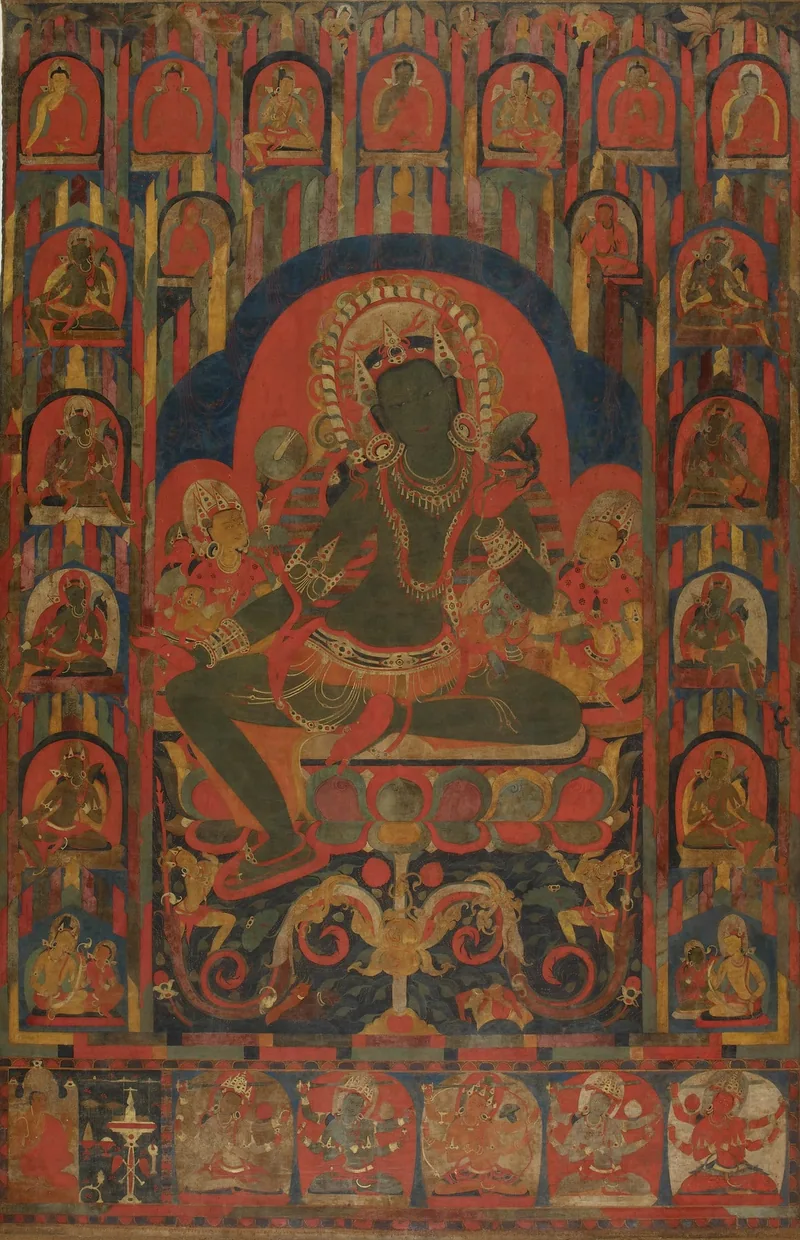
F1996.5.1 places a large seated figure in the middle of a dense red-and-ochre field. Two smaller seated figures balance the lower sides, and narrow panels continue around the central halo. The eye keeps returning to the central portrait.
C2009.2 shifts the figure left into green hills, buildings, cloud bands and small groups. Its visual movement crosses the field instead of circling stacked registers.
The first work feels panelled and gathered around a centre; the second feels like a route through terrain. This difference is a useful way to notice composition before naming every episode.
Are all life-story scenes read clockwise?
No single route covers both works. In F1996.5.1, the narrative starts at the lower left and moves clockwise.
C2009.2 includes a depicted dream in which Buddhapalita offers a volume; its scenes belong to the landscape. Follow that field rather than applying F1996.5.1’s route.
Start with the central figure, then let panels, clouds, buildings or terrain tell you where to go next.
Questions and answers
What kind of hat does Tsongkhapa wear?
Common images show a yellow Pandita hat with monastic robes.
What do the sword and book on lotus blossoms mean?
When present, they associate the figure with Manjushri, the bodhisattva of wisdom.
Are all Tsongkhapa life-story paintings read clockwise?
No. F1996.5.1 unfolds clockwise from the lower left; C2009.2 spreads its scenes through a landscape.
Where should I start with a crowded painting?
Find the central figure first, then follow the nearby forms and the divisions that lead into the surrounding scenes.