Discover / Craft & makers
Thangka Painting Composition: Centre, Scale and Story
Learn how thangka paintings organise a visual centre, surrounding figures, narrative scenes and mandala space without reducing every composition to one formula.
In this story
Thangka painting composition is the way an image distributes attention and makes relationships visible. It is related to iconography, which helps us recognise figures and attributes, but it is not the same thing. It is also different from the process of preparing and painting cloth. Start with the whole picture: where does your eye settle, what sits around that point, and how does the rest of the image guide you outward?
Composition is an order of attention
When we call a painting well composed, we are describing how its parts work together: a principal figure, a retinue, a landscape, a border, a sequence of scenes or a field of repeated forms. Composition gives the eye a route through those parts. It can make a relationship feel close, place a teacher above a disciple, or separate a sacred enclosure from the world around it.
This is why a list of symbols is only a beginning. A lotus, a book or a hand gesture may offer an iconographic clue, while its position and scale show how the painting asks us to connect that clue with other figures. Look first at the arrangement, then at the details that explain it.
Centre, scale and the visual axis
Many thangkas give the strongest visual weight to a central figure. A larger scale, a frontal pose, a clear vertical axis and open space around the figure often make it an anchor. Treat that hierarchy as a starting point: it orients the eye, while the figure’s identity becomes clearer through the wider context. Size is a compositional signal, one part of the reading.
Compare scale with placement. A smaller attendant may be close to the principal figure; a lineage teacher may appear above; a label may sit below the person it names. These relationships tell a story about hierarchy or connection even before every attribute is recognised. The useful question is not only “who is largest?” but “what does each size and position ask me to relate?”
Retinue, lineage and the space around a figure
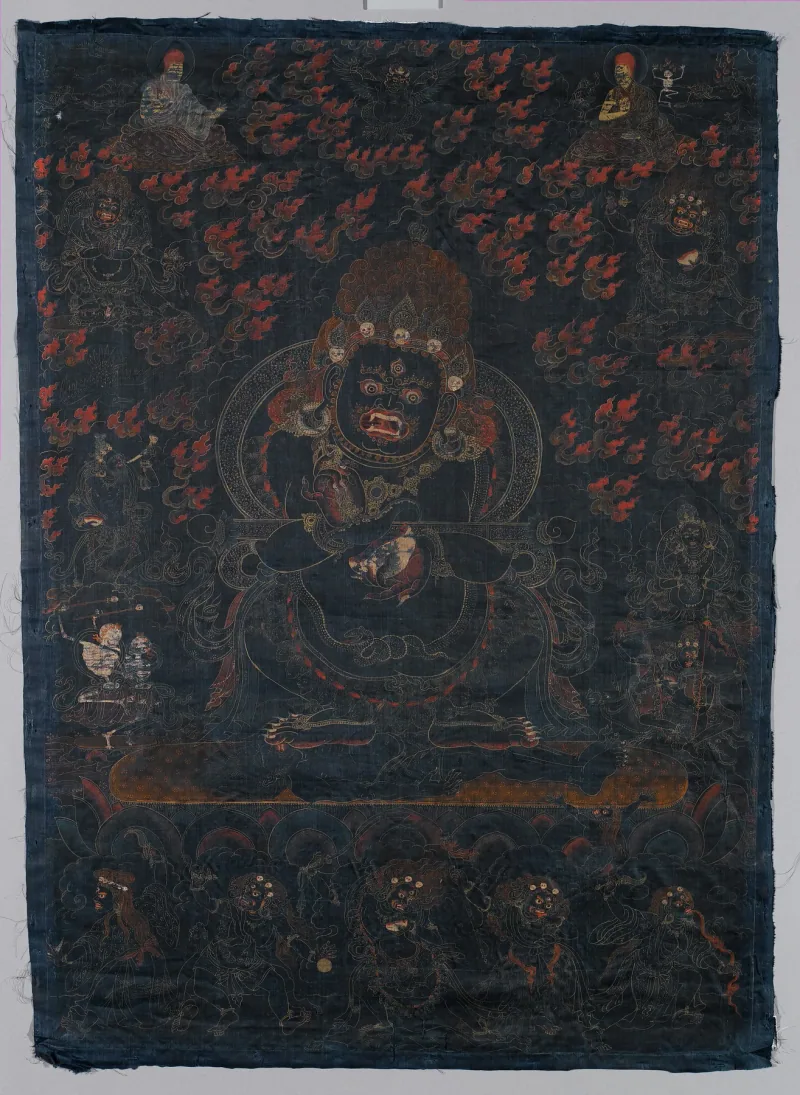
In the Metropolitan Museum’s painting used here, a seated central figure is framed by a flowering tree, while smaller figures and landscape details form layers around the vertical axis. The compositional question is how those bands and intervals lead the eye back to the centre, not only what each small figure means. Surrounding space turns a single figure into a complete visual world.
An Asia Society exhibition caption for a different Shakyamuni painting places Tsongkhapa directly above Shakyamuni, with principal disciples flanking the figures and names written below them. Here, vertical position, side-by-side placement and inscriptions reinforce one another. It is a useful object-level example of lineage and relationship; another painting may organise those relationships differently.
Narrative scenes: follow the path, not a fixed formula
A life-story painting can place several episodes around a principal figure. In the Cleveland Museum’s Tibetan Shakyamuni painting, the larger Buddha is surrounded by scenes distributed through the landscape and sky, so the narrative grows outward from the central presence. The eye may move between episodes, figures and landscape rather than follow a single line of text.
An Asia Society caption for an eighteenth-century Tsongkhapa and Scenes from His Life gives a more specific route: its scenes begin at the bottom centre and proceed clockwise, while an inscription identifies the work’s place in a series. This caption offers an object-specific way to follow the sequence; another narrative painting may lead the eye differently.
Parallel and repeated figures
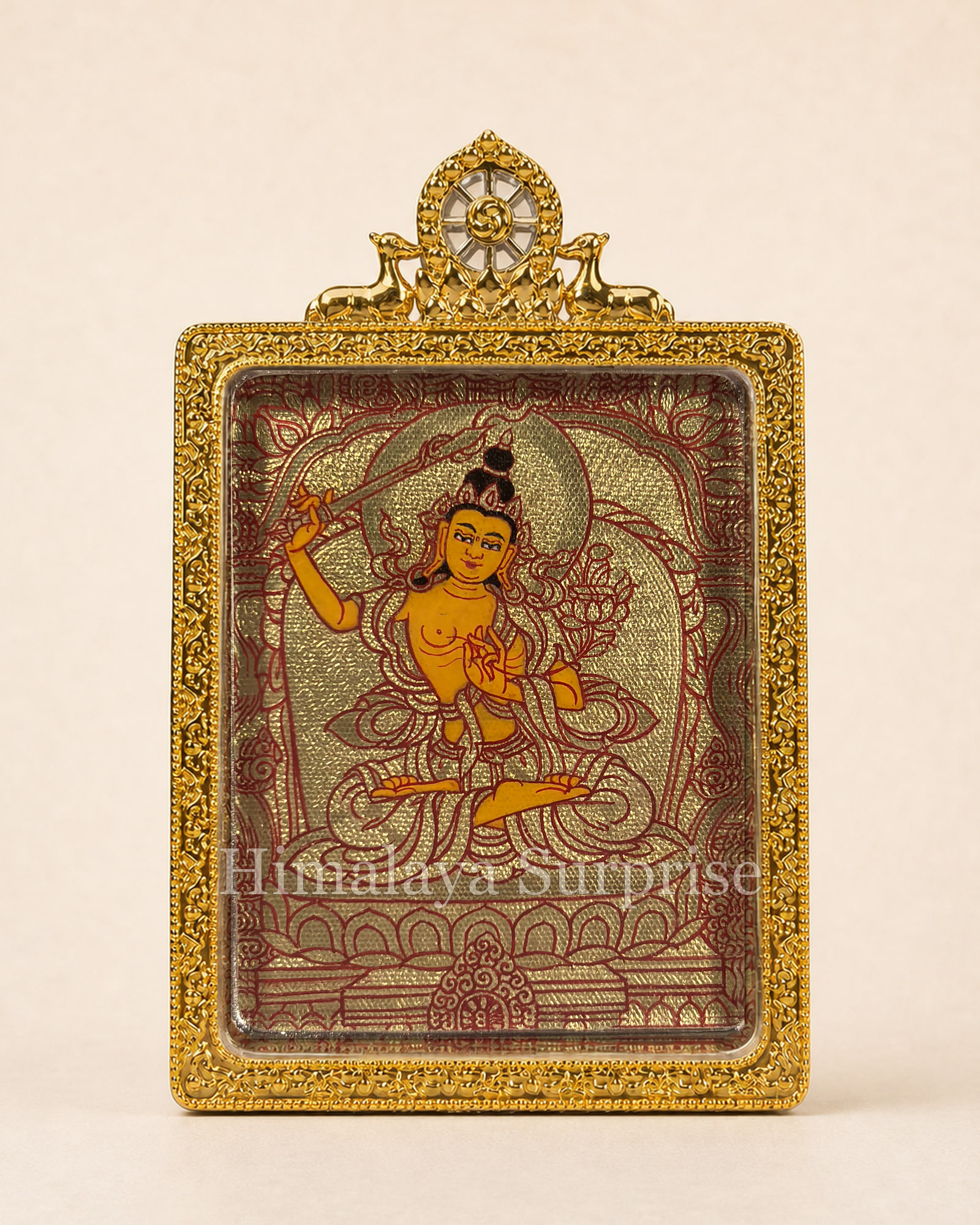
Paired figures create a different kind of balance. In the image used here, compare the near-equal height of the two seated figures, the open interval between them and the lower landscape that acts as a shared base. The contours echo one another without collapsing into perfect symmetry, so the eye moves between comparison and distinction.
Repetition can also make number and rhythm visible. An Asia Society caption for a White Tara painting records 116 small repetitions around a larger representation, with auspicious symbols between them. That count belongs to that particular object. In another painting, repetition may signal a retinue, a devotional multiplication or a patterned field; read the surrounding caption and context before assigning it one meaning.
A mandala is a different spatial system
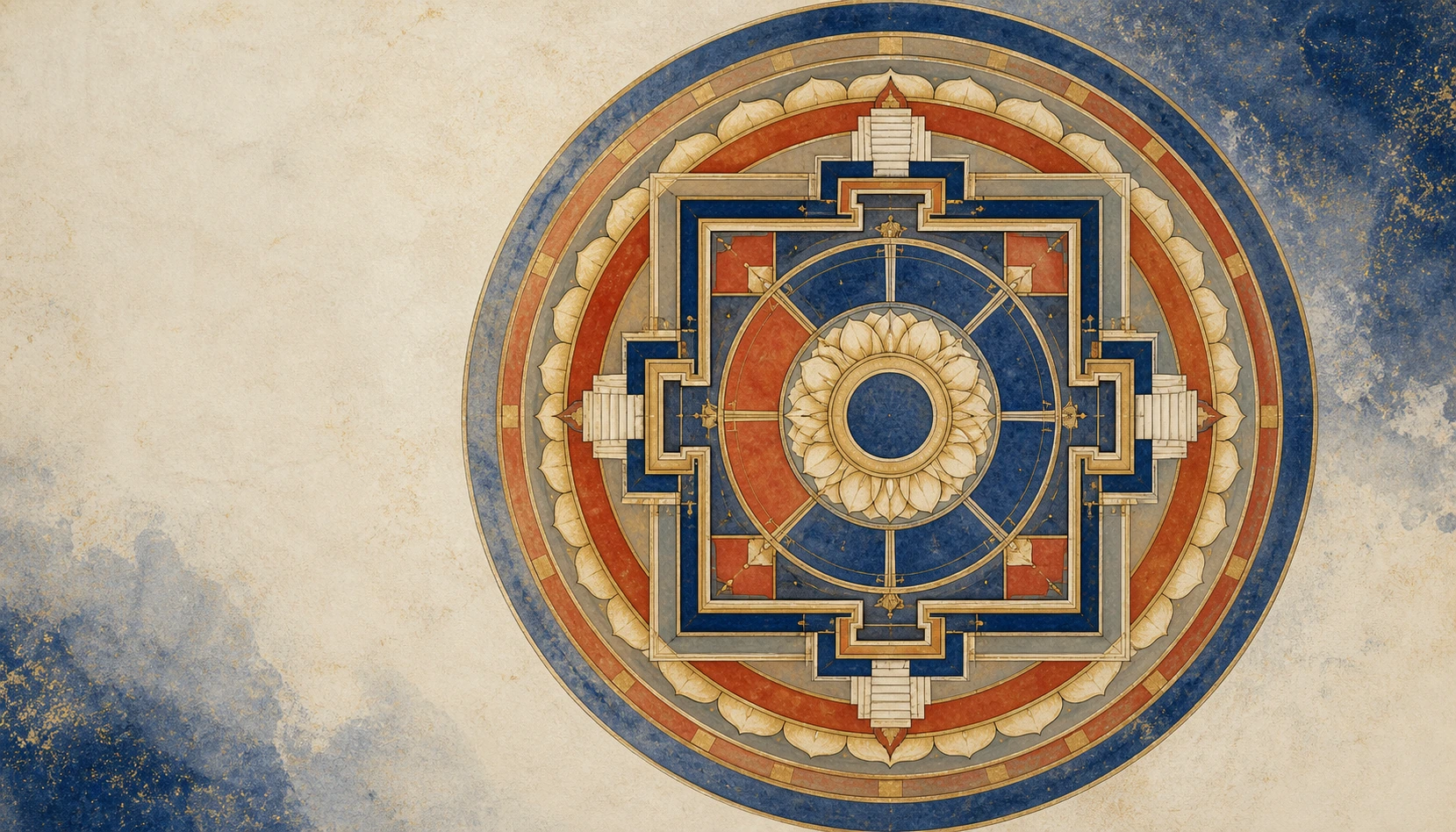
A mandala is not simply a crowded thangka. Its composition may organise a centre, an enclosure, gates, directions and surrounding registers so that the viewer reads space as a structured field. Circles, squares and repeated directional relationships can matter as much as the figures themselves.
Use the boundary as your first clue: where does the sacred space begin, and how does the centre relate to the four sides? This is a different reading exercise from tracing a life story or identifying a held object. Our guide to reading a Buddhist mandala follows that spatial logic in its own context.
Proportion gives structure; landscape leaves room to vary
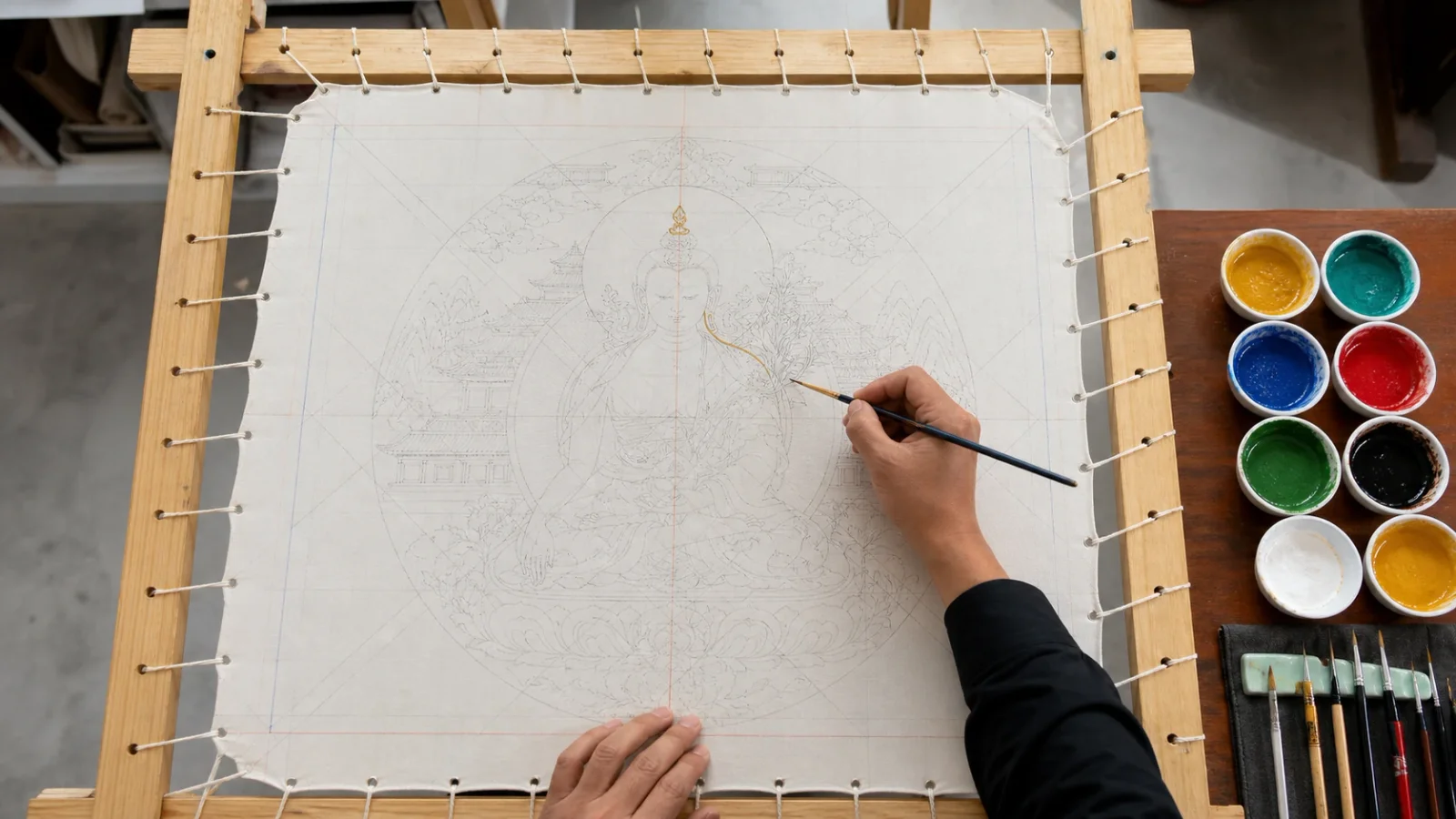
Sacred figures are drawn through proportional rules and iconometry. In one Avalokiteshvara drawing example, a relative grid uses twelve small units for one large unit, with a central perpendicular and diagonal guide lines. That ratio belongs to that specific example; it is not a number to apply mechanically to every thangka.
The same process discussion leaves more room for individual or local interpretation in backgrounds and landscapes, and notes that elaboration can vary with school, period, artist and patron. Structure and variation therefore belong together: a painting can respect a figure’s proportion while giving its surrounding world a distinct rhythm and atmosphere.
A transmitted layout is still worth looking at
A composition can travel. Rubin Museum material on paintings from printed compositions explains that a woodblock could transmit a design to paper or canvas before it was painted, while an individual artist could add details or choose pigments. A repeated layout therefore does not, by itself, prove a purely mechanical image or a completely independent design.
Once you have followed a story or traced the space around its central figure, the same thangka often looks different. A small teacher above the Buddha, a gap between two lotus seats or a path through the landscape can shift how the whole arrangement is read. Return to whichever detail first caught your eye and see what surrounds it.
Questions and answers
Does every thangka put its largest figure in the centre?
A large central figure is a familiar starting point. Other works organise attention through a mandala, paired figures, a lineage register or repeated forms, so read scale together with position, surrounding figures and the subject’s context.
Is a colour ground a type of composition?
A colour ground describes a surface and palette choice, while composition describes placement and relationships. A black, red or gold ground can change contrast and atmosphere, but it does not by itself tell you whether the layout is a single-figure, narrative, lineage or mandala composition. Read colour and composition as related layers.
Is a mandala just a crowded thangka?
No. A mandala can use an enclosure, gates, directions and a centre to organise sacred space. The number of figures is not the key distinction. Look for the spatial relationships and boundary before treating it as a general crowded scene.
Does a repeated composition prove that a thangka is a print?
No. A woodblock can transmit a familiar composition before painting, and an artist may add details or select pigments afterward. Similar layout is evidence of a visual relationship, not a complete account of how a particular work was made.