Discover / Display & Care
Thangka Restoration and Condition: Understanding Damage Before Treatment
Understand flaking paint, torn textiles and earlier repairs through museum conservation cases, and learn what to record before discussing thangka restoration.
In this story
A crease, a faded border or a small loss can raise a difficult question: does this thangka need treatment? Age alone gives no answer. The painted surface, its cloth support and the surrounding textiles can change in different ways. Looking at them together helps explain what needs attention—and why restoration does not always mean making a work look new.
What thangka restoration can mean
Restoration is often used as an umbrella word. It might mean securing loose paint, supporting a tear, reducing a stain, replacing a failing mount or making a loss less distracting. These are different interventions. A work with a fragile surface may first need stabilization, while a stable work with visible wear may be better served by improved storage or display.
Conservation considers both the present condition and the future life of the object. Visual integration is one possible part of that work, rather than its automatic goal. At LACMA, for example, colour compensation in a Yama and Yami painting was intended to help the image read as a whole while retaining a record of the losses. The purpose of treatment matters as much as the finished appearance.
Start with what has changed
A useful first record can be simple: an overall photograph, a closer view of the area that concerns you, the date and a note of what changed. A new crease after moving, powder that appeared below the painting or a stain noticed after a leak each gives an examination a starting point. Approximate dimensions and whether the work is framed or mounted as a scroll can also help.
Photograph the reverse and edges only when they are already safely accessible. A fragile scroll need not be unrolled, nor a stuck frame opened, just to make the record more complete. What is known can be described plainly; what is uncertain can remain uncertain. A note such as “dark mark at the lower right” is more useful than deciding in advance that it must be soot or water damage.
Paint, cloth and the signs between them
Cracking and flaking are related but different observations. A crack marks a break in a layer; a flake has begun to lift or detach. Newly appearing fragments, raised edges or a change after movement deserve attention. Their cause and activity need examination: touching, brushing or flexing the surface is not a useful test.
A tear in the cloth is a structural problem as well as an interruption to the image. The support can lose strength even where the painted design remains legible. At the edges, a weakened seam or heavy surrounding textile can also affect how the work hangs. This is why a thangka is examined as a combination of paint, support and mount.
Stains and changes of colour tell a less straightforward story. Moisture can leave marks in several materials; light exposure, smoke or earlier treatment can produce other changes. A close examination may distinguish these, while a photograph is better at recording their position and appearance. The useful question is what has changed, not whether every dark or faded area can be removed.
A scroll supported on a flat panel
LACMA’s Yama and Yami conservation account begins with worn, faded green silk borders. Removing them revealed that the stitches did not line up with the sewing holes in the painted cloth: the borders were a later addition. The team mapped pigment loss, flaking and damage, reduced water-related distortion and stabilized lifting paint. Examination changed the understanding of the whole object.
The painted surface was too fragile for repeated rolling and unrolling. Conservators and curators therefore chose a lightweight flat panel for storage and display; the later date of the borders also informed that choice. The work rested on the panel with support at its edges, rather than being adhered across its entire back. This was a response to the evidence in one scroll, not a rule that all thangkas should lose their flexible form.
The history hidden behind a textile image
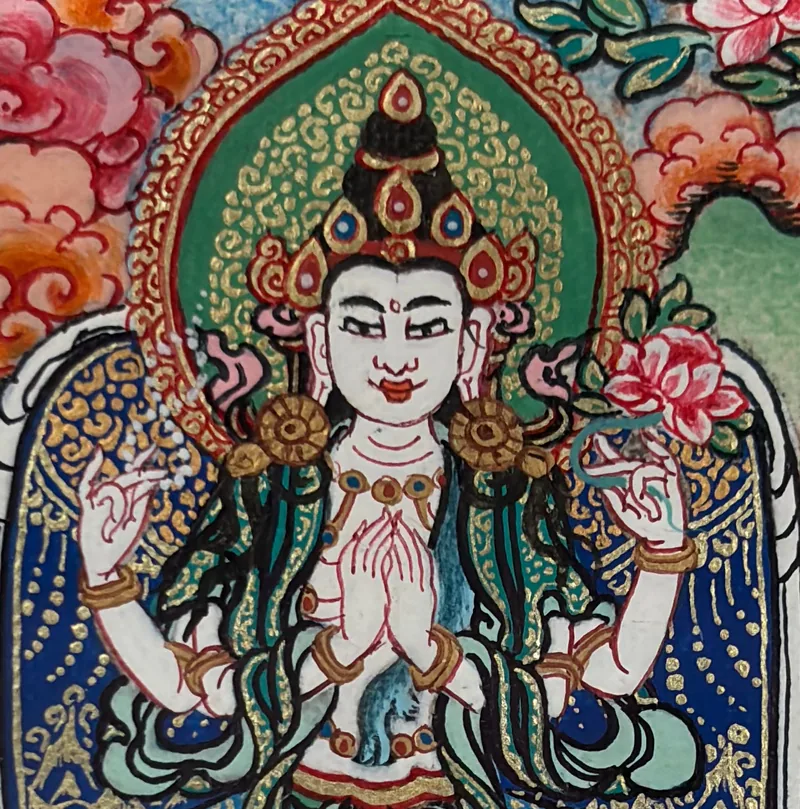
The nineteenth-century Kurukulla thangka shown here is made from appliquéd satin, brocade and damask, with embroidery and painted details. In the Met’s conservation account, magnified examination revealed the variety of fabrics and the stitching that joined them. Looking behind the image also exposed an older repair: a blue damask patch with a heat-set adhesive sheet that had discoloured and stiffened the textile.
The treatment involved testing replacement fabrics and dyes, removing problematic earlier additions and developing sewn supports. The account illustrates how a repair intended to help an object can become part of a later conservation problem. The fabric shapes and stitched details are visible in the detail shown here, but the adhesive history came from examination and documentation, rather than a diagnosis made from the front view.
Sometimes the most useful change is in storage
A preservation project connects damage with handling and repeated rolling. Its solutions varied with the works: some mounted thangkas were housed flat, while others received padded supports and purpose-made boxes. Front and reverse photography, including images made under different lighting, supported examination and reduced the need to handle the originals.
That approach adds another possibility to a restoration discussion. A better support, enclosure or display arrangement may address a risk without pursuing extensive changes to the image. Museum storage systems are designed for specific collections, but the broader lesson is useful: how a work is moved and kept can matter as much as what happens to its surface.
Care, framing and a treatment proposal
Thangka care concerns the everyday setting and preventable exposure. Framing concerns support and presentation. Conservation treatment addresses a material problem. These can overlap—a new enclosure may form part of a conservation plan—but a frame alone cannot secure lifting paint or mend a torn textile. The reason for changing the display should remain clear.
A helpful treatment conversation explains the observed problem, the proposed intervention and its likely limits. It can cover which areas will be affected, how earlier repairs will be treated and what photographs or notes will remain afterwards. Scope also explains the quotation: a small support repair and a large painting-and-textile treatment are different projects, so neither a universal price nor a fixed completion time describes them well.
Preserving a work’s continuing life
A thangka can carry religious, artistic and personal significance at the same time. Asia Society’s account of conservation work in Bhutan places local training alongside the care of paintings; material work also takes place within a community. For a work still used in worship, its use and the people who care for it belong in the treatment conversation. There is no single ritual requirement that can be assigned to every object.
A considered decision might be to improve the display, stabilize a vulnerable area or undertake a fuller treatment. It might also be to leave a stable mark in place. The aim is to keep the work available to future viewers, with its image and material history still able to speak.
Questions and answers
Does an old thangka always need restoration?
No. Age alone does not establish a treatment need. A stable work may benefit from suitable storage and display; new flaking, damp, tears or structural weakness calls for specialist assessment.
How can I tell whether paint is flaking?
Without touching the surface, note raised edges, newly appearing fragments or changes after movement. Photograph what is visible and avoid further handling. A conservator can assess whether the material is actively detaching and why.
Is reframing the same as thangka restoration?
No. A frame changes support and presentation. It may be part of a conservation plan, but it does not by itself stabilize loose paint or repair a tear.
What does thangka restoration cost?
The scope depends on the object and its condition. Paint stabilization, textile support, stain treatment, documentation and mounting involve different work. An examination and a proposed scope provide the basis for a quotation; there is no universal price.
What helps a first restoration enquiry?
Safe overall and detail photographs, approximate dimensions, the format and a short account of recent changes are useful. Include any known damage or treatment history. Ask the specialist how the object should be examined or transported, rather than moving a fragile work simply for a better photograph.