Discover / Art & History
Paubha and Thangka: What Is the Difference?
Compare Newar Paubha and Tibetan thangka through two historic paintings, their religious settings, shared techniques and the artistic exchanges that connect them.
In this story
Paubha is associated with the Newar religious-painting tradition of Nepal’s Kathmandu Valley, serving Buddhist as well as Hindu patrons. Thangka usually refers to a Tibetan Buddhist hanging image, made by painting or textile techniques. Both can present sacred figures on cloth, and their histories have long been connected. Their differences become clearer when we look at the communities, subjects and individual paintings behind the names.
Two names with different cultural settings
Paubha is a Newari term closely tied to the Kathmandu Valley. Newar artists made devotional paintings on cloth alongside illustrated manuscripts and painted book covers. Buddhist deities and mandalas belong to this history, as do images made for Hindu patrons. The word brings a particular artistic community into view, rather than naming every religious painting produced in Nepal.
Thangka has a wider geographical life than its association with Tibet might suggest. Tibetan Buddhist images are made and used in Tibetan regions, Nepal, Bhutan and other Himalayan settings. A Nepalese studio may therefore paint a thangka in a Tibetan Buddhist tradition. The place where a work is made and the tradition its imagery follows can be different parts of the same story.
A Nepalese mandala: circles, figures and movement
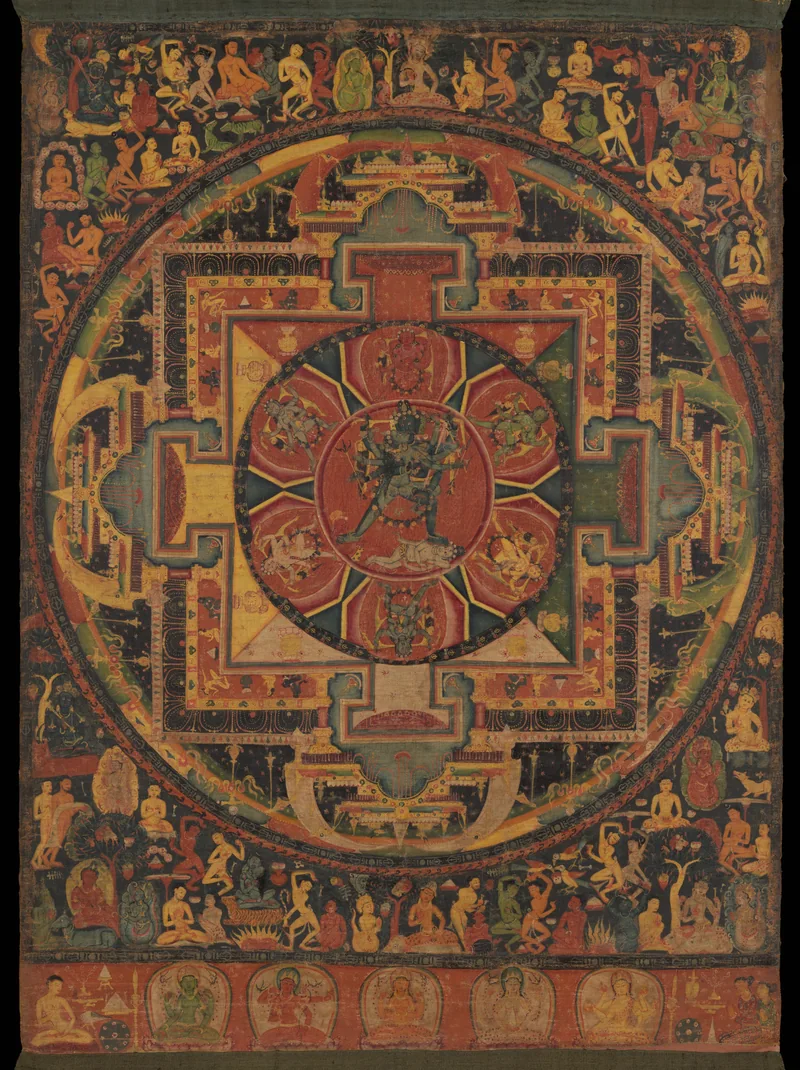
The opening image is the Chakrasamvara Mandala, a Nepalese cloth painting dated to about 1100 and an early surviving paubha. At the centre, Chakrasamvara appears with Vajravarahi. Six goddesses occupy stylised lotus petals around them, while further rings organise the space. The outer burial grounds introduce trees, figures and small scenes into the circular design.
The image invites two kinds of looking. From a distance, the circles give it a strong centre and a clear rhythm. Up close, the surrounding figures keep the surface animated. Along the bottom, five Taras appear with a tantric adept and donors. These smaller figures connect the large sacred design with human participation. Geometry and lively detail work together here; precision does not make the painting visually still.
A Tibetan painting: the central figure and its company
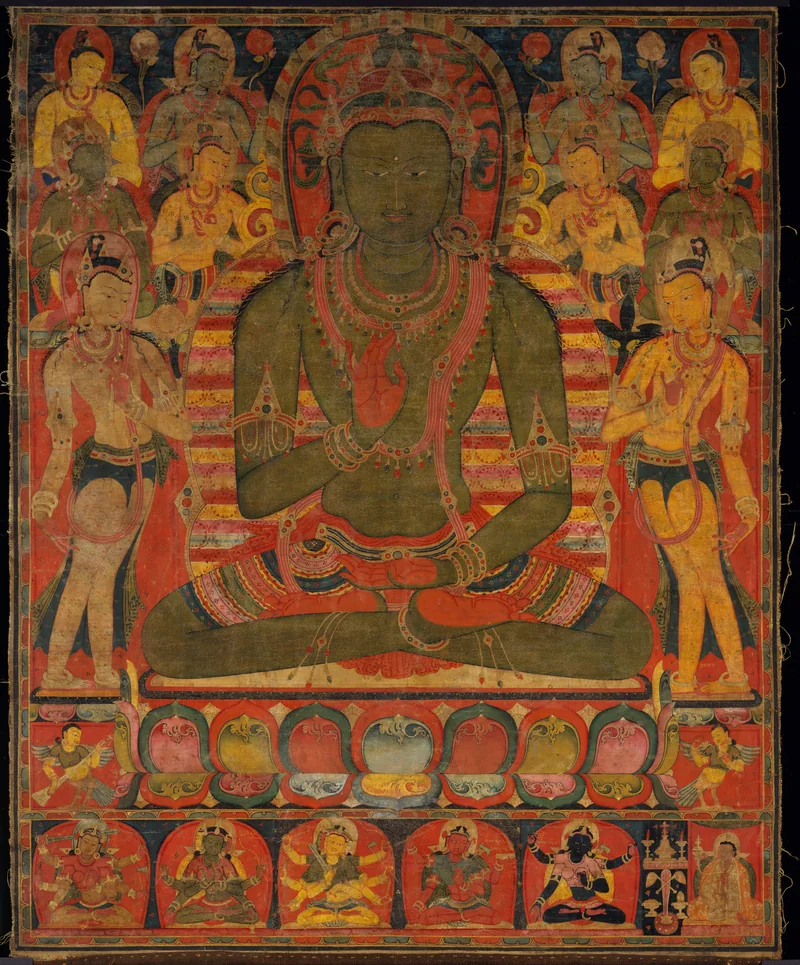
Buddha Amoghasiddhi with Eight Bodhisattvas, from Central Tibet around 1200–50, offers a different arrangement. The green Buddha sits prominently at the centre, with his right hand raised in the gesture of reassurance. Bodhisattvas fill the surrounding compartments, and a lower register contains Tara figures. A viewer meets a central presence before following the relationships around it.
Like the Nepalese mandala, this work is painted with distemper on cloth. Its visual character also reaches beyond a modern national boundary: the museum relates aspects of its style to eastern Indian Pala art and compares its crowns with paintings at Shalu in Central Tibet. The two works share a painted-cloth medium and a sacred purpose, while their subjects and compositions give them distinct identities.
Colour and detail do not follow a simple border
Paubha is sometimes described as dark and earthy, and Tibetan thangka as bright and colourful. The paintings themselves offer a fuller picture. In its account of Nepalese painting, the Met draws attention to vivid colour, exact brushwork and changing decorative forms. Tibetan painting likewise includes many palettes, from richly coloured compositions to red, black and gold grounds. A single light-versus-dark contrast leaves much of both traditions out.
Composition offers a more rewarding comparison. Notice the balance between a large central figure and the smaller ones, how a halo meets an architectural arch, where landscape enters, and how a border contains the scene. In the two examples here, the Nepalese mandala builds outward through circles, while the Tibetan Buddha painting organises companions around an enlarged central figure. That is a difference between these paintings, rather than a rule that every Paubha or thangka must repeat.
Artists and ideas crossed the Himalayas
Newar workmanship was valued beyond Nepal. Artists from Nepal received commissions in Tibet and China, and their designs became influential at different moments. Tibetan Buddhist art also drew on India, Kashmir, China and other neighbouring regions. Its history contains many encounters, with local artists reshaping what travelled. The resemblance between two paintings can therefore reveal exchange as well as shared religious subjects.
The same image can carry several histories at once: the teaching represented by its deity, the painter’s training, the patron’s wishes and the route by which a composition became familiar. Calling Paubha the source of every thangka compresses those histories too far. Calling the traditions entirely separate misses their close relationships. The more interesting story is how artists preserve recognisable sacred forms while giving them a particular visual life.
Shared materials, individual ways of working
For painted works, prepared cloth provides a surface for measured drawing, layers of colour and fine finishing. Both traditions place importance on the form and attributes of sacred figures. Recipes for grounds, binders and pigments, however, vary with period and workshop. Colour in a photograph cannot tell us whether a painter used one particular mineral, plant colour or modern pigment.
Thangka also includes textile images made through embroidery or appliqué. Here stitches or assembled cloth form the picture itself. A brocade surround on a painted work plays a different role: it frames and supports the image. Distinguishing the picture from its mounting makes the comparison clearer, especially when the same religious subject appears in more than one material.
A living painting tradition
Paubha is a contemporary practice as well as a historic art. In a 2023 interview with Inside Himalayas, painter Ujay Bajracharya describes learning and teaching in this tradition. That studio perspective brings attention back to the people whose skill sustains the images. Sacred conventions provide a framework, while training, observation and the work of individual artists keep the tradition active.
Paubha and thangka become richer terms when they lead us into this close looking. A mandala’s ordered circles, the company around a Buddha, a patient line or a bold field of colour each reveals something particular. Their shared history makes comparison possible; the individuality of the paintings makes it worth returning to.
Questions and answers
Is Paubha just the Nepali word for thangka?
Paubha is a Newari term associated with the Newar religious-painting tradition of the Kathmandu Valley. Thangka usually names a Tibetan Buddhist hanging image. Their subjects and histories overlap, but the words describe different cultural settings and are not simply interchangeable translations.
Are Paubhas Buddhist or Hindu?
Newar religious painting serves both Buddhist and Hindu patrons. A Paubha’s subject may be a Buddhist deity or mandala, or an image connected with Hindu worship. The particular figures and setting explain the work more clearly than a single religious label for the whole tradition.
Can a thangka be painted in Nepal?
Yes. Thangkas are made in Nepal as well as Tibetan regions and other Himalayan settings. A production place and an artistic tradition are different aspects of a work: a Nepalese studio can make a painting for a Tibetan Buddhist context.
Can colour alone distinguish Paubha from thangka?
No. Both contain varied palettes and detailed sacred compositions. Look at the subject, arrangement of figures, line, surface and cultural setting together. A bright or dark ground is an interesting feature of a painting, rather than a complete definition of its tradition.