Discover / Subjects & Meaning
Medicine Buddha Mantra: Meaning, Sanskrit and Tibetan Pronunciation
Read the Medicine Buddha short mantra in IAST and a common Tibetan phonetic form, with the longer text names explained.
In this story
The Medicine Buddha’s name and mantra appear here in two written forms: Sanskrit IAST and a common Tibetan phonetic rendering.
Which Medicine Buddha mantra are you reading?
In Buddhist practice, three names distinguish Precious Long Dharani, Long Mantra and Short Mantra.
The Long Mantra adds homage before the Short Mantra; the Precious Long Dharani is separate.
The short mantra in IAST
The short mantra in IAST is:
Here, bracketed BHAIṢAJYE is optional after MAHĀBHAIṢAJYE.
A common Tibetan phonetic rendering
A common Tibetan phonetic line:
Read the two presentations together: the first preserves IAST marks, while the second offers a familiar phonetic guide to the sound.
What do bhaiṣajya, guru and svāhā mean?
Bhaiṣajya covers medicine, remedy or healing, guru means teacher, and svāhā is a ritual ending. In Bhaiṣajyaguru, bhaiṣajya and guru join in the Medicine Buddha’s name. These are word clues, not a complete translation.
IAST and a phonetic line serve different purposes: one records transliteration, while the other helps a reader approach pronunciation.
Why do the spellings vary?
Some pages spell the sounds as “Bhai-sha-jye,” “Be-kan-dze” or “Randza.” These forms can reflect a different phonetic convention, so they are not automatically interchangeable.
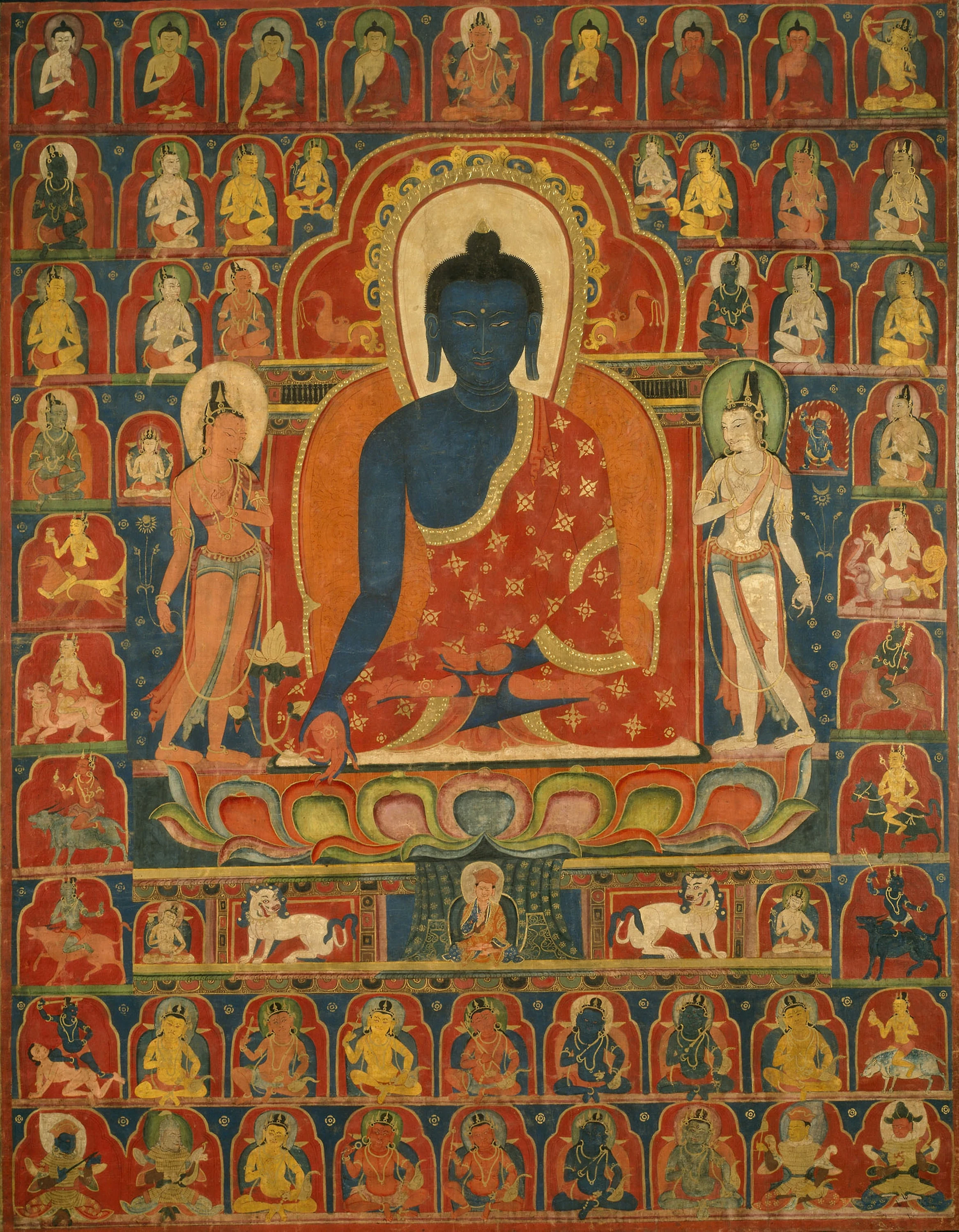
The Medicine Buddha meaning guide reads the blue body, bowl and surrounding assembly in the image; this page stays with the mantra text.
Questions and answers
What changes between the Long and Short Mantra?
The Long Mantra adds homage before the Short Mantra; the Precious Long Dharani is separate.
Why can the same mantra look different on another page?
Different phonetic conventions can spell the sounds differently; compare the full lines rather than correcting one word in isolation.
Can the Medicine Buddha mantra replace medical care?
This page explains a religious text and its spelling; it is not medical advice or a treatment claim.