Discover / Subjects & Meaning
Kalachakra mandala: reading the palace of the Wheel of Time
Explore the meaning of the Kalachakra mandala, its four gates, colours and five levels. Historical paintings and a stained-glass emblem reveal different ways of representing the Wheel of Time.
In this story
A Kalachakra mandala represents the sacred residence of Kalachakra and the assembly of deities around him. Its nested squares and outer circles bring a three-dimensional palace onto a flat surface. The name means “Wheel of Time” or “Cycles of Time”: it belongs to a Buddhist teaching system that connects the wider world, the human body and a path towards awakening. The palace gives those relationships a visible form.
What does “Wheel of Time” mean?
Kala means time; chakra means a wheel or cycle. The teaching considers change on several scales: the movement of the heavens, the passing of seasons, the rhythms of the body and the recurring conditions of life. This is why a Kalachakra image can connect celestial and bodily themes within one carefully ordered space.
Namgyal Monastery distinguishes outer, inner and alternative Kalachakra. Outer concerns the environment and the universe; inner concerns living beings and bodily cycles; alternative concerns the Buddhist path that transforms ordinary experience. Alexander Berzin’s overview explains this relationship through external and internal cycles of time and practices for liberation. These three aspects describe the teaching; they are not three separate pictures to look for inside every mandala.
The square is a palace seen from above
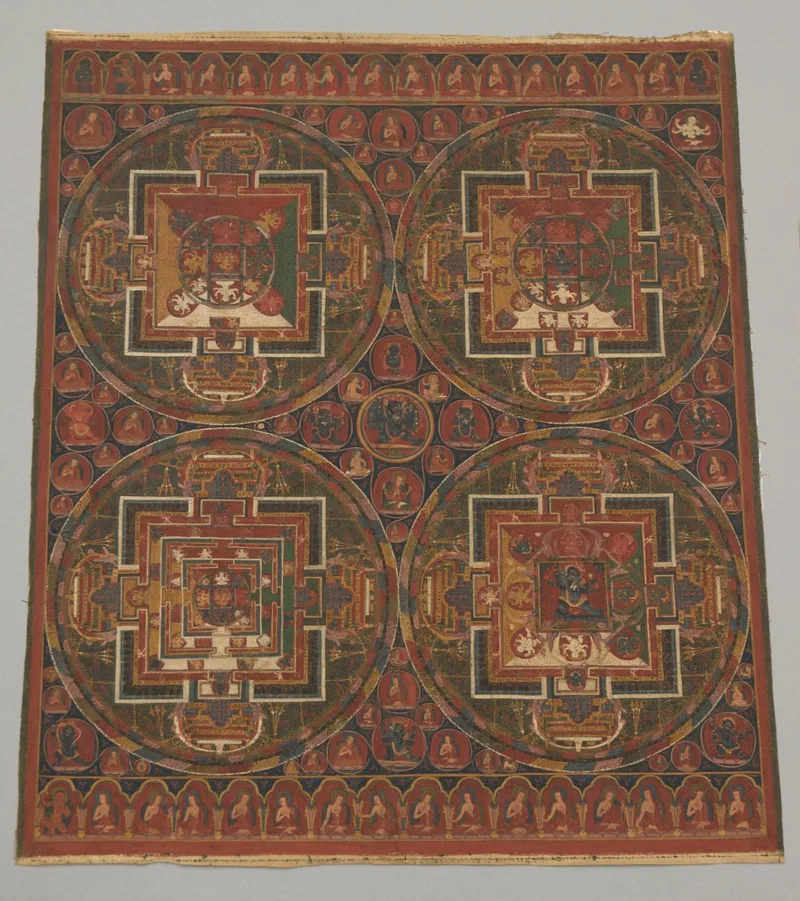
Look at the historical painting above. A large circle encloses several square structures, each with a projection towards the middle of its four sides. Those projections mark the gateways. Within them, smaller squares lead the eye towards the central figures. Around the circular enclosure, seated teachers and other figures occupy a separate painted field. The composition has a centre, an architectural order and a surrounding community.
Namgyal describes a five-level mansion, with walls, doors, a roof and raised platforms. A painted or sand mandala shows these relationships in a plan-like arrangement. Gate structures that would stand upright in the imagined palace spread outwards on the flat image. Once you recognise that change of viewpoint, the repeated rectangles become easier to understand as architecture.
Why is the dark gate at the bottom?
In the standard arrangement explained by the International Kalachakra Network, east faces the viewer and appears at the bottom of a flat image. Its colour is black; blue and black can also alternate in Kalachakra imagery. In that arrangement, the red south lies to the viewer’s left, white north to the right, and yellow west at the top. The colours belong to directions and to the faces of the central deity.
This explains an apparent reversal when someone expects north to be at the top, as on a modern map. The top of the painting and geographical north serve different purposes. In an actual work, follow the gates, coloured fields and central figure together; age, pigments and photography can alter the appearance of a dark passage or pale wall.
Three mandalas within five levels
The outer body mandala stands at the lowest level. The speech mandala rises within it; the mind mandala rises within the speech mandala. At the centre of the mind mandala are two further platforms, associated with pristine awareness and great bliss. This is how body, speech and mind can describe three principal divisions while the palace is explained as five levels.
The full system described here assigns 536 deities to the body division, 116 to speech and 70 to mind: together, 722. Figures may appear as bodies, symbols, syllables or small coloured marks. The number belongs to the described full system; it does not mean that every painting lets a viewer count 722 miniature portraits. A work devoted to the mind mandala presents a smaller portion of that palace.
Kalachakra and Vishvamata at the centre
A palace plan can make its inhabitants very small. This separate painting, Kalachakra and his Core Assembly, brings the central couple forward. This seventeenth-century work in the Rubin Museum collection is painted with mineral pigments on silk. The blue principal figure and golden-coloured consort stand together, with numerous arms spreading into an arc; smaller figures surround them. The textile mounting remains visible around the painted field.
The principal couple is Kalachakra with Vishvamata. In Buddhist explanations, their union is associated with wisdom and method, or emptiness and compassion. A painting centred on the couple and a palace mandala can therefore belong to the same teaching cycle while organising attention differently. One foregrounds the inhabitants; the other makes their ordered residence visible.
Sand, painting and a three-dimensional palace
A sand mandala is assembled from coloured grains on a flat support. The International Kalachakra Network describes the tradition followed by the Dalai Lama: the mandala is prepared before an initiation and dismantled afterwards. Its temporary life draws attention to impermanence. A painted mandala keeps a related visual arrangement in a durable image; it is not a sand mandala preserved under glass.
A three-dimensional model reveals the height suggested by that plan. Michael Henss, with contributions from artist Pema Namdol Thaye, discusses the Kalachakra palace mandala in the Potala Palace, dated to the 1690s. Gilt-brass repoussé, cast figures, a wooden armature and stone, crystal and glass inlays build an elaborate structure about 6.2 metres across. This example helps explain why a flat diagram can contain doors, terraces and roofs: a whole architectural world has been brought into a single view.
The Kalachakra emblem is a different image
This photograph shows a stained-glass window at Samye Ling in Scotland, taken in July 2009. Its centre contains coloured, interwoven letterforms above a lotus, surrounded by eight auspicious signs. These are different visual components from the nested walls and gateways in the historical painting. The shared Kalachakra name does not make the window a full palace plan.
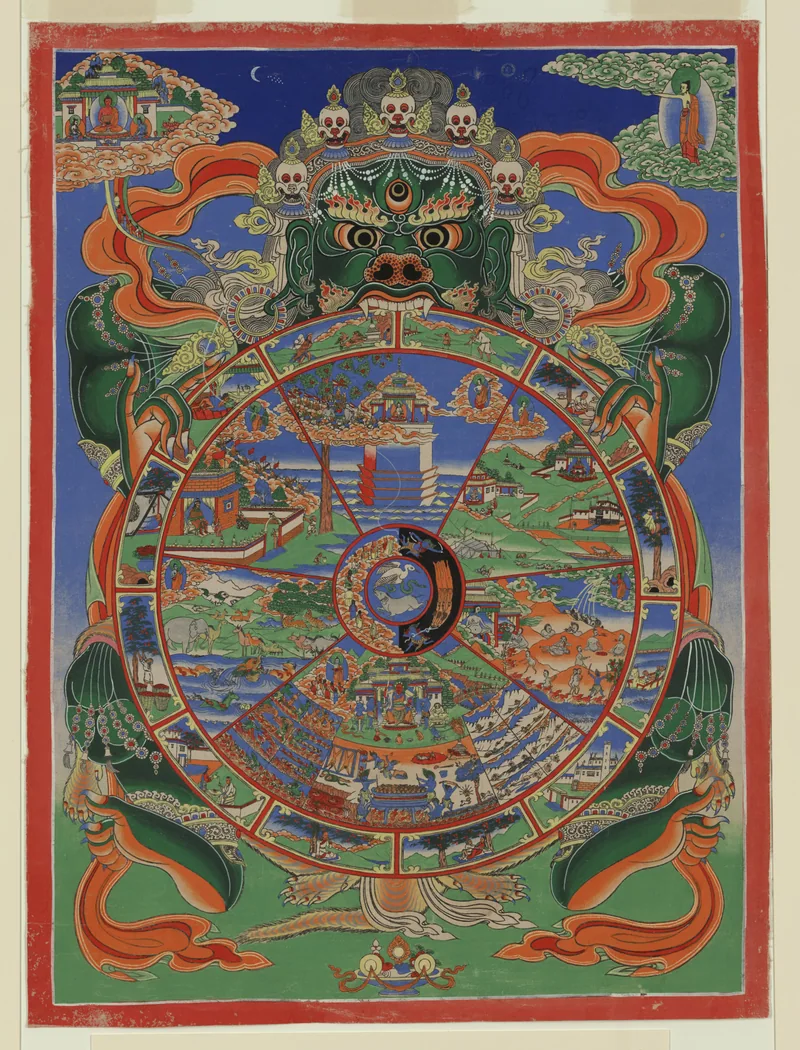
The composite letter emblem is often called the tenfold powerful symbol. A Kalachakra deity painting, a palace mandala and this emblem offer three recognisable representations of the same tradition. The Wheel of Life is another subject again: its realms, scenes and enclosing figure describe the cycle of existence through a different composition. Our Wheel of Life guide explores that image.
Let the structure guide your eye
Begin with the four gates, follow the squares towards the centre, then notice how the circles hold the palace together. This movement allows the larger order and small details to come into view at different moments. For a broader introduction to Buddhist mandalas, read our guide to their layout.
Questions and answers
Is every circular mandala a Kalachakra mandala?
No. Buddhist mandalas belong to different deity cycles and have different arrangements. A circle alone does not identify Kalachakra; the palace, central figures, inscriptions and named context provide more specific clues.
Does the dark lower gate mean the painting is upside down?
In the standard Kalachakra arrangement explained here, the dark eastern gate faces the viewer and is shown at the bottom. This differs from the north-up convention of many modern maps.
Can looking at the artwork replace initiation or instruction?
An artwork can introduce the visual language and support careful study. Formal Kalachakra practice belongs to a transmitted teaching tradition, with initiation and guidance. Namgyal’s explanation places visualisation within that practice context.