Discover / Materials & Craft
Thangka vs Mandala: How a Painting Can Be Both
Understand the difference between thangka and mandala through three historic paintings: cloth scrolls, sacred palaces, a five-Buddha arrangement and the life of a sand mandala.
In this story
A painting can be both a thangka and a mandala. Thangka names a hanging-scroll tradition; mandala describes an ordered sacred space or arrangement. One tells us about the work’s form, the other about the world it brings into view.
A hanging artwork and a sacred space
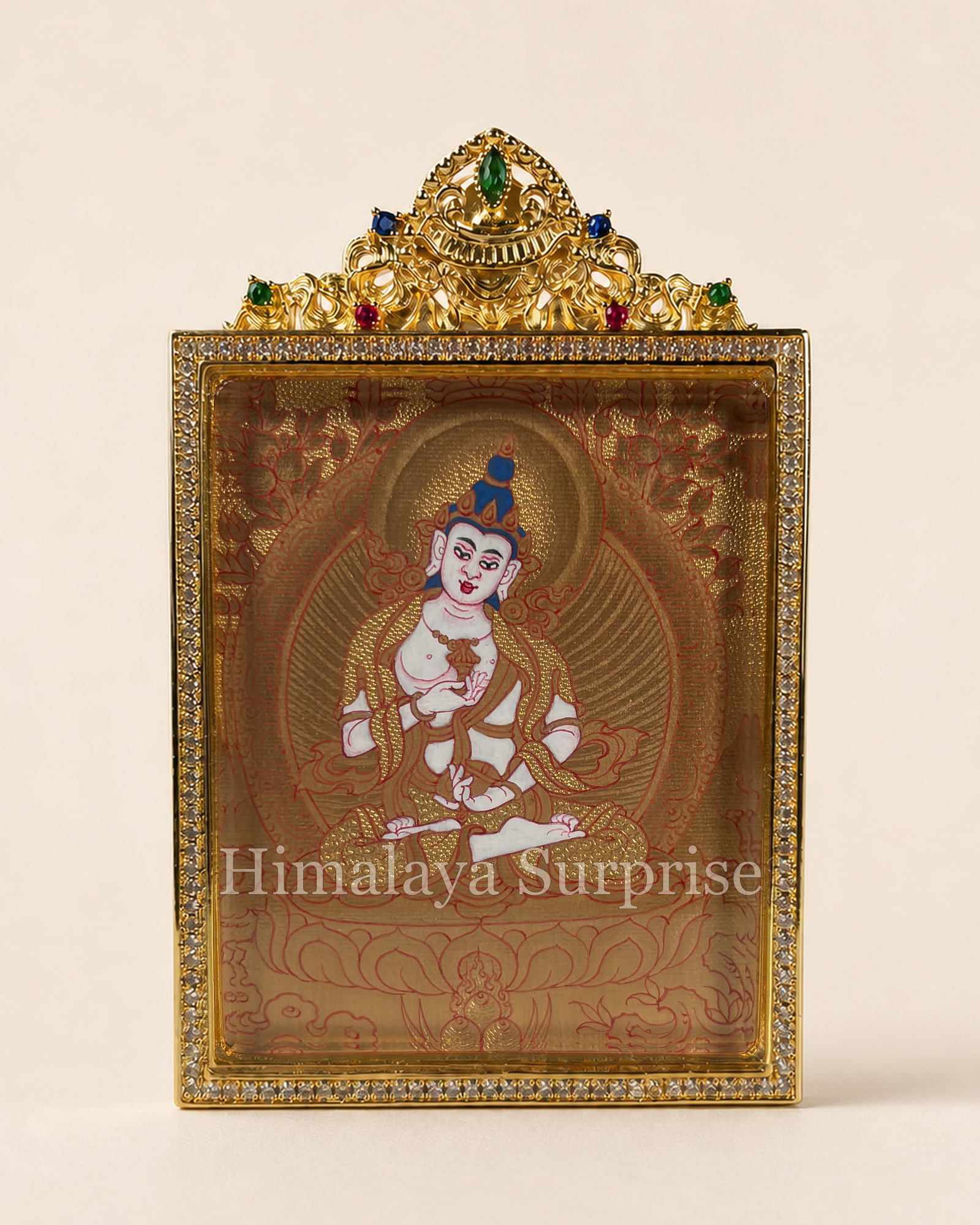
A thangka commonly consists of an image painted on cloth and assembled with a textile surround for hanging. Embroidery and appliqué offer other ways of making the image. Its subject can be a Buddha, a teacher, a story, a group of deities or a mandala. The format leaves room for many kinds of composition. The introduction to thangka looks more closely at this relationship between picture and hanging work.
In Himalayan Buddhist art, a mandala organizes a sacred realm around a centre. A deity’s palace, its inhabitants and their relationships may become visible through gates, enclosures, figures and measured spaces. A mandala can be painted on cloth, made in sand, built in three dimensions or expressed through an arrangement of objects. A circular shape is common, but it is not the whole meaning of the term.
Four mandalas on one painted cloth
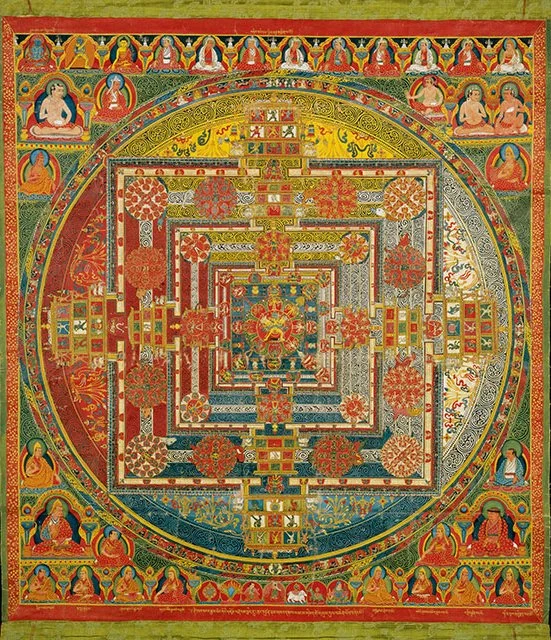
The sixteenth-century Tibetan painting at the opening shows four mandalas of the Guhyasamaja cycle. Each circular enclosure contains a square palace with projecting entrances. Small figures occupy positions within and around it. The rectangular cloth carries four complete, carefully separated realms; its outer shape does not compete with the circles inside.
This is where the familiar “rectangle versus circle” comparison breaks down. The rectangle belongs to the support; the circles and squares belong to the represented architecture. The work is a thangka containing mandalas. Following the gates towards each centre makes that relationship much clearer than assigning the entire painting to only one category.
A single figure can belong to a larger mandala
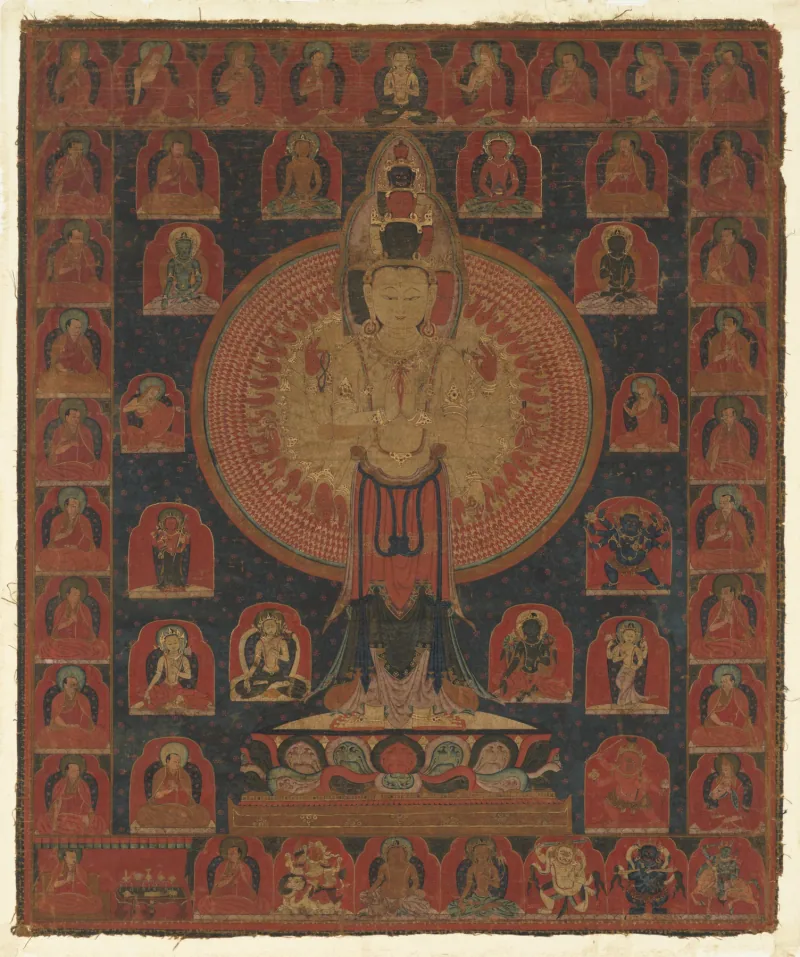
This painting of Akshobhya, made in Central Tibet in the thirteenth or early fourteenth century, seems at first to offer the opposite composition. A large blue Buddha sits on an elaborate throne, with smaller figures arranged around him. His body, seat and surrounding details hold the attention rather than a large plan of a palace.
Yet the painting belonged to a set of five Buddhas. Such sets could be venerated in a mandala configuration, with each Buddha connected to a position, colour and attributes. The arrangement extended beyond a single panel. A close view of one painting therefore cannot tell the whole story of how the group occupied a space.
The example adds an important nuance: a figural thangka and a mandala are not always separate alternatives. Sometimes their relationship is visible within the picture; sometimes it emerges between several pictures. The five Buddha families guide explores the group behind this arrangement.
Figures live inside the geometry
The Chakrasamvara mandala illustrated here was painted in Nepal around 1100. At its centre, Chakrasamvara embraces Vajravarahi. Six goddesses occupy stylized lotus petals around them. Farther out, eight charnel grounds, each with a deity beneath a tree, form another ring of places.
Along the lower edge are five forms of Tara, an adept and two donors. The painting combines a concentrated centre with smaller, individual presences. Its structure is geometric, but its content is far from empty ornament. Figures and sacred architecture work together, making “deity painting versus geometric painting” another comparison that cannot cover every example.
Why a sand mandala has a different life
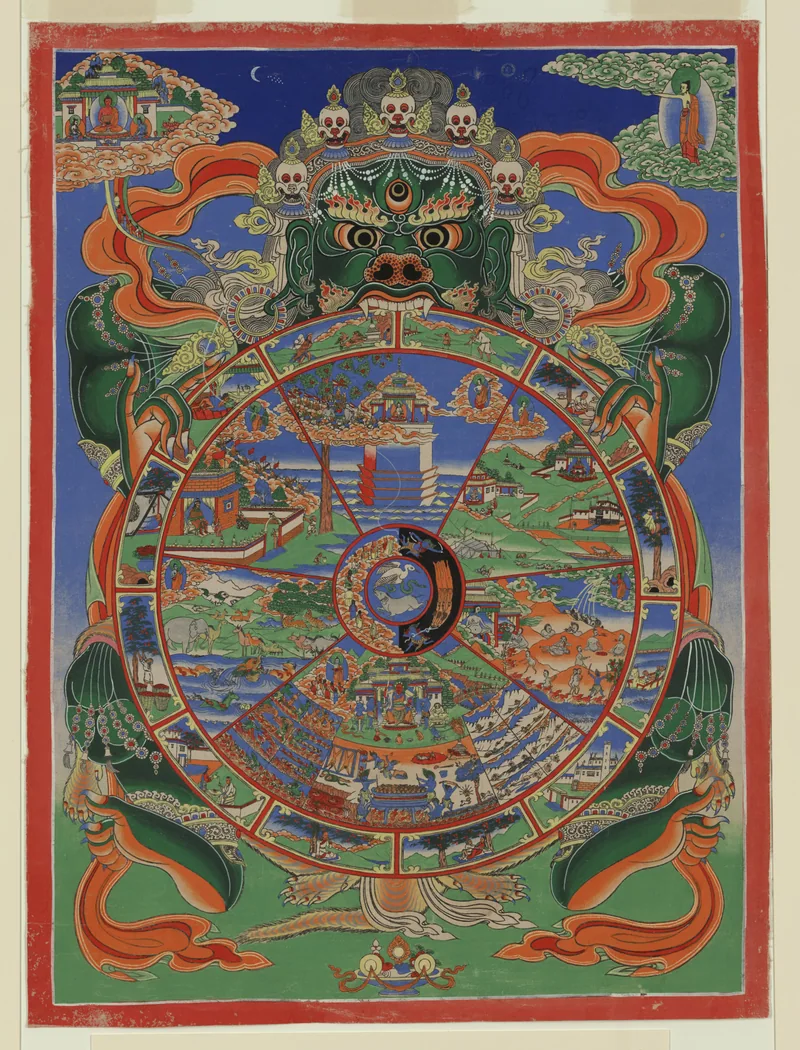
A painted cloth can remain a hanging work over many years. A sand mandala is made from loose grains, often carefully placed over a period of days, and some are ritually dismantled after completion. The dismantling is part of that particular practice and expresses impermanence. It does not mean that every mandala is temporary or that a painted mandala is destined for the same treatment.
Three-dimensional mandalas provide another possibility. A palace that appears as an ordered plan in a painting can also be conceived as an architectural space. With the Kalachakra mandala, looking at a painted version alongside the idea of a palace helps explain why the square enclosure, gates and nested levels matter.
Look at the centre, then the space around it
When looking at an unfamiliar work, begin with what draws the eye: a face, a pair of figures, a central palace or a cluster of smaller images. Then follow the surrounding structure. Gates, petals, repeated seats and rings can reveal how individual figures relate to a larger space. Support and subject become easier to distinguish as the eye moves between them.
The word mandala also appears in modern colouring books, circular designs and uses beyond Buddhism. Those works may share symmetry or a strong centre without representing a Buddhist deity’s palace. Likewise, a circular design printed on a canvas does not by itself become a traditional thangka. The shared visual appeal is real; the histories and purposes can still be different.
The comparison opens another way of looking
A face and a palace can offer different points of entry, but they need not belong to opposing kinds of art. In these paintings, the hanging form, central figure and surrounding world meet in different ways. Once their relationship becomes visible, a familiar image can reveal a much larger space than it first seemed to contain.
Questions and answers
Are thangka and mandala the same?
They overlap, but are not synonyms. A thangka is a hanging artwork within a Tibetan and Himalayan tradition. A mandala represents or arranges a sacred space. A mandala painted as a thangka belongs to both descriptions; thangkas can also have other subjects.
What does “mandala thangka” mean?
It usually means a thangka whose subject is a mandala. The cloth painting may show a palace, its central deity, surrounding figures and enclosures. The expression joins the artwork’s form with the world represented in its image.
Why do monks dismantle sand mandalas?
In practices where a sand mandala is ritually dismantled, its temporary form expresses impermanence. This applies to that sand construction and its ritual setting; painted and three-dimensional mandalas can have different uses and lifetimes.
Is a thangka or a mandala better for meditation?
The terms do not describe two competing levels of effectiveness. A mandala thangka already combines both. Within Buddhist practice, the image and its use are connected to particular teachings. For art viewing, either a figure or a palace can offer an absorbing place to begin.