Discover / Craft & makers
What Are Dzi Beads Made Of? Agate, Patterns and Age
Explore the agate and chalcedony used in Dzi beads, how natural bands and deliberately made patterns differ, and what scientific studies tell us about old and modern beads.
In this story
Many Dzi beads are described as agate or chalcedony: a fine-grained silica stone whose bands can form striking layers and eye-like shapes. The familiar pale eyes and lines of patterned Dzi may involve additional colouring or etching processes. The stone, the design and the bead’s age each tell a different part of its story. Looking at them together reveals more than a single material name can.
Agate, chalcedony, quartz and carnelian
Agate is generally a banded variety of chalcedony. Chalcedony is composed of very fine silica crystals, chiefly quartz, rather than the large transparent crystals associated with rock crystal. Its compact structure takes a smooth polish, making it well suited to small beads. Agate’s layers are part of the stone itself; a bead may reveal straight bands, curved ribbons or a series of rings depending on how it was cut.
Carnelian names a red-to-orange variety of chalcedony. It appears often in archaeological writing about decorated stone beads, including the category “etched carnelian.” Quartz, chalcedony, agate and carnelian therefore describe related things at different levels: a mineral, a fine-grained material family, and particular varieties within it. They are more useful when their relationship is understood than when they are simply treated as four competing stones.
How natural agate bands become a design
Agate forms as silica-rich material accumulates within spaces in rock. Differences between successive layers can produce changes in colour, translucency and texture. Gemological research describes several models for this growth; the details vary with the geological setting. For a viewer, the result is a stone in which structure and colour belong together.
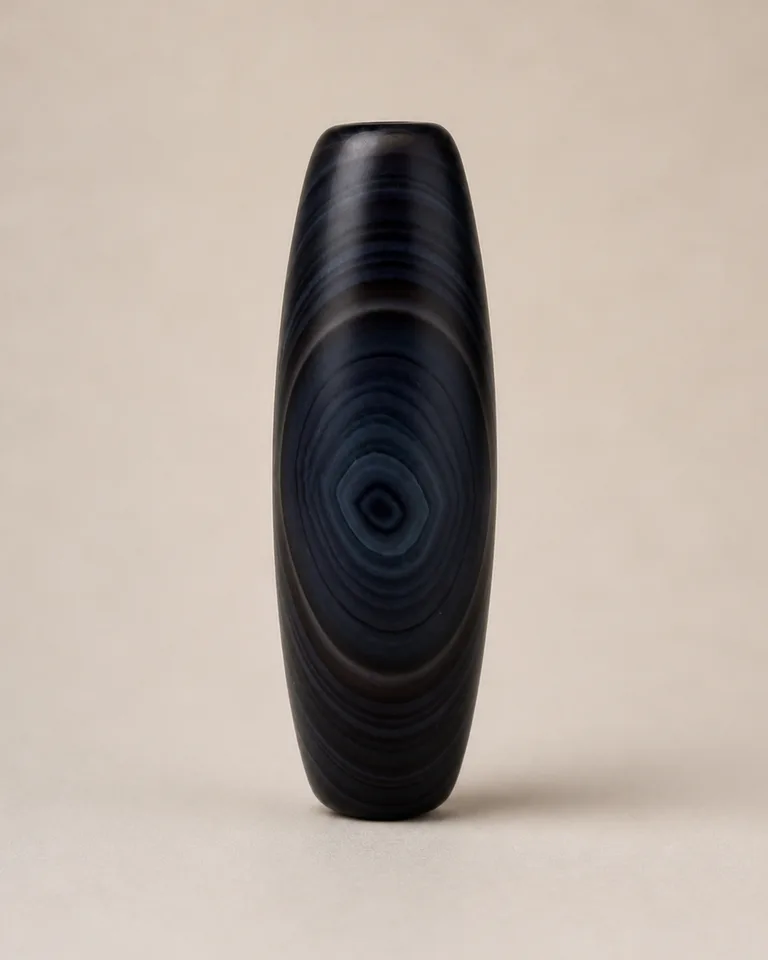
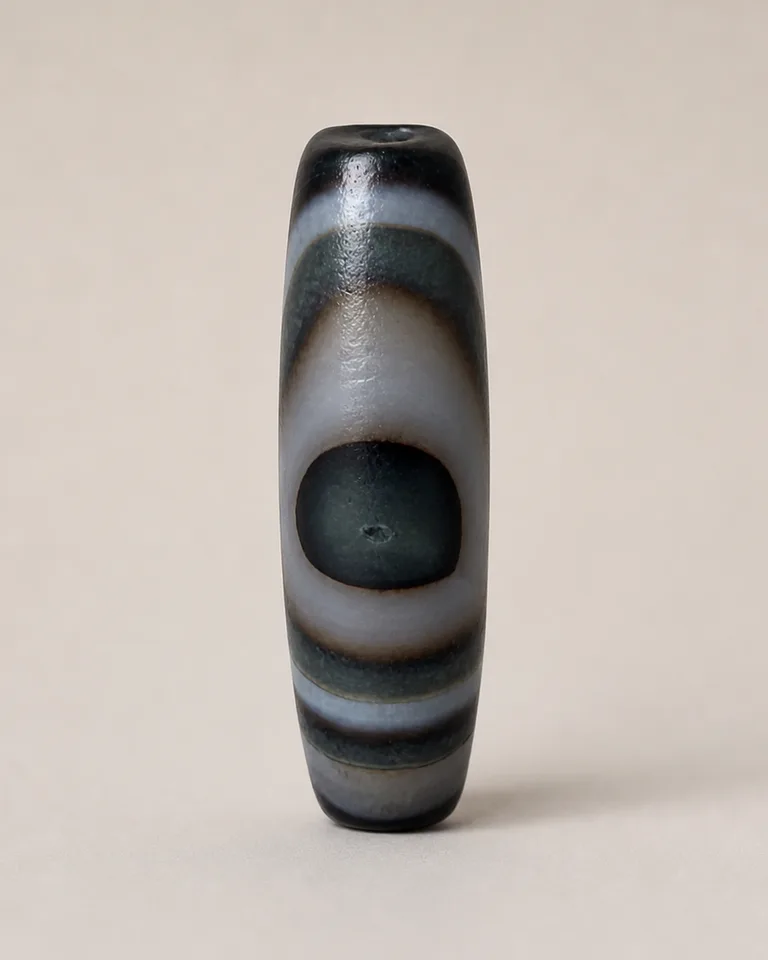
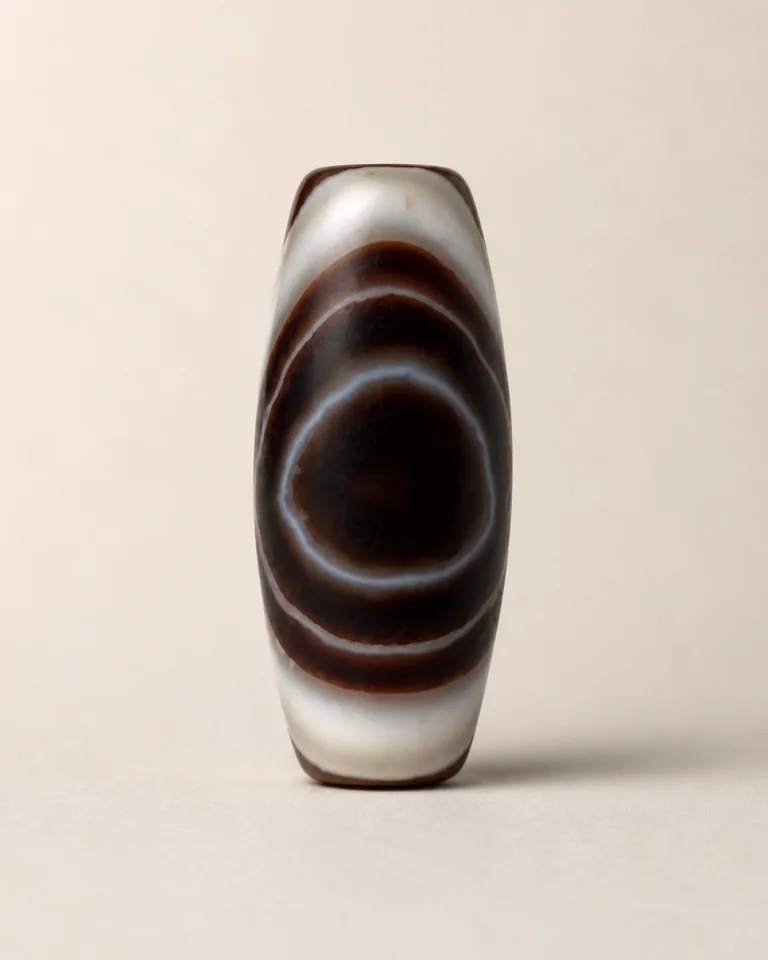
Cutting gives those layers their visible arrangement. A curved layer may meet the polished surface as an oval; several layers may gather around one dark centre. In the banded-agate examples photographed here, broad pale zones contrast with fine dark lines. Such forms explain why a naturally banded stone can look eye-like without every ring being a separately made “eye.”
How deliberately patterned beads differ
A patterned bead adds a design to the stone’s original appearance. In decorated agate and carnelian, treatments can change colour or create pale lines against a darker field. The word “etched” is commonly used for some of these effects, although the processes studied in archaeological beads involve more than simply scratching a line into the surface.
A deliberately made pattern can follow a planned sequence of eyes, bands or angular shapes around the bead. Natural layers follow the stone’s growth instead. The two can coexist in one object, and some treatments reach below its outer surface. Looking closely helps describe the design, while mineral analysis is needed to establish how particular areas were formed.
This is also why “Dzi” is not a mineral name. It belongs to a cultural vocabulary of beads and motifs. Glass or other imitation materials may reproduce a similar outline, but visual resemblance alone does not make them agate. Material names and design names serve different purposes.
Red, black and white in ancient agate beads
A 2023 study in Heritage Science analysed eight beads from four burials at Jirzankal Cemetery in the eastern Pamirs, a site dating to roughly 2,500 years ago. The samples included patterned agate and carnelian as well as striped examples. Because their archaeological context was known, the researchers could investigate colour-making in a specific group of ancient objects.
In these samples, red colour was associated with heating, while black areas contained carbonaceous material entering fine channels in the stone. Some scattered white areas had been chemically altered: the roughened surface scattered light and appeared pale. Naturally white areas had different mineral characteristics. Their similar appearance made analytical methods particularly useful.
These are findings about excavated agate beads, not a universal recipe for Tibetan Dzi. They show that ancient craftspeople could modify a stone’s colour in several ways, and that pale lines need not all have the same origin. The study also places decorated beads in the wider history of exchange across the Pamirs, rather than assigning every similar bead to one region.
Inside one three-eye Dzi sample
A separate study published in Heritage in 2020 examined one three-eye Dzi bead bought in a Chengdu jewellery shop. The researchers cut the bead and analysed its material, surface marks and internal pattern. They found a quartz-rich body consistent with an agate origin, pale rings and regularly placed copper-rich spots around one ring.
The light-and-dark pattern continued into the bead after sectioning. That observation is more revealing than describing the pattern as a coating sitting only on the outside. The authors proposed possible alkaline and copper-related processes, while leaving parts of the mechanism unresolved.
The sample’s age was not established by its purchase from a shop, and the study was not a dating test. Its contribution is narrower and more interesting: it shows what detailed analysis can reveal about one patterned bead. The Jirzankal study and this shop-bought specimen should remain separate examples, with their different contexts intact.
Ancient and modern Dzi: what changes?
A newly made bead can use agate and a traditional-looking design, just as an older bead can. The material family and motif therefore do not establish age. What changes is the object’s history: when it was made, how it circulated, whether it was worn or reworked, and what records survive with it.
Loose beads in a collection may have passed through many hands. Excavated finds provide a different kind of context, associated with a burial and other objects. The dates attached to those finds cannot be transferred to a loose bead merely because it has similar eyes, bands or wear. Sellers may also use “old,” “vintage” and “ancient” differently, so those labels are best read in their specific context.
Contemporary beads have their own interest: how a pattern is arranged, how cleanly the stone is finished, and how colour and proportion work together. They can continue a visual tradition without needing to carry the history of an ancient object. There is likewise no single modern recipe that explains every bead sold under the Dzi name.
From stone to a personal object
Stone explains the bead’s substance; a pattern gives the surface rhythm and recognisable motifs. Meaning adds another layer through the stories and wishes associated with those motifs. These ways of understanding a bead can sit comfortably together: knowing that a band is part of the stone does not lessen its visual appeal, and enjoying a symbol does not require it to prove an ancient date.
The banded-agate photographs in this article are contemporary collection examples, used to show layers, centres and contrast. For the common meanings of eyes, bands and lotus motifs, our Dzi pattern guide continues that part of the story. The material is one starting point; the finished object offers much more to look at.
Questions and answers
What are Dzi beads made of?
Many Dzi beads are described as agate or chalcedony, fine-grained silica materials chiefly composed of quartz. The Dzi name describes a cultural bead category rather than one guaranteed mineral. A specific bead may also have deliberately made colours or patterns in addition to the stone’s natural bands.
Are agate, chalcedony, quartz and carnelian the same thing?
They are related terms, but they do different work. Quartz is a broad mineral term; chalcedony describes a microcrystalline silica form; agate usually refers to a banded variety; carnelian is commonly used for a red or orange chalcedony variety. Actual catalog and gemological wording can vary, so they should not be swapped automatically.
Are Dzi patterns natural or etched?
A visible pattern alone cannot answer that for an individual bead. Archaeological and analytical studies have documented more than one way to create or change colour and pattern in named samples, while natural banding can also create strong contrasts. Treat a photograph as a description of appearance and keep any process statement tied to its own evidence.
Do copper spots, patina or an eye count prove that a Dzi bead is ancient?
No single visible detail proves age. A 2020 study observed copper-related traces in one cut specimen, but its process interpretation was partly preliminary and the sample was not a dating standard. Age claims need object-level archaeological, catalog or specialist evidence; a photograph, eye count or surface mark is not enough on its own.
What does “new Dzi” mean?
“New Dzi” usually refers to a contemporary bead rather than an ancient one. It describes age or a seller’s category, not a particular stone or one fixed manufacturing process. A new bead can still be made from agate and carry a design with traditional associations.