Figures & meaning
Thousand-Armed Avalokiteshvara: the meaning of hands and eyes
From a composed centre, arms extend outwards like rays. The image brings seeing suffering and responding to it into a single expansive form.
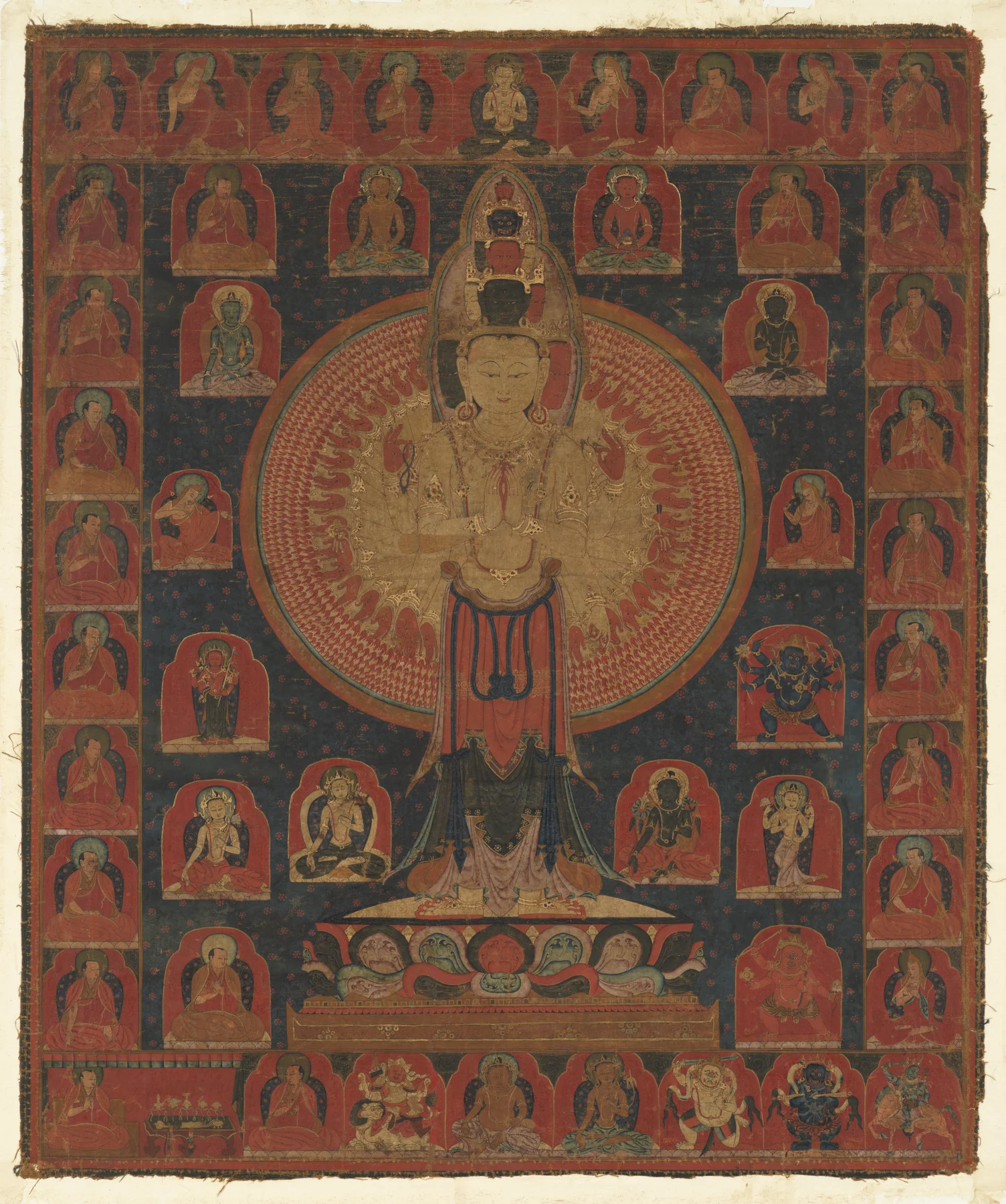
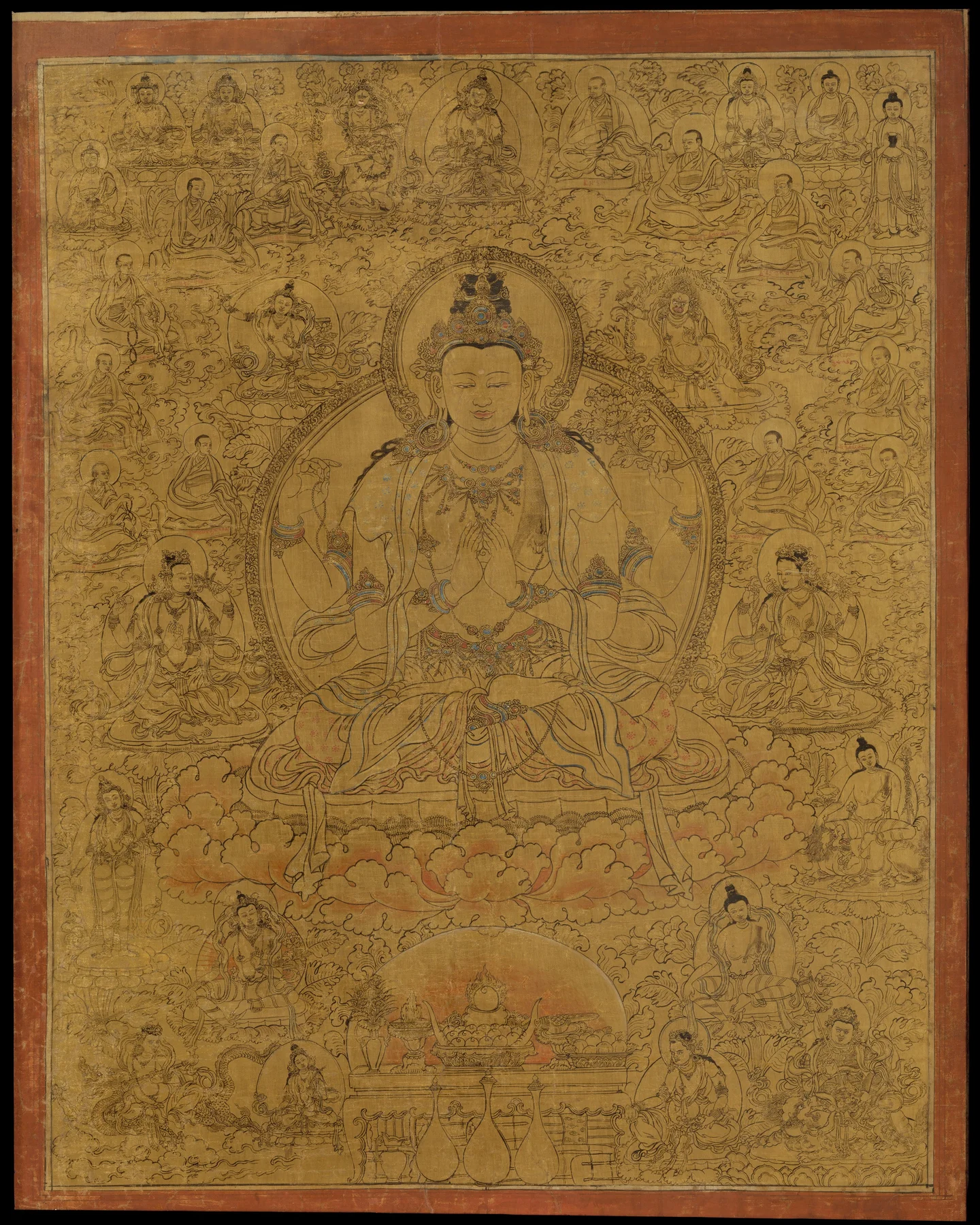
Thousand-Armed Avalokiteshvara is a form of the bodhisattva of compassion, known as Chenrezig in Tibetan and Guanyin in Chinese. Four-armed and thousand-armed images express compassion through different visual structures.
The radiating circle of arms often makes the strongest first impression. A useful introduction begins not by counting every hand, but by understanding the relationship between the central figure, the principal arms and the outer palms.
Eyes that see, hands that respond
The many arms express an expansive capacity for compassionate action. Eyes in the palms bring awareness and action together. Seeing suffering and reaching out in response is central to understanding the form.
The thousand conveys an immense scale. Painters make that breadth visible through dense, repeated and ordered hands. Small eyes and palms accumulate into a presence that exceeds the proportions of a single human body.
It is also a powerful pictorial idea. From afar, the hands gather into one radiating field; close up, each becomes a particular gesture. Moving between whole and detail gives compassion both breadth and an individual focus.
Multiple faces, distinct traditions
Eleven-faced, thousand-armed Avalokiteshvara is a familiar form, but historical images are not uniform. Different practice traditions and works use different combinations of faces and arms. The specific painting and its identification are more reliable than a single remembered formula.
The fourteenth-century thangka illustrated here is recorded as a ten-headed form. Stacked faces, a central body and radiating arms create both a vertical order and a circular one, with teachers and other figures arranged around them.
Those variations make comparison rewarding. Notice how faces are stacked, how the main arms emerge and how the outer palms establish a rhythm. The shared theme of compassion coexists with each painting’s particular organisation.
From the centre to the edge, and back
Find the central face and principal hands near the chest. They offer a steady starting point within the complexity. Follow the clearest arms outwards, distinguishing held attributes from the surrounding spread of palms.
Then look at the spaces between arms. Density, direction and colour determine how clearly the elaborate form reads. In miniature painting, this is an especially useful way to notice how the artist organises a limited surface.
Finally, return to the face. The more expansive the surrounding activity, the more striking the composed centre becomes. Much of the image’s force lies in that relationship between far-reaching action and stillness.