Discover / Subjects & Meaning
Palden Lhamo: Meaning, Forms and Symbols in Tibetan Art
Explore Palden Lhamo’s protector role, the two-armed Magzor Gyalmo form and a four-armed historic painting, with a closer look at the mule, flames and offerings.
In this story
Palden Lhamo means “Glorious Goddess” and is a name associated with female protectors in Tibetan Buddhism. Her best-known images are fierce: a dark body, blazing hair and a mule moving through a turbulent scene. Yet there is more than one form behind the name. The familiar two-armed Magzor Gyalmo and the four-armed figure in the painting above show why her imagery rewards a closer look.
A protector’s fierce appearance
In Tibetan Buddhist art, a dharmapala is a protector of the Buddhist teachings. Palden Lhamo belongs to this protective world, where a fierce face and forceful movement carry religious meaning. Flames, fangs and staring eyes convey the energy of confronting obstacles to the Dharma. They are part of a sacred visual language, rather than a portrait of everyday anger.
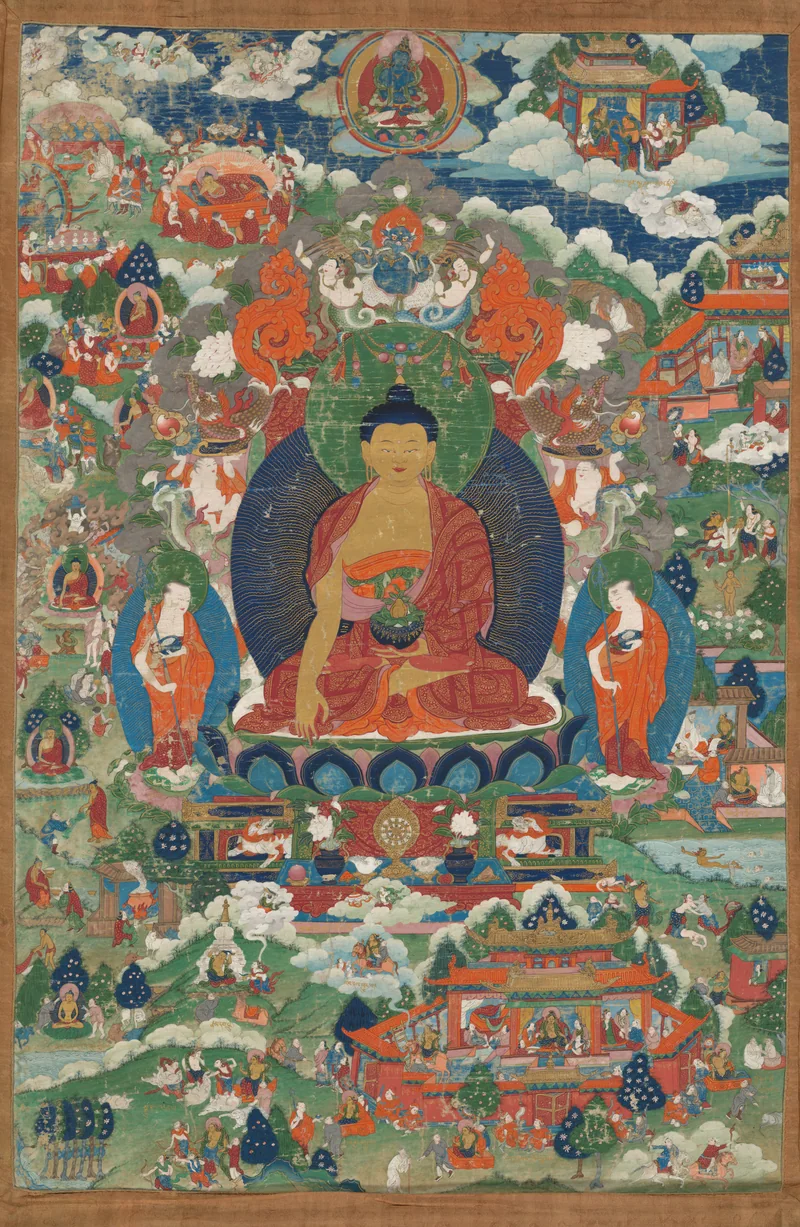
Her presence can be especially striking beside a peaceful Buddha image. A Buddha’s settled posture draws attention inward; the protector’s mount, lifted weapon and surrounding flames send movement through the scene. Both belong to Buddhist art, but they address the viewer through different rhythms. The contrast helps explain why a wrathful image can occupy a devotional setting.
Palden Lhamo, Shri Devi and Magzor Gyalmo
Palden Lhamo and Pelden Lhamo are English spellings of the Tibetan name. Shri Devi, a Sanskrit name also encountered in art catalogues, needs a little more explanation. In Tibetan Buddhist iconography, it covers a category of female protectors with many forms. It does not describe one unchanging appearance. A broad title and a particular form can therefore sit at different levels of the same image’s identity.
Magzor Gyalmo, “Queen Who Repels Armies,” is a widely depicted form within this category. Other forms include Kamadhatvishvari and Dorje Rabtenma. These are distinct names, not simply alternative spellings of Magzor Gyalmo. The difference is visible in the bodies, arms and attributes of the images, which gives the names an artistic as well as a religious significance.
The two-armed Magzor Gyalmo
Magzor Gyalmo commonly has one face, two arms and a blue-black body. She sits side-saddle on a mule. Her raised right hand carries a staff tipped with a vajra, while her left holds a skull cup near the heart. Three eyes, exposed teeth, a skull crown and flame-like hair intensify the face. The mount and hand arrangement give this form a more specific identity than its fierce expression alone.
Smaller features bring further variety: a peacock-feather parasol may rise above her, and lion and snake earrings appear at the ears. Their placement differs between Sakya and Gelug descriptions. Magzor Gyalmo is also understood as a wrathful manifestation of Vajra Sarasvati in these traditions. Such details make her images recognisable while leaving room for differences within a shared form.
A four-armed painting and its surrounding offerings
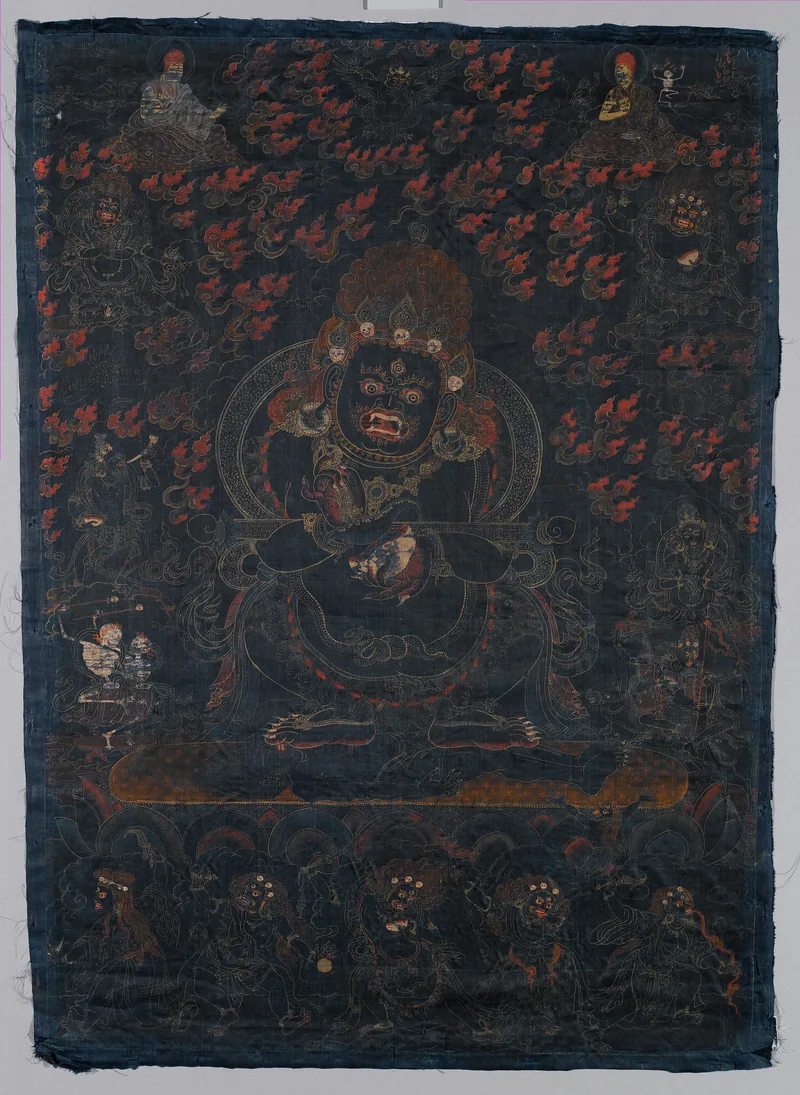
Offerings to the Goddess Palden Lhamo, made in Tibet in the late sixteenth century, places a four-armed figure at the centre of a large black-ground painting. The cloth measures about 170 by 112 centimetres. Orange flames gather around her dark body, and her mule moves across the lower part of the scene. This is a different arrangement from the two-armed Magzor Gyalmo just described; the broad Palden Lhamo title should not erase that visible difference.
The detail photograph reveals a second centre of interest around the deity. Instruments and ritual objects form repeated rows: drums, conches, stringed instruments and bells are among the shapes visible above and beside the flames. Their repetitions turn the surrounding space into an ordered offering scene. The painting is not only a striking central figure; much of its character comes from the relationship between that figure and the objects around her.
Black-ground painting is often called nag thang. Here the dark field allows fine lines and small coloured objects to emerge with particular clarity. The work belongs to the visual world of a gonkhang, a protector chapel, and is related to offering imagery found in its murals. Its dense arrangement makes sense within that setting. Black is a feature of this painting tradition and this work, rather than a requirement for every Palden Lhamo image.
The mule, the stories and the oracle lake
The mule also carries a narrative dimension. Traditional accounts describe Palden Lhamo’s departure from a kingdom opposed to Buddhist teaching and her commitment to protect the Dharma. Some versions explain marks on the animal through the story of her escape. The details change across retellings, but the journey and vow help give the moving mount its significance. These are sacred narratives, not a historical biography of the goddess.
Another enduring association is Lhamo Latso, the oracle lake in Tibet. Traditions concerning the recognition of Dalai Lamas connect visions at the lake with Palden Lhamo’s guidance. This relationship helps explain her importance beyond an individual painting: the goddess is part of religious memory, pilgrimage and the continuity of a teaching community. Not every picture illustrates the lake, but its story belongs to the wider setting of her imagery.
A companion to Mahakala, not the same figure
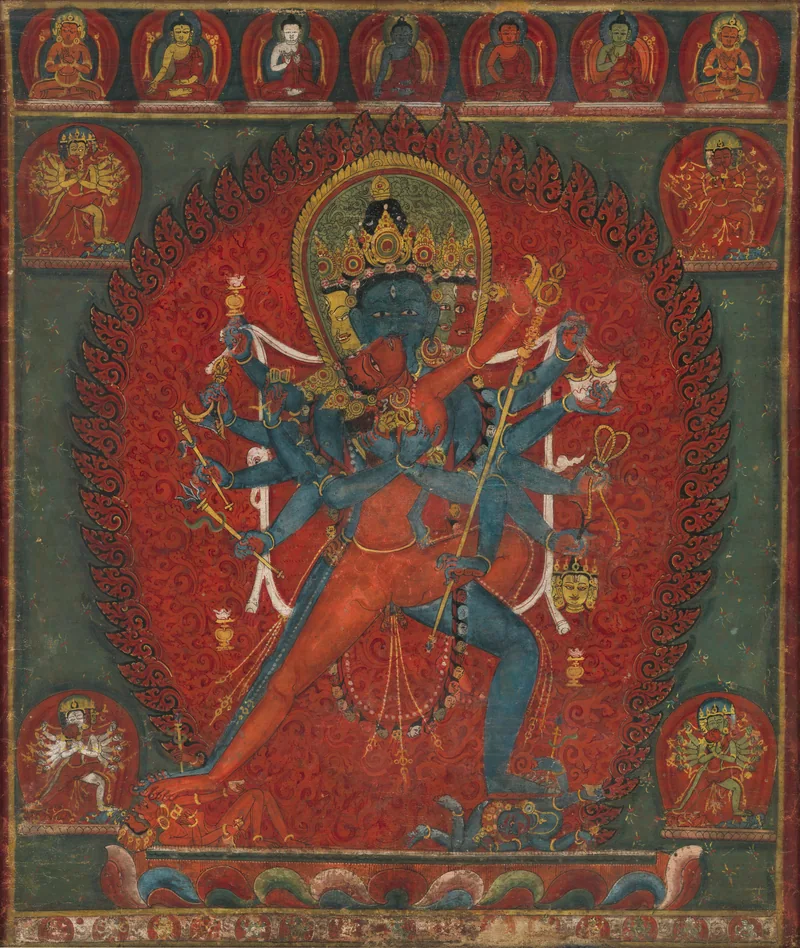
Shri Devi forms are often paired with particular forms of Mahakala. The pairing places male and female protectors within a shared religious setting, but does not make their identities interchangeable. Mahakala himself has multiple forms. A protector assembly can therefore bring together several distinct figures, each with its own body, posture and attributes.
Looking from one figure to the next makes these relationships visible. A shared crown, fierce face or skull cup may express a common visual language, while the mule, number of arms and arrangement of implements distinguish the figures. The surrounding company can be as interesting as the central presence, especially in a painting that gathers more than one protector.
The painting’s movement and fine detail
Palden Lhamo’s paintings hold large gestures and small details together. A lifted arm, a moving mule and a blaze of orange can establish the image at a distance. Closer looking reveals the fine lines of a crown, the shape of an earring or a repeated row of offerings. The contrast between those two scales gives the scene much of its visual force—and keeps a familiar name from becoming a single fixed picture.
Questions and answers
What does Palden Lhamo mean?
The Tibetan name means “Glorious Goddess.” In Tibetan Buddhist art it is associated with female protectors, including the widely depicted Magzor Gyalmo form.
Is Shri Devi another name for one fixed Palden Lhamo form?
Shri Devi is a category with many forms in Tibetan Buddhist iconography. Magzor Gyalmo belongs within it, alongside other named forms. A broad catalogue title does not mean all of those images have the same arms or attributes.
Does Palden Lhamo always have four arms?
No. Magzor Gyalmo commonly has one face and two arms, with a vajra-tipped staff and skull cup. Four-armed images also occur, including the historic painting shown here. The number and arrangement of arms help distinguish the forms.
Why is the mule important?
The mule is a prominent part of Palden Lhamo’s imagery and of traditional stories about her journey and protector vow. In Magzor Gyalmo images, the side-saddle posture combines with the two hands and their attributes to form a recognisable arrangement.
Is Palden Lhamo the same as Mahakala?
No. Shri Devi forms are often paired with particular Mahakala forms, but they remain distinct protectors. Their shared wrathful imagery expresses a related visual language, while their bodies, mounts and attributes differ.