Discover / Culture & ritual
Kangling Meaning: The Tibetan Ritual Trumpet in Buddhist Art
Learn what kangling means, how leg-bone, wood and metal forms differ, and how the trumpet appears beside Buddhist images and ritual objects.
In this story
The kangling has a distinctive profile: a narrow tube opening into a wider end. Historical bone examples and forms in wood or precious metal give the instrument a varied material history. This guide follows its name, sound and two museum objects to explore its place in Tibetan Buddhist art.
What does kangling mean? Start with the name and the object
Kangling is the English spelling most often used for the Tibetan rkang gling. The name is commonly explained as “leg flute”: kang points to the leg, while ling means a flute or wind instrument. In English it may be called a bone trumpet, leg-bone trumpet or horn. These names describe a family of instruments, not one identical object.
In a painting, the trumpet’s outline is often easier to see than its material. Follow the mouthpiece and the open end, then look at the hand holding it and the other objects nearby.
Bone, wood and metal are different material histories
Older descriptions often focus on human thighbone. Wood and precious-metal examples show how the same instrument name can travel across different materials. Bone, polished wood and worked metal each give the surface a different character.
Object 68.59.91 is a useful counterexample to a single-material definition: it is made of brass and silver, made in India between 1900 and 1950 for the Tibetan Buddhist market. It belongs to a ritual soundscape, but its actual material is metal.
Read the mouth, shaft and bell as one instrument
The mouthpiece, hollow shaft and widening end form a compact wind instrument. In the photograph, the change from the narrow body to the bell is a useful structural clue; decoration can then be seen against that outline.
Its sound is often described as bright and piercing. In a painted scene, the trumpet’s direction, the figure’s posture and nearby implements can suggest how the instrument participates in a wider ritual setting.
Kangling, Chöd and the visual language of impermanence
The kangling is closely associated with Chöd, often translated as “cutting”. A leg-bone trumpet and a damaru can appear together in this setting. Bone gives the reflection on mortality and impermanence a tangible form.
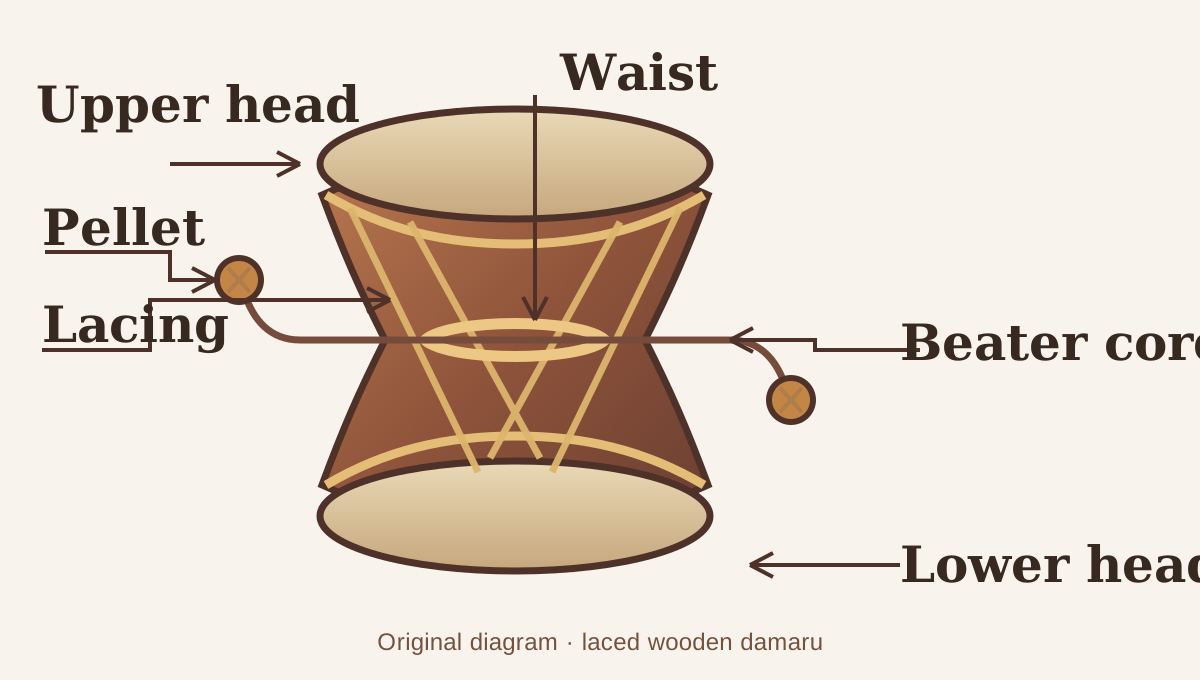
Seen together, the trumpet and drum create a vivid contrast: one is held at the mouth, the other in the hand. That relationship can help a reader follow an instrument through a composition.
One object in close view: Rubin SC2019.3.2
Rubin Museum’s SC2019.3.2 is a Tibetan leg-bone trumpet dated to the 18th–19th century. Human bone, copper, coral and leather form an object measuring 36.2 × 7.6 × 8.9 centimetres.
Its shaft carries a copper sheath, with a wrap around the joint. Bone and metal meet along the same profile, bringing the material history into close view.
How to look at a kangling in Buddhist art
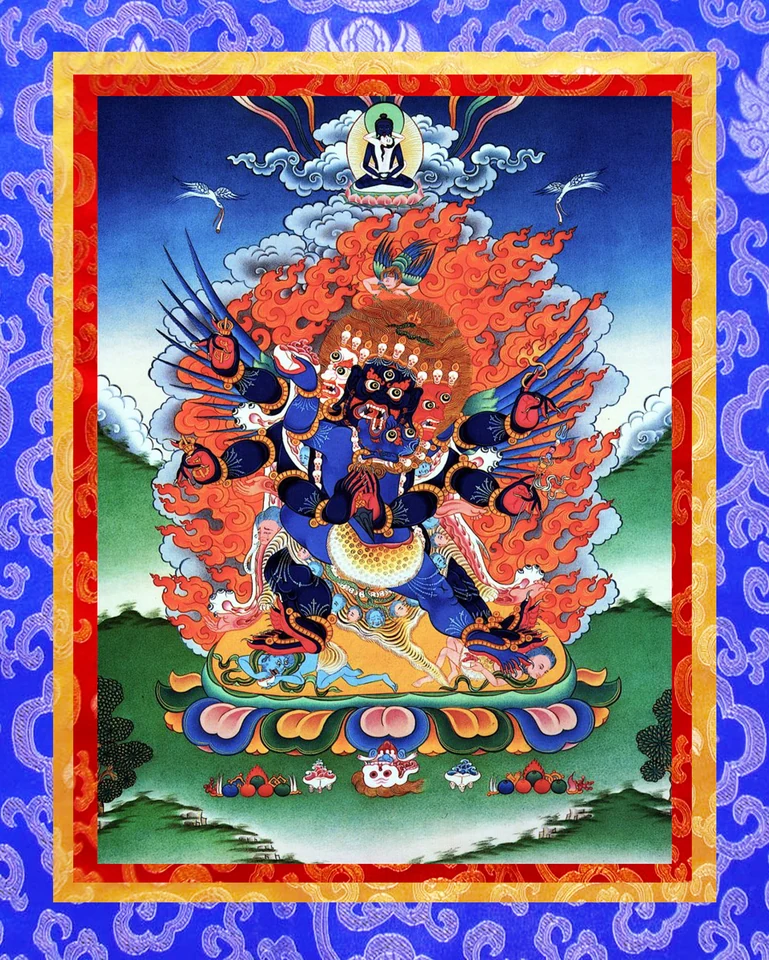
When a figure holds a kangling, first follow the instrument’s outline: where is the mouthpiece, which way does the bell point, and is the body bone, wood or metal in the work being shown? Then look outward to the hand, the companion drum or bell, the figure’s posture and the surrounding retinue. The object becomes legible through those relationships.
A museum object reveals materials, measurements and traces of making. A painting shows how the held trumpet contributes to a figure’s identity and to the scene around it. Moving between these two views brings the instrument into sharper focus.
Questions and answers
What does kangling mean?
Kangling is the common English spelling of Tibetan rkang gling, usually explained as “leg flute”. It refers to a Tibetan Buddhist wind instrument or trumpet, especially in historical descriptions of a leg-bone form.
Are all kanglings made from human bone?
No. Historical accounts connect the instrument with a tibia or femur, but wood, brass, silver and other precious-metal forms are also recorded. Object 68.59.91, for example, is brass and silver rather than bone.
Is a kangling the same as a damaru?
No. A kangling is a wind instrument or trumpet, while a damaru is a small drum. They can appear together in Chöd and related Buddhist settings, but their shapes, materials and ways of making sound are different.