Who is Acala—and what does “immovable” mean?
Immovability is not the absence of energy. Acala's image brings energy under firm direction: a forceful expression, an active arm and a grounded body can all belong to the same figure. In Buddhist traditions, devotees honour Acala with aspirations for courage, steadfast practice and the strength to face obstacles.
That is the attraction of the image: not an easy serenity, but composure that holds its ground. The face meets difficulty directly. The painting gives a visible centre to the wish to remain clear and resolute when life feels unsettled.
Read the sword, the noose and the stance
Begin with the sword. In familiar Acala imagery it is held in the right hand, often raised, and represents wisdom cutting ignorance. Then find the left hand and the cord or noose. Its line can be much smaller and easier to miss than the blade; it belongs to the imagery of restraining or overcoming obstacles.
Now follow the posture. Acala appears in kneeling and standing forms, including a blue-bodied kneeling form. A bent knee or firmly planted foot gives the painting its direction and tension; the eyes, mouth, hair and ornaments carry that movement through the figure.
A raised sword is shared by several Buddhist figures, including Manjushri. Look for the combination of attributes and the recorded subject of the work. With Manjushri, the sword often rises above a peaceful bodhisattva; Acala's expression and bodily force create a different encounter.
A CLOSER LOOK
Fierce does not mean the same figure
These two miniature wrathful-deity paintings show how colour, stance and surrounding ornament shape a fierce presence. The sword is a useful starting point; the whole composition completes the reading.
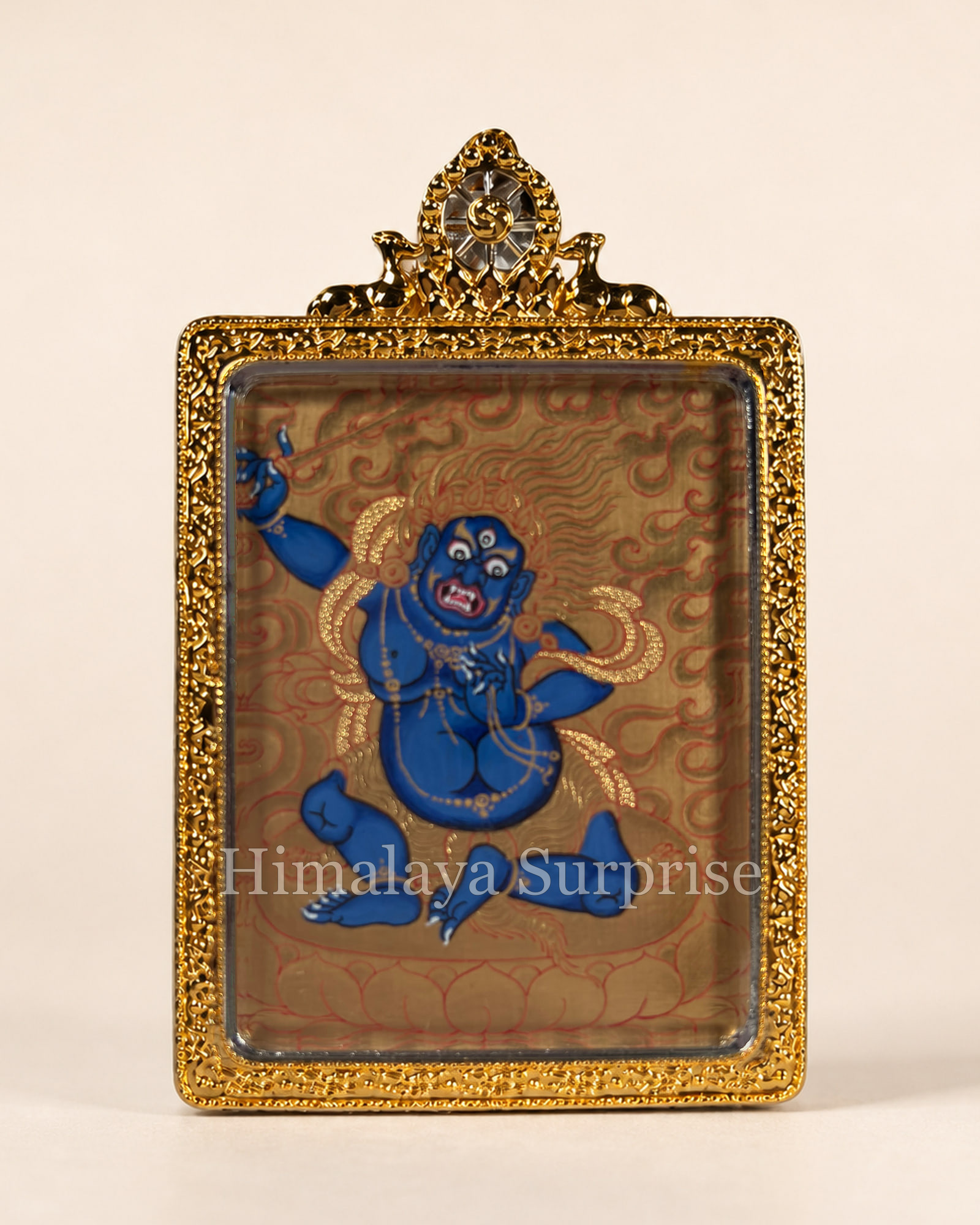
TG-011 · Gold-ground Acala
- A dark figure is framed by a bright gold field. The raised sword draws the eye upward; the powerful stance anchors it below.
- Look beyond the face: the arms and the relationship between figure and ground create much of the intensity.
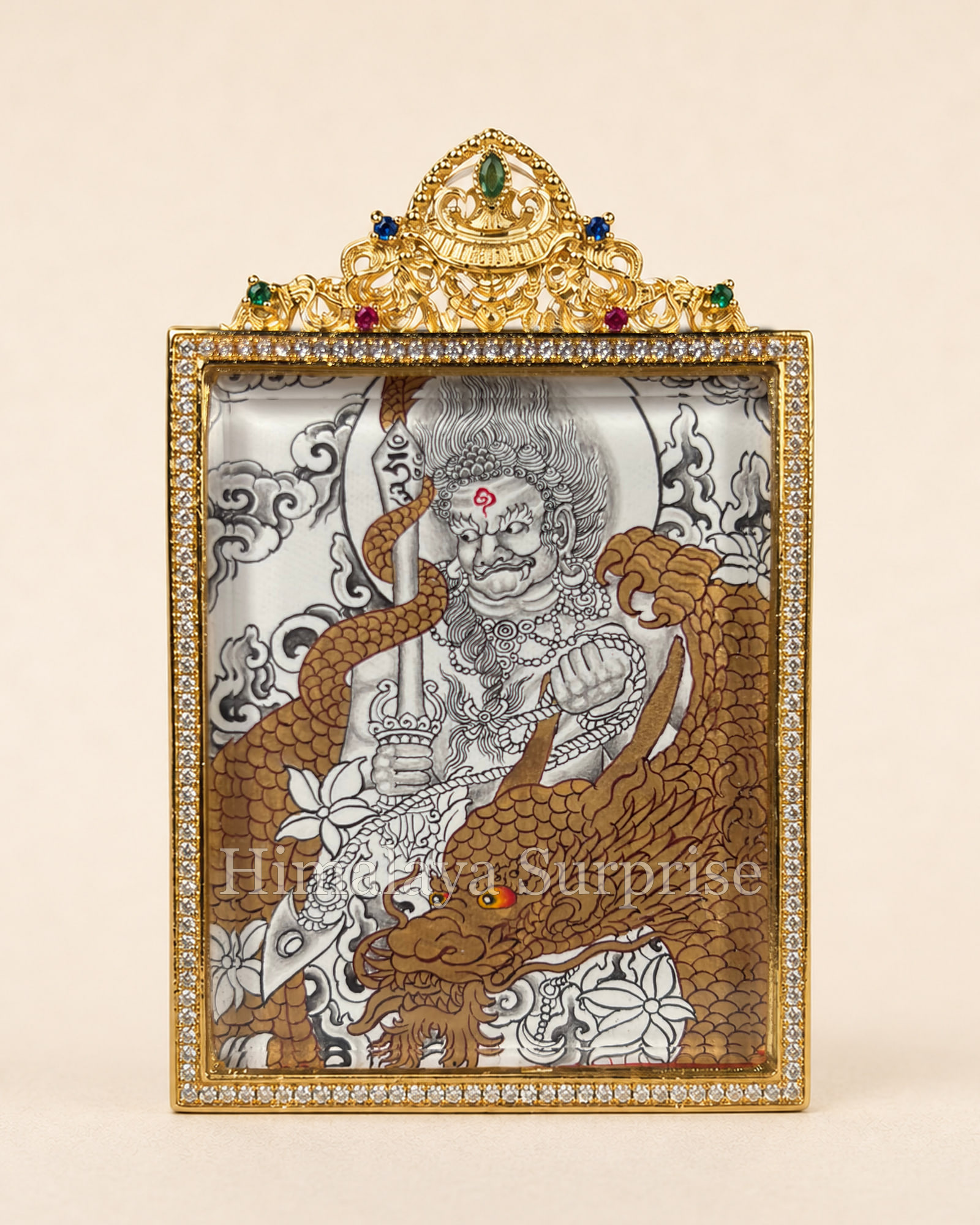
TG-020 · Acala with a golden dragon
- Dark contours on a pale ground meet the golden dragon crossing the foreground. Follow the dragon's scales, then return to the figure behind it.
- Compared with TG-011, the composition comes closer: face, hair and jewellery fill more of the field, with the dragon creating a second focal point.
Acala and Fudō Myōō: connected, not identical pictures
In Japanese esoteric Buddhism, Acala is known as Fudō Myōō, a Wisdom King associated with Dainichi, or Vairocana. The sword and noose remain recognisable across seated and standing forms; the posture changes how their force is expressed.
Tibetan and Himalayan images have their own compositions, including blue kneeling forms within larger sacred assemblies. A Japanese sculpture and a Tibetan painting may share a name and attributes while arranging posture, attendants and setting differently.
Two miniatures, two ways of holding the eye
TG-011 sets a saturated blue figure against a gold-toned field. The figure's rounded body, open mouth and lifted arm carry the image. Seen close, the surrounding lines keep the gold field active without dissolving the central silhouette.
TG-020 moves closer. Dark lines on a pale ground describe the face, streaming hair and jewellery, while a golden dragon crosses the foreground. Instead of reading the gold as one large field, follow the dragon's curve and the fine drawing behind it.
Both have a 4 × 5 cm painted area. Their appeal lies in different arrangements within that same small field: concentrated colour in one, layered drawing and a sweeping dragon in the other. The full-resolution galleries let you move between the overall image and the details.
Choosing a work you will return to
Start with the encounter: the expression that holds your attention, the colour you want to see again, or a line that invites another look. Then examine the full object—painting, frame, reverse and hanging loop—and compare the recorded materials, maker and dimensions on its work page.
For a miniature, close viewing is part of the pleasure. Its fierce presence can be surprisingly intimate: an entire painted world held within a few centimetres, ready to be lifted into view.